Photography

Detroit public schools, abandoned and left to the scrappers

(Click on each photo to see a larger picture on a separate picture page.)

While driving in east Detroit, near the long-abandoned Packard Plant, I stumbled on another abandoned building, the recently shuttered Crockett Technical High School, originally known as the John Burroughs Intermediate School. It sits on the corner St. Cyril and Georgia Street. As recently as 2011-12, it was a functioning high school. Then, it was closed, and within less than three years, a perfectly fine and even upgraded school, dating from 1925, was left the scrappers and vandals and plundered beyond any reasonable repair.

In 2012, amid Detroit’s fiscal woes, the Detroit Public Schools (DPS) announced a round of massive school closures, carried out by DPS emergency manager Roy Roberts. All told, 16 schools building closed permanently. The Detroit Free Press reported that the DPS had lost about 100,000 students in the past decade, and 2012-13 enrollment was expected to be about a third of what it was a decade earlier.

Seal of the City of Detroit on the front of the now closed building

Seal of the City of Detroit on the School Entrance

As recently at 2011-12, the Detroit Public Schools released an annual report on Crockett, noting, “Crockett High School made adequate yearly progress (AYP) in the tested subjects (mathematics, reading, science).” The same report noted, “Parents and community members are an integral part of the school program at Crockett High School. Parents and community members are included in decision making at the school levels through their involvement on committees and special programs. The Local School Community Organization (L.S.C.O.), provides programming for parents/guardians and the entire community.”

Another high school, Finney, also was slated to closed, and students from there and Crockett were to be sent to a new $46.5-million East English Village Preparatory Academy being constructed on the former Finney site. Meanwhile, the DPS allowed Crockett to fall into total disarray and be gutted and destroyed by scrappers.

I spoke to two guys working on a car across the street from Crockett, who told me this story. They noted that the DPS police did nothing to stop the scrappers once the schools alarm system failed. First the scrappers busted the windows and ripped out the metal. Then they went to work on the interior. One of the men, who said he had lived on that corner much of his life, said he even tried to follow the criminal scrapper and his accomplice once. His calls went unanswered by the school district, he said, and the scrappers did their destruction mostly at night.

I casually walked around the school. It was easy to enter it. I jumped in a window. I couldn’t believe what I saw. Perfectly good school furniture was left to rot in the elements. Science labs were ripped apart. The structure of the building, however, looked perfectly sound, appearing better than public schools I attended growing up and have seen elsewhere in the country. The neighbors I met with said the school had even been recently fitted with high-speed internet connections to promote a science and technology curriculum.

It reminded me eerily of the film Children of Men, in a future world where humans are sterile and are unable to reproduce, and schools are left to rot without children to fill them. Crockett was one of the saddest things I saw in Detroit. In nearly any other major American city, such a situation would provoke outrage and activism. Here, no one seemed to care. Meanwhile, the DPS–whose motto is “see it, believe it”–is looking for a buyer for a school it decided it could not even protect. And another piece of Detroit slides into decay, without much fanfare to accompany the fall.

AK Steel Ashland Works plant, form and function

The AK Steel company’s Ashland Works plant includes a pig iron blast furnace and oxygen furnace. It stands on the banks of the Ohio River in the small industry town. As you drive by the industrial facility on Highway 23, one cannot help but stop and be amazed by the facility’s purely utilitarian function and form. (Click on the photo to see a larger picture on a separate picture page.)

It’s not the destination, it’s the journey that matters

I will be taking a road trip in a week. The destination is probably where most people in my country last would want to be traveling. But I always seems to find unexpected treasures when I pick a new place, and have a purpose, and find wonderful, beautiful things in places overlooked or shunned. Hoping your journey leads to new discoveries for you.

Honoring those who work for a living

I have been fortunate to see how many people work around the world. I have seen flower pickers running at breakneck speed in the pre-dawn hours to their jobs in greenhouses around Kenya’s Lake Naivasha. I have met Mexican migrant farm workers in central Washington state, who pick all of the apples, cherries, and other fruits and vegetables we eat around the country. I have met the men who do the hard labor building roads and buildings in Vietnam. And there are so many more. The work I have seen humbles me in its physical intensity and also brute reality. But people have to work, to make better lives for themselves and their families. So, today, on Labor Day, a moment to honor those who have to use their bodies to eek out a living, where ever they call home.

Click on the photo to see a larger picture on a separate picture page.

In the long shadow of Evel Knievel, daredevils still risk it all

Every modern motorcyle and extreme sports daredevil since the 1960s and  1970s stands in the long shadow of stunt rider Evel Knievel. The Butte, Montana, native and international showman built a legacy of thrilling audiences with death-defying leaps on his motorcyle over long distances. From the grisly televised crash at Caesar’s Palace in December 1967 to jumping 15 buses in Wembley Stadium in London in May 1975, Knievel conquered the public’s imagination. He had spectacular failures and reportedly broke more than 400 bones in his battered body over his long years as a showman extraordinaire and one-of-a-kind daredevil.

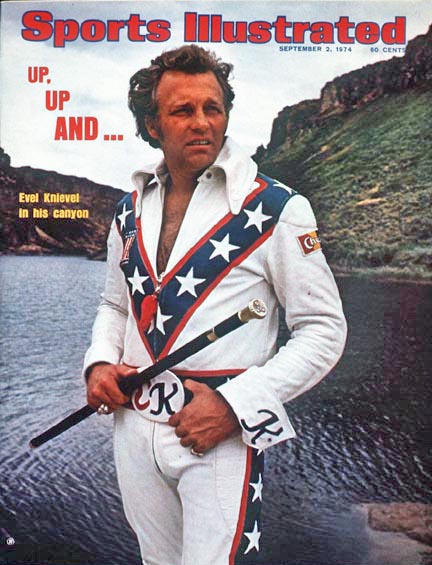
The Sports Illustrated cover shows Evel Knievel in his purest form, decked out in his all-American jump suit (great photo).

The Sports Illustrated cover shows Evel Knievel in his purest form, decked out in his all-American jump suit (great photo).

Knievel completely invented himself, his persona, and his brand of entertainment from the ground up, with his imagination knowing no boundaries. His first recorded jump, according to the new documentary on his life called Being Evel, was over two cougars and a box of rattle snakes in Moses Lake, Washington, and he crashed open the box of snakes who got away. He then built up his reputation the hard way, show after show, and also crash after crash. His greatest media stunt, and failure too, was attempting to jump in a specialized vehicle over the Snake River Canyon on Sept. 8, 1974, with him crashing yet again in the canyon floor. But he got back up and kept at it.

As a kid, I likely fell under the Kneivel spell, and saw him many times on TV, on lunch boxes, and on tabloid newspaper covers. He made more than half a dozen appearances on ABC’s Wide World of Sports in the 1970s, when I was growing up. He personified a type of fearless recklessness that excites nearly every young boy, and inspires a few to try such feats later in life. The current climate of Red Bull fueled stunts, jumping from outer space to leaping from cliff faces in wing suits, owes it all to him. Knievel proved you can become a legend if you are willing to put it all on the line and entertain the masses while doing it. Knievel died in 2007 at 69 years of age, a badass to the end, being totally himself.

The photos above were taken at the Omak Stampede in August 2013. I took these shots during practice for a great half-time event at the stampede later that night. Three daredevils, whose names I now cannot find, put on a show with multiple leaps on their dirt bikes and four wheeler. The best rider did a back flip during the show on his bike and totally nailed the landing. They had all of their gear in trailers they hauled by trucks, a bit like Knievel. All three of these guys were accompanied by a trio of totally beautiful women, who stood proudly by their sides. In that way, nothing has changed since Knievel’s day. The daredevil is made of different stuff, and it is the stuff that still appeals to women who like dangerous men. As Knievel may or may not have said, “bones heal, pain is temporary, [and] chicks dig scars… .”

It’s a big old goofy world in carnie land

I visited the Oaks Amusement Park this weekend, in southeast Portland, along the Willamette River. This 110-year-old facility is a classic, old-style small amusement park, not a corporate-themed fantasy land that milks consumers for all they got. It is among the oldest in the country. Old-school amusement parks are part of an older, carnival world that dates back to the Midways and Pikes of the 1893 and 1904 World’s Fairs in Chicago and St. Louis. In fact, Oaks Park is part of that tradition, opening as part of the 1905 Portland World’s Fair.

There is something utterly low-brow about businesses like these. No one who attends the opera would be found anywhere near here. The rides are not forcing us to buy Disney products or watch a Universal Pictures film. Most are just about flinging our bodies in different directions, so we can momentarily feel a sense of safely packaged fear and excitement, with a slight twinge of panic these old contraptions might break down and fling us to oblivion.

What I saw at Oaks Park also was about the most diverse crowed I have seen in one place in Portland since arriving. Parents and their kids, and also grandparents, were letting it rip, laughing, and having a good time. The carnie atmosphere prevailed on the main strip, complete with gun-skills galleries, basketball tosses, junk food, and stuffed toys. I thought about the people who worked here and what they thought about their daily grind, and the people who spend their hard-earned money just to escape from life for an hour or two without going broke.

Surprisingly, amusement parks are almost always portrayed as sinister places in film, from West World to Jurassic Park, to even older films like the noir classic Third Man with Orson Welles and Joseph Cotten. This American Life did a pretty good episode on amusement parks also. It is worth a listen too. So amid that joy, and it was joy, you always feel that sense of trepidation, like maybe, just maybe, the rides might not work. And maybe, that is why people keep coming back, year after year.

The fury of fire

Following the hottest July ever in human recorded history on planet earth, the American west is having the greatest outbreak of wildfires since the great fires of 1910, which ravaged Montana, Idaho, and Washington state.

Fires are burning widely across my home state of Oregon, Washington, California, British Columbia, and Alaska. Three firefighters were killed on Aug. 19, fighting a blaze in the Methow Valley near Twisp–an area hammered by wildfires in 2014. There is major change taking place. This will involve how we plan for fire, build in fire zones, speculate for fast profits in pretty Western scenery (if you can afford that game), and consider what is safe.

Maybe the lessons will be forgotten. People, particularly wealthy people, will still want to live near the mountains and wild places where fires naturally occur, but with global warming patterns due to climate change, the ecosystem will be transformed more and more by big burns. We as a country cannot afford to purely protect all of the property here, particularly when the sacrifice is lost firefighters’ lives. Will it one day be left just to burn?

I took this picture about a week after fires ravaged the town of Pateros, in central Washington, again at the center of Washington’s complex of fires.

(Click on the picture to see a larger photograph on a separate picture page.)

Has it been 20 years already, Machu Picchu?

Yes, Machu Picchu, with a llama munching on grass, is a complete photographic cliché. I do not care. I snapped this photograph in the very very early morning hours at this great Inca hill city in late August 1995. I hiked the Machu Picchu Trail to get here, passing six ruins. It was a highlight of my life, mainly because of the incredible mountain topography, the historic footprint of the now-gone Inca culture, and the fulfillment of a dream of mine to mix my passions for mountains, long-distance trekking, and archaeology-history. The negative for this photo was damaged by the developer, as I made a big mistake entrusting my film to a shop in Santiago. But with a little Adobe magic, it turned out OK.

When I arrived at Machu Picchu, it was smoked out from fires on the Amazon basin, where farmers and cattle owners were burning land. I had camped out at Intipunku (Sun Gate), which looks down on the ruins from a nearby pass. That was not, ahem, entirely allowable, but I practiced low-impact camping and had zero impact. And I know my footprint was radically less than the organized tours, some of whom were leaving trash at camp sites. I am now glad the trail is more regulated. There simply is no other way with such a globally popular destination.

(Click on the photo to see a larger picture on a separate picture page.)

Washington Park Cemetery, the forgotten burial place

In the completely overlooked and unknown north St. Louis County community of Berkeley, Missouri, lies an overgrown, forgotten, and largely abandoned cemetery. Washington Park Cemetery was founded in the 1920s as a burial place for the St. Louis area’s black residents. It lies just off Natural Bridge Road, about 1.5 miles from Lambert International Airport.

Today, few if anyone knows about this place. It has been the subject of news stories throughout the years, mainly involving land use controversies that led to cemetery land and graves being removed to make way for an interstate and more recently in 1993 for the MetroLink light rail, which connects the urban center with the airport. Literally thousands of former bodies were removed to make way for major public infrastructure.

I knew about this battered resting place ever since I was a kid. I could see the graves literally right next to Interstate 70, and read stories in the 1990s about the light rail and airport expansion disputes. When I stayed in a hotel literally just across from this cemetery in July, I instantly knew what the place was, even though I found no signs. All I found were grave markers, names of African-American residents who were interned and the weeds, trees, and brush that were taking over the place. It reminded me of Jewish cemeteries I found in Poland, now abandoned since the tragedy of the Shoah in the 1940s.

Here are a few shots that I took wandering around on my last night before flying back to Portland. It was hot, humid, and eery. In the distance in one shot is the Renaissance Hotel, a luxury airport accommodation that looms over the cemetery. I doubt a single guest at that place ever wanders in the back to see the history that is now slowly being taken over by the Missouri bush.

(Click on each photograph to see a larger picture on a separate picture page.)

Hot, dry and scenic Wasco County, Oregon

I took a short trip in July to the Deschutes River, in north central Oregon. It’s a region defined by a great giver, beautiful rolling hills, ranches and farmland and remnants of Oregon’s more agricultural past. All of these photos were taken in Wasco County. Here is my tip. Never go biking in the late afternoon sun. Choose the morning.