Architecture

Slovak and Czech heritage in the Midwest

During my recent trip to Ohio and Michigan I stumbled accidentally on two meeting halls that served the needs of Czech and Slovak immigrants in the industrial Midwest, where many central and eastern European immigrants settled in the late 1800s and early 1900s. So-called fraternal organizations were common for Czech and Slovak immigrants in American cities in this era. Outside of churches or synagogues, this was where ethnic identity was allowed to flourish, celebrating the music and dance of the Old World in the New World. I found these two buildings very functional, and sturdy in a Midwest urban way.

However, hard times have fallen on Detroit, and the Detroit Slovak Home is a ghost, whose ethnic enclave has fled to the suburbs and all that remains is another abandoned building on Detroit’s east side, not far from the old Packard Plant. It was among many ethnic houses in Detroit, serving Polish, Lithuanian, German, Ukrainian, and Russian communities. The Bohemian National Home, or Sokol, Greater Cleveland’s Czech Cultural Center, in the Broadway neighborhood above the steel factory, still lives on to promote Czech culture. It too is in a lower-income neighborhood now that is experiencing economic decline.

(Click on each photo to see a larger picture on a separate picture page.)

And now the house is gone, too

I recently visited Detroit, to see where parts of my biological family (I am adopted) once lived. I previously reported on what I had discovered about the neighborhood where my grandparents once called home, in west Detroit, on Stout Street, not far from River Rouge Park. Using historical snapshots with Google Maps street view between 2007 and 2013, I learned that the old house that my grandparents called home for decades up until the mid-1960s had fallen into decay, like literally tens of thousands of other abandoned homes in the Motor City. My grandparents left Detroit for the suburbs in 1968. That was a year after the devastating riots that marked a turning point moment in Detroit’s recent history defined by economic decline, white flight, and population loss that outpaces any similar decline experienced by any major American city.

This picture is taken from a Google Maps street view, for the purposes of editorial comment.

The Stout home in 2013; this picture is taken from a Google Maps street view, for the purposes of editorial comment.

On my return visit in September 2015, I found the spot where the house used to stand. It is now a cleared lot, on property now owned by the Detroit Land Bank public authority, which manages the thousands of distressed properties in the 139-square-mile city. Based on photographs I saw on Google Maps street view, the tearing down of the house and its neighboring homes was inevitable. Arson and looting was visible in feral houses still on the street, across from the now closed Kosciusko Elementary School, itself an abandoned property and among dozens of public schools now vacated and being gutted by scrappers citywide.

I took a look inside one of remaining burned and abandoned homes on the block. It is a cookie-cutter house, built for the emerging lower-middle class of Detroit in its industrial heyday. Tract houses like this run for blocks in all directions, either of wood or brick construction. It was disturbing to see what was once a home where families once lived in such a state of destruction, brought on by economic decline. There were still spices in the kitchen cabinet, along with a bottle of Aunt Jemima syrup. About a quarter of a century earlier, when I first saw this street, it was still a home for the people who lived there. They, like my grandparents, had left too.

This was the small piece of real-estate where my family’s story intersected that the bigger narrative of decline that has proven stubbornly hard to turn around. And now there is no trace of that history to be found except a cleared lot.

Skylines of the Midwest, Cleveland and Detroit

Detroit and Cleveland, once proud Midwest cities that defined America’s economic might, now symbolize what has become of America’s industrial economy. Both cities have lost residents by the tens of thousands (in Detroit’s case by more than 1 million residents in five decades). They have seen industrial production shift overseas, and now are struggling to define themselves in the new American economy. Wonks label cities such as these as part of the “rust belt,” in part to diminish what industrial production meant and means to America’s overall economic health.

The jobs that once accompanied heavy manufacturing are not coming back. There is still a lot of heavy industry in both cities, including steel plants and in Detroit’s case, automobile assembly and manufacturing, among many others. But the future is likely more tied to firms like Quicken Loans, owned by billionaire Dan Gilbert, who has properties in both cities and sees declining Detroit as a bargain for real-estate acquisition. (He recently raised hundreds of millions in junk bonds for his Detroit property schemes.)

I also have ties to both cities through my adoptive and biological families. I was born in the Motor City. I spent a fair bit of time in Cleveland over the years because of my adoptive father’s family ties.

Here is how the two former majestic American metropolises look today, in a way they would like the country to perceive them: strong, modern and proud. But behind that facade, there is a lot of struggle, felt by the people trying to re-invent their lives in the “new economy.”


Detroit public schools, abandoned and left to the scrappers

(Click on each photo to see a larger picture on a separate picture page.)

While driving in east Detroit, near the long-abandoned Packard Plant, I stumbled on another abandoned building, the recently shuttered Crockett Technical High School, originally known as the John Burroughs Intermediate School. It sits on the corner St. Cyril and Georgia Street. As recently as 2011-12, it was a functioning high school. Then, it was closed, and within less than three years, a perfectly fine and even upgraded school, dating from 1925, was left the scrappers and vandals and plundered beyond any reasonable repair.

In 2012, amid Detroit’s fiscal woes, the Detroit Public Schools (DPS) announced a round of massive school closures, carried out by DPS emergency manager Roy Roberts. All told, 16 schools building closed permanently. The Detroit Free Press reported that the DPS had lost about 100,000 students in the past decade, and 2012-13 enrollment was expected to be about a third of what it was a decade earlier.
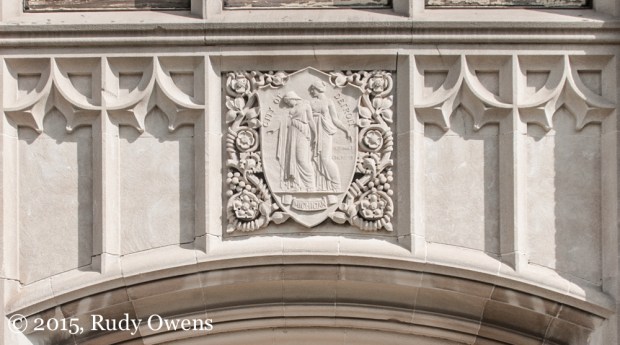
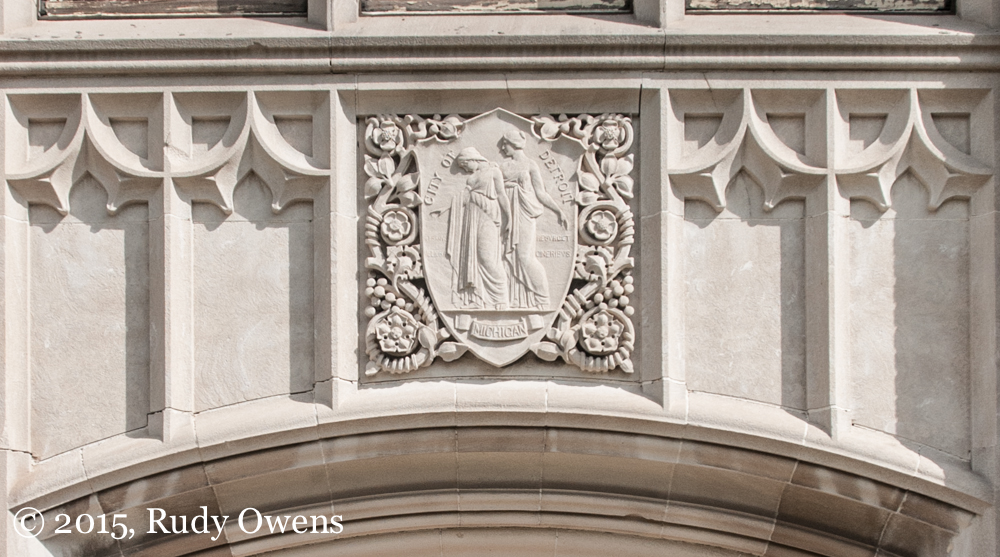
Seal of the City of Detroit on the front of the now closed building

Seal of the City of Detroit on the School Entrance

As recently at 2011-12, the Detroit Public Schools released an annual report on Crockett, noting, “Crockett High School made adequate yearly progress (AYP) in the tested subjects (mathematics, reading, science).” The same report noted, “Parents and community members are an integral part of the school program at Crockett High School. Parents and community members are included in decision making at the school levels through their involvement on committees and special programs. The Local School Community Organization (L.S.C.O.), provides programming for parents/guardians and the entire community.”

Another high school, Finney, also was slated to closed, and students from there and Crockett were to be sent to a new $46.5-million East English Village Preparatory Academy being constructed on the former Finney site. Meanwhile, the DPS allowed Crockett to fall into total disarray and be gutted and destroyed by scrappers.

I spoke to two guys working on a car across the street from Crockett, who told me this story. They noted that the DPS police did nothing to stop the scrappers once the schools alarm system failed. First the scrappers busted the windows and ripped out the metal. Then they went to work on the interior. One of the men, who said he had lived on that corner much of his life, said he even tried to follow the criminal scrapper and his accomplice once. His calls went unanswered by the school district, he said, and the scrappers did their destruction mostly at night.

I casually walked around the school. It was easy to enter it. I jumped in a window. I couldn’t believe what I saw. Perfectly good school furniture was left to rot in the elements. Science labs were ripped apart. The structure of the building, however, looked perfectly sound, appearing better than public schools I attended growing up and have seen elsewhere in the country. The neighbors I met with said the school had even been recently fitted with high-speed internet connections to promote a science and technology curriculum.

It reminded me eerily of the film Children of Men, in a future world where humans are sterile and are unable to reproduce, and schools are left to rot without children to fill them. Crockett was one of the saddest things I saw in Detroit. In nearly any other major American city, such a situation would provoke outrage and activism. Here, no one seemed to care. Meanwhile, the DPS–whose motto is “see it, believe it”–is looking for a buyer for a school it decided it could not even protect. And another piece of Detroit slides into decay, without much fanfare to accompany the fall.

Historic Lemp Brewery, in St. Louis

At the time of the St. Louis World’s Fair in 1904, the Lemp Brewing Co of St. Louis was the third largest brewery in America. Founded by a German-American entrepreneur, Adam Lemp, in the city’s south central area, the brewery proved to be an innovator up until the time of Prohibition. Family misfortunes and the Temperance movement took their toll. In response to the outlawing of booze, the Lemp facility attempted to brew a non-alcoholic beverage called Cerva, which flopped. The company could not sustain the factory operations.

In 1922, the family owners sold the complex, covering an entire city block, to the International Shoe Co. for practically nothing. The ISCO in turn finally sold the complex in 1992, leaving it without major tenants. The old brewery and factory site is considered an archtecturally and historically significant site in St. Louis, and the Lemp Hall is still used for catered events.

If you find yourself in St. Louis, a visit to Cherokee Street, which ends at the Brewery’s doorstep, is well worth your time. I lived nearly two decades in St. Louis and knew nothing about this place until I came back recently. Proves to me how ignorant I was as a teen and how wonderful older American cities can be if you bother to spend time exploring.

For the brew historians among you, and there are many I think, here are some interesting anecdotes:

  • Lemp brewed the first successful lager beer in the United States.
  • Lemp used natural underground caves in St. Louis to allow its beer to ferment and produce a superior product.
  • Lemp was the first shipping brewery to establish a national shipping strategy.
  • It was the first brewery to run its own railroad, the Western Cable Railway Company, that connected all of the plant’s main buildings to shipping yards near the Mississippi River.
  • The mansion of the Lemp Family is included on many haunted homes and buildings lists, if you believe in ghosts.

A wonderful documentary that does not use a distorted fisheye lens, like a GoPro I used here, can be found on the Built St. Louis web site.

As beautiful and grand as architecture get, all in St. Louis

I grew up in Metro St. Louis until I was 18. I did a fabulous city architecture tour in my senior year of high school and was blown away by the depth and richness of St. Louis’ architectural past. I learned it was misfortune and visionary legislation that made this possible.

A disastrous and deadly fire in 1849 led the city passing an ordinance preventing the construction of wooden buildings. The easy access to clay deposits led to a boom in brick buildings that provide a richness almost unparalleled in any American city. The money from the industrial era and real-estate speculation allowed for the construction of amazing homes and neighborhoods, even though slums were widely prevalent. Those gems from the golden era of St. Louis remain today. The pictures here are from the historic Cherokee Street area, near the river in South St. Louis, and the Lafayette Square area, in south central St. Louis. In racial terms, those remain mostly white, but that is also changing. Cherokee Street now hosts Hispanic celebrations, due to their large presence.

A web site dedicated to St. Louis’ diverse architectural styles provides a nice overview for those who do not have a background in architecture, with a nice sample of the gems any visitor can find with a map and simple curiosity. The styles I have captured are mostly Second Empire, inspired by French designs, and one Neoclassical design for the Chatillon mansion.

How Portland Looks from the Burnside Bridge

Burnside Bridge gives one a great view of the Willamette River and downtown Portland. It’s also near the areas where the city’s large homeless community congregates. One normally has to keep one’s wits about oneself here at night. Usually some crime noir is happening here, in a not so pleasant way. I came here on summer solstice to capture a few random views. I love the view of the grain elevator the Steel Bridge to the north and the freeway jumble where I-84 and I-5 collide.

Google Street View tells a story of Detroit’s struggles


Last night, I discovered a story how Google Street View can be used to tell the story of cities, including the agony of my home city, Detroit. I wish I had discovered this earlier, because it is a great tool to document change, despite the weirdness of Google’s spy cam on all of us, in our neighborhoods. I decided to use the time machine portal to see how the former home of my Michigan relatives fared between 2007 and 2013. So this is a very personal issue for me.

What I found was not surprising, and I had reported on this on an earlier post. What I discovered today was a more rich visual tale of the decay that really is the story of Detroit’s ills over the past six years (2007-’13). I think this kind of storytelling should be used in the face chirpy “Detroit on the rebound” news coverage that some want to promote that seeks to ignore the full story.

About a month ago, I published a blog about my reaction to seeing parts of Detroit that had fallen into disturbing decay, complete with ravaged neighborhoods, arson-torched homes, and the collapse of communities. This sparked a bit of a backlash by a group of current and former Detroit area advocates (all white, like me by the way) who rushed to Detroit’s defense and said negative storytelling ignores the “good people” and “good stories” and tales of the recovery. I then reviewed the data, and think rose-colored perspectives can be naive at best given the indicators of crime, poverty, employment, population health, and more. I do think balance is critical, but you cannot ignore what you see, particularly with tools like Google Street View, and in the work of recent documentary photographers.

This is an American story and an American tragedy, with many villains, many victims, and a still uncertain future. Recovery will take decades. Right now many people are struggling, and many people have just walked away–like my relatives did decades ago. Many in leadership positions in our country  would prefer to have our country spend tens of billions to preserve our strategic priorities in foreign lands and willfully ignore a once great city that is, by all definitions, an “African American” community that many in this country care very little about.

I talked about this with an old public health classmate of mine and how young Americans go overseas to address global issues of poverty and development. He wryly commented, maybe some new grads can work on “third world” issues in our country. I think he is right.

Detroit, my home town

This is the final post I am making, for a while at least, on the city of my birth, Detroit. I wanted to capture the industrial area located in Dearborn and southwest Detroit, around the River Rouge and Zug Island. The neighborhood filmed is called Delray. The murals shown in the video are by Diego Rivera, at the Detroit Institute of the Arts. They capture the world-famous Mexican muralist’s impressions of industrial production and Ford’s River Rouge complex, then the world’s largest factory, in the early 1930s.

Thousands of them a year, bro

Charlie LeDuff, author of Detroit, An American Autopsy, has provided one of the most painful descriptions of nihilistic self-destruction I have ever read. It is a brutally honest dissection of Detroit. While working as a reporter for the Detroit News, he became close to a company of the city’s beleaguered firefighters, who have battled literally thousands of fires intentionally set by criminal arsonists throughout the metro area. LeDuff shared this comment from one of the firefighters who is asked to do the near impossible–save a city the residents are intentionally burning down.

“In this town, arson is off the hook. Thousands of them a year, bro,” the firefighter told LeDuff. “In Detroit, it’s so fucking poor that a fire is cheaper than a movie. A can of gas is three-fifty, and a movie is eight bucks, and there aren’t any movie theaters left in Detroit so fuck it. They burn the empty house next door and they sit on the fucking porch with a forty, and they’re barbecuing and laughing ‘cause it’s fucking entertainment. It’s unbelievable. And the old lady living next door, she don’t have no insurance, and her house goes up in flames and she’s homeless and another fucking block dies.”

In my entire life, during which I have visited dozens of countries, I have not witnessed anything as bizarre as this. I have seen worse than this, and things vastly more evil than this. But the utter pointlessness of this chaos, besides pure anger and loss of meaning, seem overwhelming. And people live with this, next to his, surrounded by this, engulfed by this. For those of you out there who may snicker and even enjoy this, take heed. LeDuff and many other chroniclers of the downfall of the American middle-class in cities like Detroit have a message for you. Detroit is not the past. Detroit is the future, coming to a place near you, and quicker than you think.

Most of these crime scenes are in what used to be called the Delray neighborhood, near Dearborn and Jefferson, by Zug Island. Hard to imagine that people still make the best of it here. It is home to someone. I often wonder what Canadians just across the Detroit River may have thought seeing flames, if they could see the smoke amid the heavy industry that surrounds this former Hungarian-American enclave. This is now called a “ghost town” within a city.