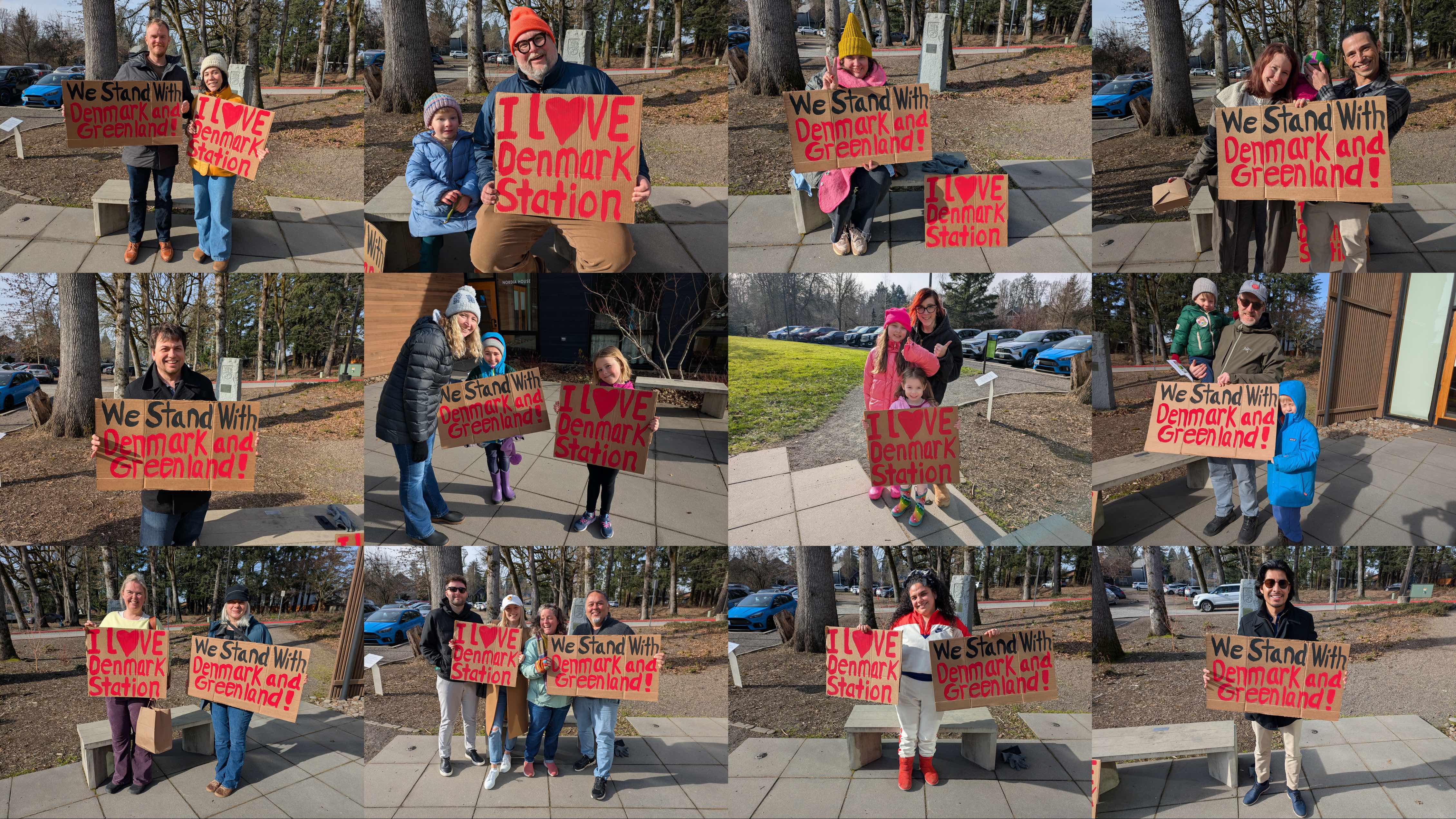
In response to the ongoing threats being made by the leader of the United States to Greenland and Denmark, I want to say to my personal friends in both lands, and all the people that call those places home, we in the United States, the people of the United States, are your friends. We send love.
To show this, I took these photos this morning (January 25, 2026) in Portland, Oregon, at Nordia House, a cultural center celebrating the ties between Nordic nations and peoples and the United States.
Everyone who I met shared warm words for all the people in Greenland and Denmark. We the people will never sever our friendship. We the people are not spoken for by the increasingly dangerous man who is leading my country to a dark place.
To that darkness, I shine light. That light is the love you see here from the people, some who have relatives in Denmark and others who will be visiting.
To see all of my portraits as individual photos, visit the my “Love Portraits” page dedicated to the people of Greenland and Denmark.
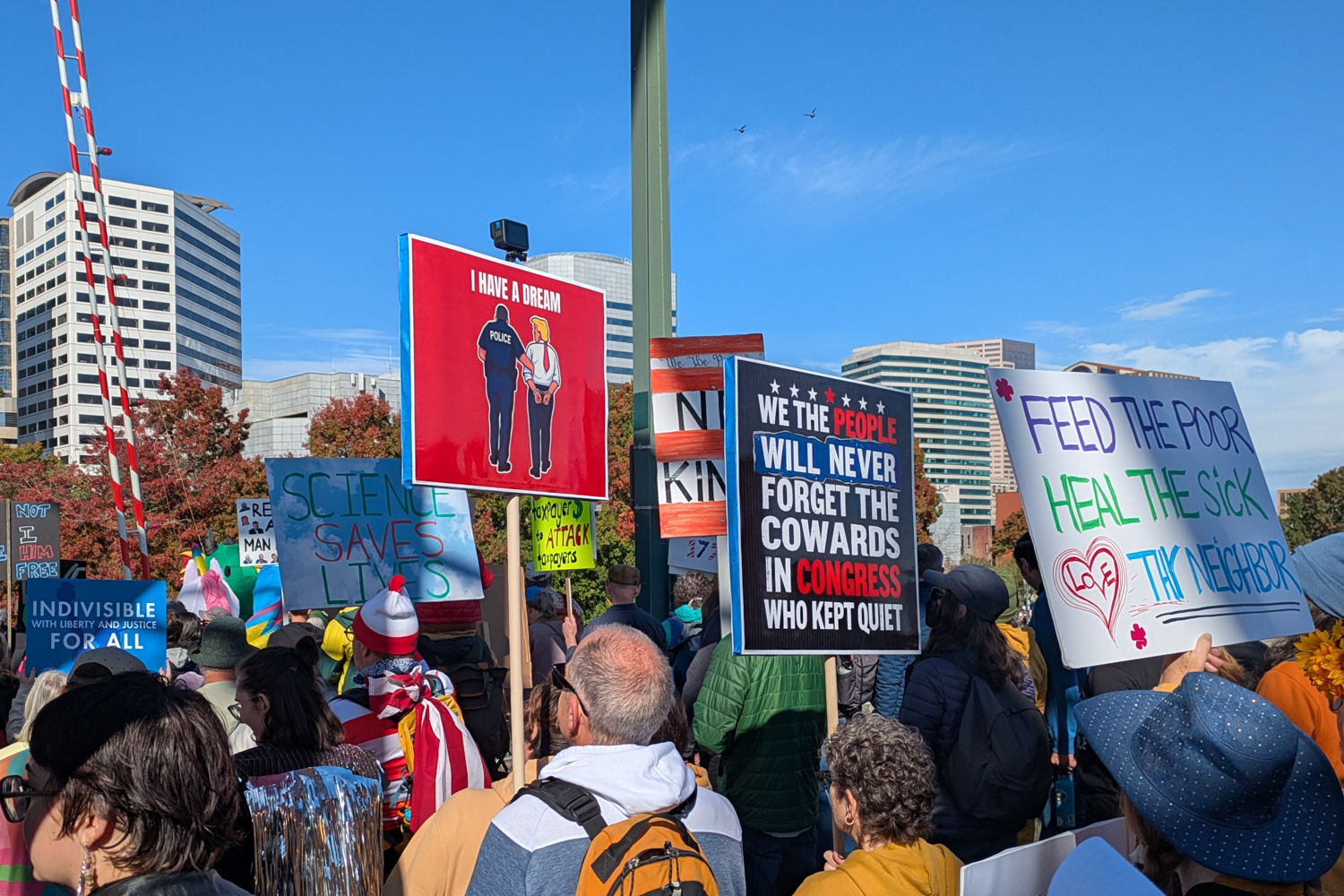
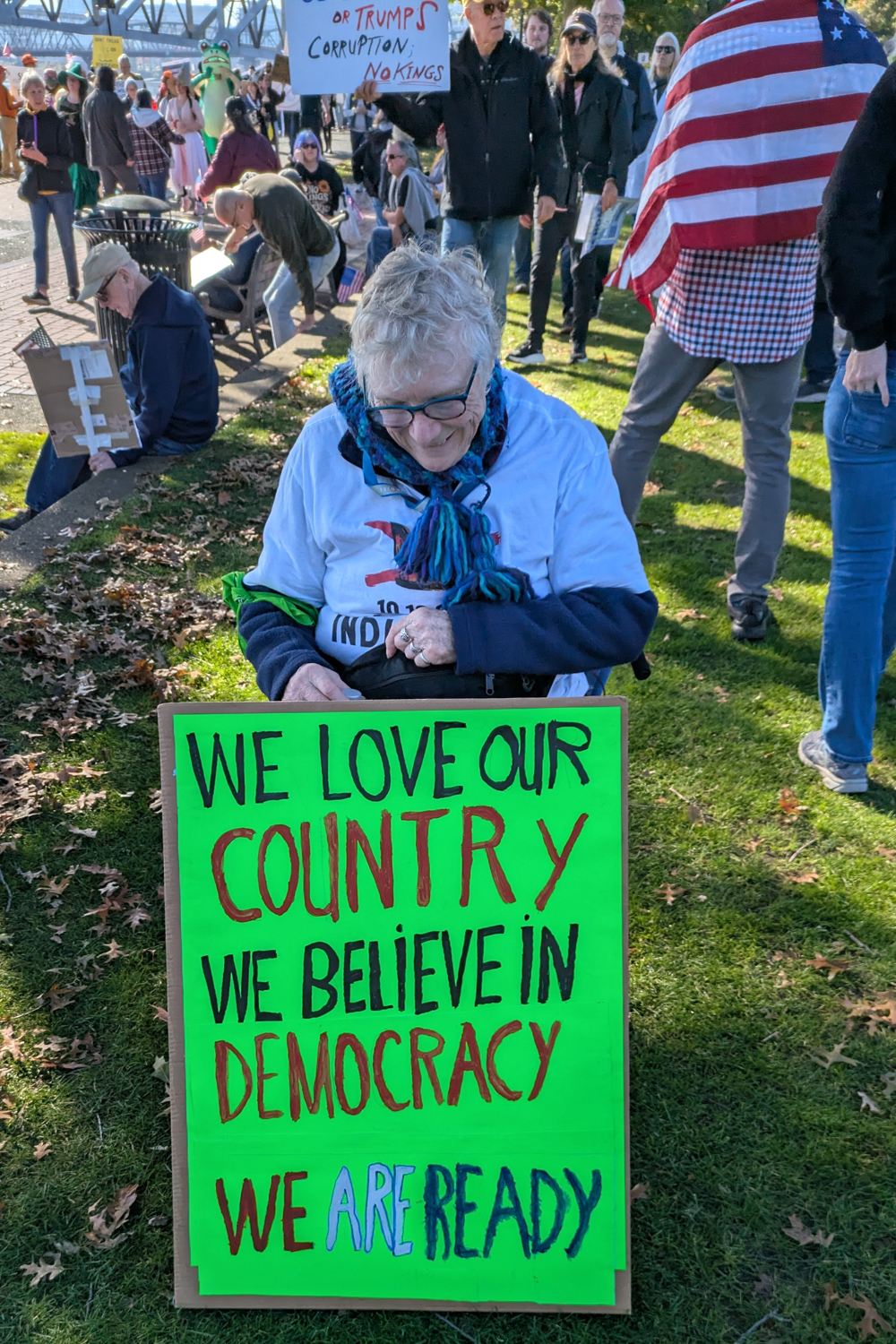
That’s right: October 18, 2025, “No Kings Day,” will go down in American history as a defining day for our troubled, imperiled democracy.
The protests were mobilized around one theme: that in the United States we have no kings. And they took place to challenge the authority of a sitting president and his administration that have falsely called peaceful American cities, like my hometown of Portland, Oregon, “war zones.”
Current estimates peg the number of protesters at 7 million, at least, in more than 2,600 locations, spread throughout every state.
VISIT MY POST ON MY WEBSITE TO SEE MORE PHOTOS AND READ MORE.
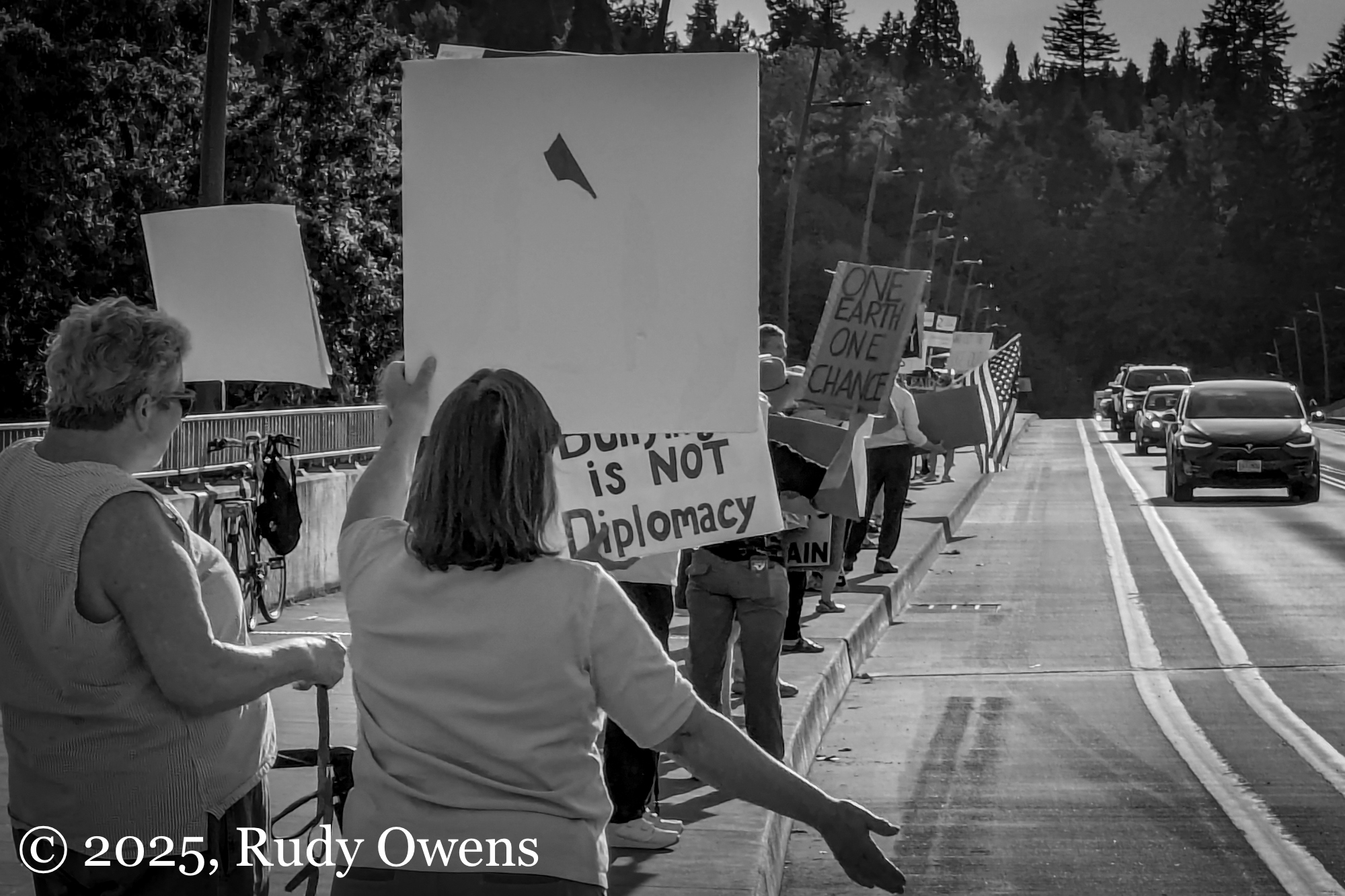
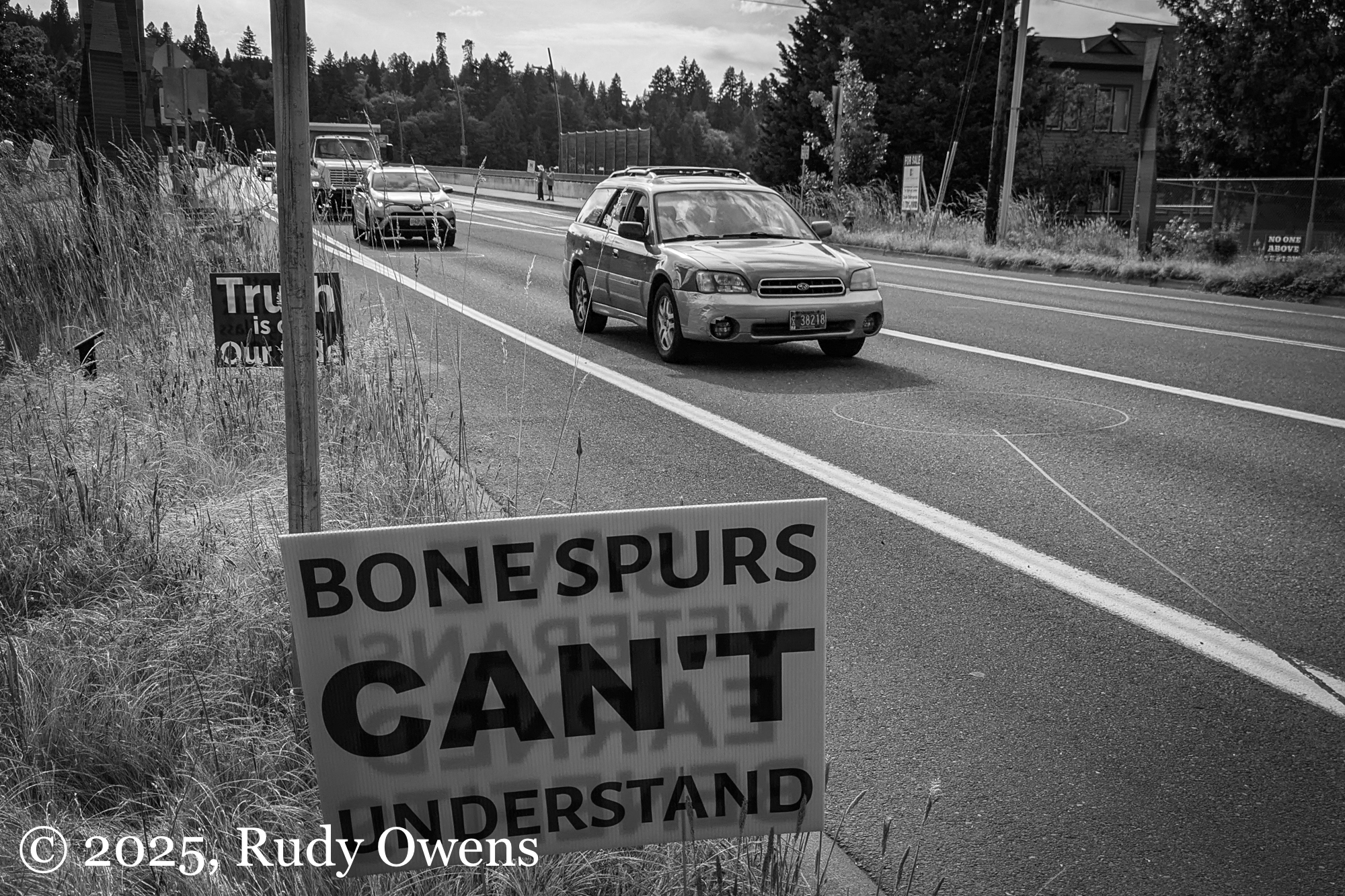
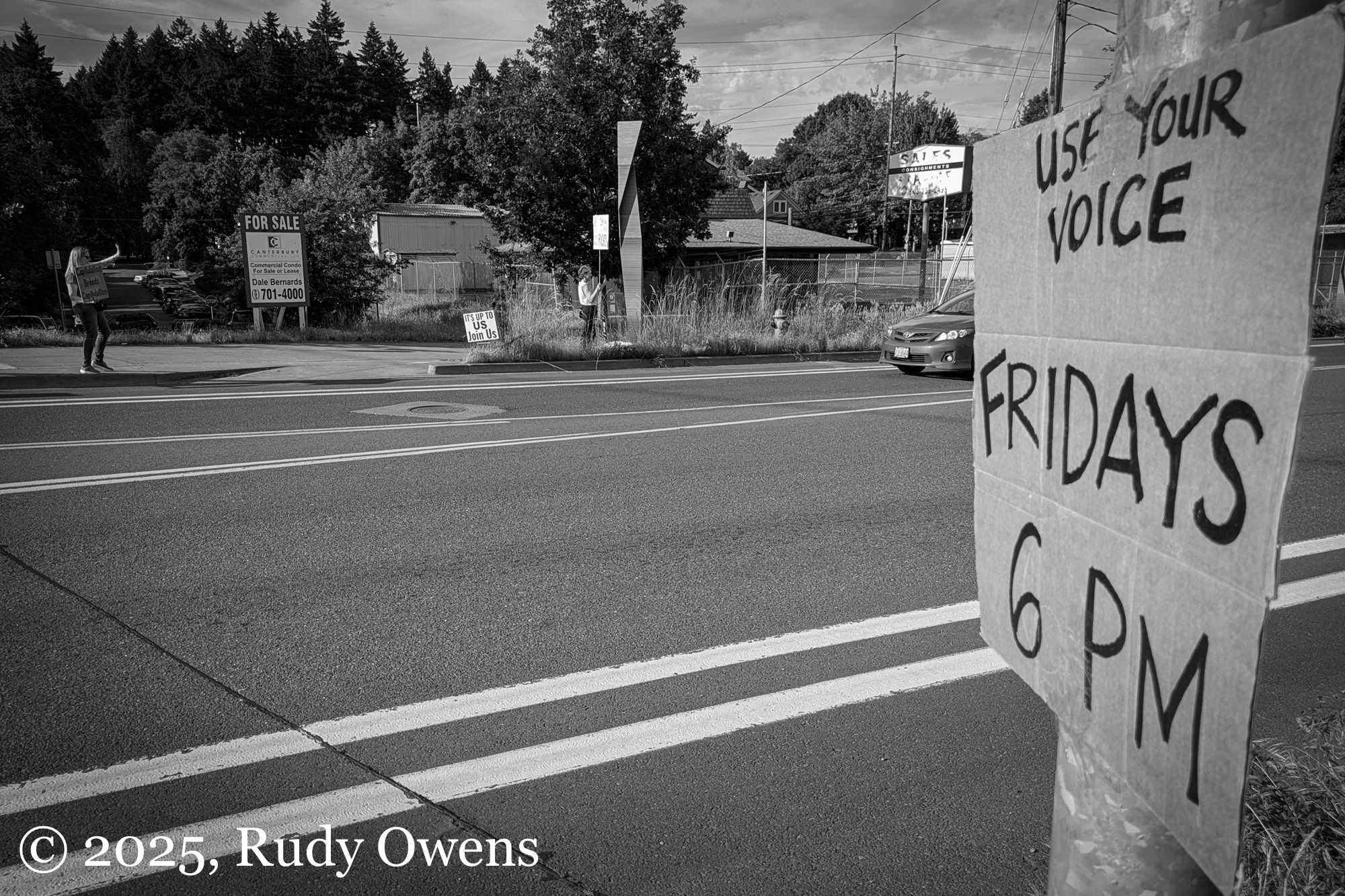
Every Friday since early April I have been joining a group of mostly older (like me) Portland residents at peaceful protests on Portland’s Sellwood Bridge during the Friday night, after-work rush hour.
The local organizers live in southeast Portland, like me, not far from Sellwood Bridge. The bridge is found on the south side of Portland, straddling the Willamette River. It’s a busy corridor for traffic heading from mostly Democratic and left-of-center leaning Multnomah County to a more evenly split jurisdiction politically, Clackamas County, which lies the south.
The organizers call their weekly civic event “Friday protests on the Sellwood Bridge.” It is an apt name. Their mission is simple too: “Our goal is to encourage our community to stay engaged and to use our voices and First Amendment rights to protest any erosion of our Constitutional freedoms or functioning government.”
The last event took place on Friday, May 30, 2025. My photos, all intentionally hiding most of the faces of the participants, were taken at the protest under sunny, warm skies.
That night, from about 5:30-7 p.m., over 75 folks assembled on the Sellwood Bridge to defend our country, exercise protected speech, and engage hundreds and hundreds of rush-hour commuters. We come with our own signs—painted, drawn, or marked out with Sharpies. Participants can also use the many more professional signs and repurposed but evergreen cardboard signs brought by the organizers.
On the last Friday of May 2025, the horn energy was righteous under the early summer sun.
Supporters in the passing rush hour cars, and also cyclists, outnumbered the few angry white male bird flippers by about a ratio of 25-1. That was encouraging.
Like previous weeks, I saw the outrage and solidarity in people’s faces. They showed with their expressions they were all in on the resistance themes. I observed how they leaned into their horns, giving protesters a thumbs ups, pumping their fists, and even yelling in support.
For the commuters, they see people engaged. They see protest happening. They see the signs focusing on: cuts to Medicaid, violations of due process, cuts to our federal health system, illegal firings of tens of thousands of federal workers, threats to the environment and education, the gutting of our federal bureaucracy, the illegal disappearance of lawful residents to gulags out of the United States, and more.
The drivers recognize that their frustration and outrage at the ongoing coup to the U.S. Constitution is not a personal assault, but one shared by their neighbors and our country. And man, were they laying in on the horns on May 30, 2025.
The Sellwood Bridge Protest logo
The importance of showing up, week after week
The protests each Friday on the Sellwood Bridge are all organic, with almost no coordination, outside of weekly email reminders.
A few people started the civil actions in February 2025, and they have grown. The entire purpose is to keep showing up, to keep calling out the violations of law by the current president, and to demand a restoration of law and the end of corruption and lawbreaking by the current administration of President Donald Trump, a convicted felon.
What’s important about the events each week is the consistency of civil disobedience and the act of protest.
Renown historian of 20th century tyranny, Professor Timothy Snyder of the University of Toronto, in an interview on May 31, 2025, with MSNBC’s host Ali Velshi, said, “Democracy is a verb.” It’s not a static thing. It’s action. When there is action, others engage, and the acts themselves become part of a system that is vital to human goodness.
I think Snyder described the value of action so perfectly: “But we also have to recognize that it’s not on any one of us to solve the whole thing. Right. So each of us does a little bit, and together that changes the whole landscape.”
I plan to keep going to these events as long as my democracy is under siege, and it looks like it will be a long and painful four years, at least.
(Click on the image see a larger picture on a separate picture page.)
I took this shot with my Samsung smartphone, which has a mediocre lens, even for cellphones. Even then, it can occasionally capture something special.
This location is at the corner of SE 26th Avenue and SE Steel Street, in sourtheast Portland, Oregon. I used to bike by here decades earlier, when I attended college a few blocks away. Despite Portland’s massive gentrification, some neighborhoods outside of the Port of Portland still have the blue-collar industries that used to dominate the economy not long ago.
My first memory of Portalnd was of that time, and I loved its grittiness when I first came here. That seems long gone now.
We have now passed the peak week for cherry blossoms in Portland. It is always an amazing sight to behold, up and down the wet side of the Cascades, particularly in cities where arborists and planners have planted cherry trees.
Now that I live in Portland, I take walks that put me in their path. I took these the last week of March 2018 at Reed College, where I attended many years ago. I always remember the blossoms from those years telling me the end of the year was close at hand. They gave me comfort and hope during that time, always.
This homeless encampment is underneath Interstate 405, next to the city’s affluent and trendy Pearl District. Portlanders of all income levels literally walk by these mini shantytowns daily, and their number is growing citywide this year as rents continue to rise dramatically–more than any other city in the nation.
This row of old Portland homes is about three blocks from areas where the city’s homeless encamp daily, underneath Interstate 405.
(Photos taken three blocks apart. Click on each photo to see a larger picture on a separate picture page.)
Last week I attended an event where participants discussed the regional crisis around homelessness. The City of Portland has already declared a housing crisis, to confront rents that are climbing fastest here than any city in the country. The average rent has climbed more than 40 percent since 2010 (data from 2015, and only worse since). The Guardian newspaper in February reported “shelter for the homeless has become anything but discrete.” The Guardian reported: “Portland saw rents appreciate nearly 15% in 2015 – the highest increase in the nation – with an average rent of $1,689 per month, according to real estate company Zillow. Five years ago, it was around $980.” A person I heard at the forum I attended described the tent communities positively, even one downtown at the entrance to Chinatown, for being self-run. Others I know have described such shantytowns as frightening, particularly for single women walking by. The person who shared their concerns with me about the Chinatown situation travels by that shantytown everyday (and, yes, I will call them shantytowns).
Tents encampments are widely visible under most overpasses, under bridges, in rights of way like the Springwater corridor, and in public parks. There is nothing sanitary about them. Trash is strewn all around them, and it is doubtful the residents of these tent encampments are using sanitary systems to dispose of human waste. Many of these residents also have drug and mental health issues. And the situation has grown dramatically more visible since I first arrived in September 2014.
Some places once that had green spaces on state right of ways now have a tent encampment of at least 15 units, all over the city. In February, Portland Mayor Charlie Hales legalized camping by homeless residents. Portland and Multnomah County claim they will spend up to $30 million to fight homelessness and offer more affordable housing. But that will not happen til July this summer. We will see what happens.
Seattle’s Mayor, Ed Murray, has taken on tent cities as failures, and his hired expert claims tent cities prolong the homeless problem without solving it. This came after a shooting at Seattle’s notorious “jungle,” which attracted national attention. In that attack in January this year, two were shot dead, and three badly wounded. One known encampment for homeless residents on the Springwater Corridor trail, in nearby Gresham, was the scene of a reported sexual assault by a recently released ex-convict, who was apprehended the same day, on March 25, about a half mile from my house. As someone who once passed homeless encampments every day for two years in Seattle and who sees homeless encampments every week in Portland, I do not have a magic solution. The housing bubble is certainly a root cause to the crisis, along with national economic issues and income inequality, plus regional market forces. So long as rents continue climbing in cities like Portland and more Americans cannot find stable housing with low paying jobs, they will flock to the Northwest, and its many mini-jungles, along with the more brutal Skid Row in Los Angeles, home to an estimated 40,000 to 60,000 homeless.






 What Beautiful Light