Travel

Back-roads bike ride in Lane County, Oregon

I used to live in Eugene, Oregon, in the mid-1990s. I had not been back for nearly two decades to do one of my favorite bike rides, up Fox Hollow Road, out into rural areas by the millionaires’ high-priced mcmansions and rural homes, then back into town on the Lorane Highway. It’s a classic short ride, with great views of Spencer’s Butte and rural Lane County.

Colors were about at their peak brightness, but a bit brown because of drought. I saw more than two dozen wild turkeys that day too–the most I have ever seen in Oregon. I love this ride. I miss it, but not the pay level I had working as a reporter in that area. Ultimately I left because I could not sustain things. I always enjoy my visits there to see places I know and the people I once had as neighbors and co-workers.

A great list of area rides is published by the local bike advocacy group called GEARs.

And now the house is gone, too

I recently visited Detroit, to see where parts of my biological family (I am adopted) once lived. I previously reported on what I had discovered about the neighborhood where my grandparents once called home, in west Detroit, on Stout Street, not far from River Rouge Park. Using historical snapshots with Google Maps street view between 2007 and 2013, I learned that the old house that my grandparents called home for decades up until the mid-1960s had fallen into decay, like literally tens of thousands of other abandoned homes in the Motor City. My grandparents left Detroit for the suburbs in 1968. That was a year after the devastating riots that marked a turning point moment in Detroit’s recent history defined by economic decline, white flight, and population loss that outpaces any similar decline experienced by any major American city.

This picture is taken from a Google Maps street view, for the purposes of editorial comment.

The Stout home in 2013; this picture is taken from a Google Maps street view, for the purposes of editorial comment.

On my return visit in September 2015, I found the spot where the house used to stand. It is now a cleared lot, on property now owned by the Detroit Land Bank public authority, which manages the thousands of distressed properties in the 139-square-mile city. Based on photographs I saw on Google Maps street view, the tearing down of the house and its neighboring homes was inevitable. Arson and looting was visible in feral houses still on the street, across from the now closed Kosciusko Elementary School, itself an abandoned property and among dozens of public schools now vacated and being gutted by scrappers citywide.

I took a look inside one of remaining burned and abandoned homes on the block. It is a cookie-cutter house, built for the emerging lower-middle class of Detroit in its industrial heyday. Tract houses like this run for blocks in all directions, either of wood or brick construction. It was disturbing to see what was once a home where families once lived in such a state of destruction, brought on by economic decline. There were still spices in the kitchen cabinet, along with a bottle of Aunt Jemima syrup. About a quarter of a century earlier, when I first saw this street, it was still a home for the people who lived there. They, like my grandparents, had left too.

This was the small piece of real-estate where my family’s story intersected that the bigger narrative of decline that has proven stubbornly hard to turn around. And now there is no trace of that history to be found except a cleared lot.

ArcelorMittal steel plant, Cleveland

Cleveland’s industrial legacy still lives. As one drives into Cleveland from the south, it is almost impossible not to see the massive ArcelorMittal steel plant on the Cuyahoga River. This plant covers more than 950 acres, with 7 million square feet of building space and nearly 2,000 workers. The company, based in Luxembourg, accounts for about 10 percent of all steel production globally, and also has been attacked for its environmental standards by critics. Iron and steel production in Cleveland and other northern Ohio towns have been a part of the economic landscape since the mid-1800s. The complex here dates to the turn of the 20th century, to the Charles A. Otis Steel Co., and has undergone a series of ownership changes until the current owners acquired the facility in 2004.

I have always been fascinated by the power embodied in these facilities, which belch out exhaust and steam and churn raw materials into the building blocks of our modern world. Cleveland is a place where such facilities still function, as heavy raw material production has moved from the United States abroad. (Click on each photo to see a larger picture on a separate picture page.)

Finding mini-treasures in central Ohio

Ohio is likely not on most Americans’ list of tourist destinations, which is a shame. There are some stunningly beautiful places, particularly in the foothills of the Appalachia Mountains in southeast Ohio, stretching from Gallipolis all the way to New Philadelphia, and even further north in the Cuyahoga Valley National Park, south of Cleveland. I found some hidden gems and surprises here. Cambridge was particularly fun. Its historic courthouse, built in 1881, is the centerpiece to a lovely old downtown, unfortunately surrounded by highway developments and Walmarts and dollar stores that are too common everywhere.

Exploration and drilling crews filled up the hotel where I stayed in Cambridge, Ohio

Exploration and drilling crews filled up the hotel where I stayed in Cambridge, Ohio

I found a lot of roughnecks at a local hotel here. They were crews working in the Marcellus oil and gas formation, which stretches into eastern hill country of Ohio. Where there is energy, there are men ready to do hard work.

I would have loved to have had a half day to bike some of the back roads around here. Maybe in another life. (Click on each photo to see a larger picture on a separate picture page.)

A garden in the rough, and I mean rough

The urban gardening scene in Detroit has been making waves for a while, far beyond the city. It has been written up in thoughtful tomes about the city–books by good authors describing the challenges of a city that painfully downsized in the last 40 years. I met a Detroiter, an African-American musician, who talked a fair bit about them too, positively and with a smile of pride. The Kellogg Foundation has made a passionate effort to improve healthy food access as well, funding gardens as a way to promote health and community.

I am glad these are happening, here and everywhere. As to whether a once and still industrial city can be transformed into an urban gardening hub in the 21st century, I find that about impossible to imagine without some corporate-run farm scheme. What I do imagine are local efforts by residents to promote community pride and good food. Gardens will never restore Detroit to its former status, and they will not create a middle class that is disappearing. They do represent a good thing, that diamond in the rough, and hope is always a good thing.

For more on Detroit’s illustrious urban garden history that precedes all urban gardening movements by a century, read up on Mayor Pingree’s Patches (great story, and history is now repeating itself).

Click on each picture to see a larger photo on a separate photo page.

In the long shadow of Evel Knievel, daredevils still risk it all

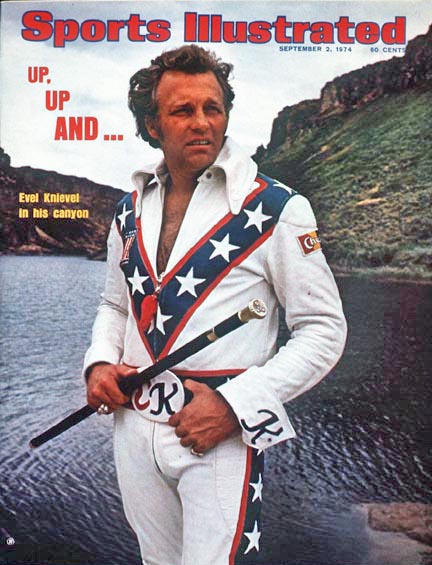
Every modern motorcyle and extreme sports daredevil since the 1960s and  1970s stands in the long shadow of stunt rider Evel Knievel. The Butte, Montana, native and international showman built a legacy of thrilling audiences with death-defying leaps on his motorcyle over long distances. From the grisly televised crash at Caesar’s Palace in December 1967 to jumping 15 buses in Wembley Stadium in London in May 1975, Knievel conquered the public’s imagination. He had spectacular failures and reportedly broke more than 400 bones in his battered body over his long years as a showman extraordinaire and one-of-a-kind daredevil.

The Sports Illustrated cover shows Evel Knievel in his purest form, decked out in his all-American jump suit (great photo).

The Sports Illustrated cover shows Evel Knievel in his purest form, decked out in his all-American jump suit (great photo).

Knievel completely invented himself, his persona, and his brand of entertainment from the ground up, with his imagination knowing no boundaries. His first recorded jump, according to the new documentary on his life called Being Evel, was over two cougars and a box of rattle snakes in Moses Lake, Washington, and he crashed open the box of snakes who got away. He then built up his reputation the hard way, show after show, and also crash after crash. His greatest media stunt, and failure too, was attempting to jump in a specialized vehicle over the Snake River Canyon on Sept. 8, 1974, with him crashing yet again in the canyon floor. But he got back up and kept at it.

As a kid, I likely fell under the Kneivel spell, and saw him many times on TV, on lunch boxes, and on tabloid newspaper covers. He made more than half a dozen appearances on ABC’s Wide World of Sports in the 1970s, when I was growing up. He personified a type of fearless recklessness that excites nearly every young boy, and inspires a few to try such feats later in life. The current climate of Red Bull fueled stunts, jumping from outer space to leaping from cliff faces in wing suits, owes it all to him. Knievel proved you can become a legend if you are willing to put it all on the line and entertain the masses while doing it. Knievel died in 2007 at 69 years of age, a badass to the end, being totally himself.

The photos above were taken at the Omak Stampede in August 2013. I took these shots during practice for a great half-time event at the stampede later that night. Three daredevils, whose names I now cannot find, put on a show with multiple leaps on their dirt bikes and four wheeler. The best rider did a back flip during the show on his bike and totally nailed the landing. They had all of their gear in trailers they hauled by trucks, a bit like Knievel. All three of these guys were accompanied by a trio of totally beautiful women, who stood proudly by their sides. In that way, nothing has changed since Knievel’s day. The daredevil is made of different stuff, and it is the stuff that still appeals to women who like dangerous men. As Knievel may or may not have said, “bones heal, pain is temporary, [and] chicks dig scars… .”

Leaving Alaska on the Inside Passage

Five years ago almost to the day I left the Great Land, as Alaskans call their home. I departed the exact same way I came up, taking the Inside Passage on the Alaska Marine Highway, from Haines to Prince Rupert, BC. (FYI, that is the state-run ferry system.) That is just an incredible way to experience one of the world’s cleanest, healthiest, and most scenic waterways and landscapes.

I captured all of these photos on my pont and shoot Canon, which did what I wanted to do–preserve a memory of a very important moment in time when I transitioned from one stage of my life to another. (Click on each picture to see a larger picture on a separate picture page.)

Has it been 20 years already, Machu Picchu?

Yes, Machu Picchu, with a llama munching on grass, is a complete photographic cliché. I do not care. I snapped this photograph in the very very early morning hours at this great Inca hill city in late August 1995. I hiked the Machu Picchu Trail to get here, passing six ruins. It was a highlight of my life, mainly because of the incredible mountain topography, the historic footprint of the now-gone Inca culture, and the fulfillment of a dream of mine to mix my passions for mountains, long-distance trekking, and archaeology-history. The negative for this photo was damaged by the developer, as I made a big mistake entrusting my film to a shop in Santiago. But with a little Adobe magic, it turned out OK.

When I arrived at Machu Picchu, it was smoked out from fires on the Amazon basin, where farmers and cattle owners were burning land. I had camped out at Intipunku (Sun Gate), which looks down on the ruins from a nearby pass. That was not, ahem, entirely allowable, but I practiced low-impact camping and had zero impact. And I know my footprint was radically less than the organized tours, some of whom were leaving trash at camp sites. I am now glad the trail is more regulated. There simply is no other way with such a globally popular destination.

(Click on the photo to see a larger picture on a separate picture page.)

As beautiful and grand as architecture get, all in St. Louis

I grew up in Metro St. Louis until I was 18. I did a fabulous city architecture tour in my senior year of high school and was blown away by the depth and richness of St. Louis’ architectural past. I learned it was misfortune and visionary legislation that made this possible.

A disastrous and deadly fire in 1849 led the city passing an ordinance preventing the construction of wooden buildings. The easy access to clay deposits led to a boom in brick buildings that provide a richness almost unparalleled in any American city. The money from the industrial era and real-estate speculation allowed for the construction of amazing homes and neighborhoods, even though slums were widely prevalent. Those gems from the golden era of St. Louis remain today. The pictures here are from the historic Cherokee Street area, near the river in South St. Louis, and the Lafayette Square area, in south central St. Louis. In racial terms, those remain mostly white, but that is also changing. Cherokee Street now hosts Hispanic celebrations, due to their large presence.

A web site dedicated to St. Louis’ diverse architectural styles provides a nice overview for those who do not have a background in architecture, with a nice sample of the gems any visitor can find with a map and simple curiosity. The styles I have captured are mostly Second Empire, inspired by French designs, and one Neoclassical design for the Chatillon mansion.

My faith in humanity

On days when chaotic people around me seem overwhelming, in that place called life and the real world, I always seek the solace in what I know to be universally true. And that is the goodness in others.

I ignore the emotional tornadoes who suck energy from others, and I bring back memories of people I have met everywhere in the world. Today, on a day when the whirlwind people were a bit too much, I got a jolt of the “rest of humanity” through some friendly old smiles. Here are a few of their faces, taken from my travels in Bali and Java, in Indonesia, in February 2009.

(Click on each photo to see a larger picture on a separate picture page.)