Travel

Newberry Crater, a hidden gem of central Oregon

Newberry National Volcanic Monument, known affectionately as Newberry Crater, is one of the most beautiful places in the Pacific Northwest. The volcanic landscape features 54,000+ acres of lakes, lava flows, and one of the most amazing geological features in central Oregon. Imagine Crater Lake, its more well-known cousin, except Newberry has two lakes. They are not as blue and deep as Crater Lake, but they are majestic twins. The highest point is Paulina Peak, 7,985 feet above sea level, which provides a commanding view of the natural area’s lava flows and cinder cones.

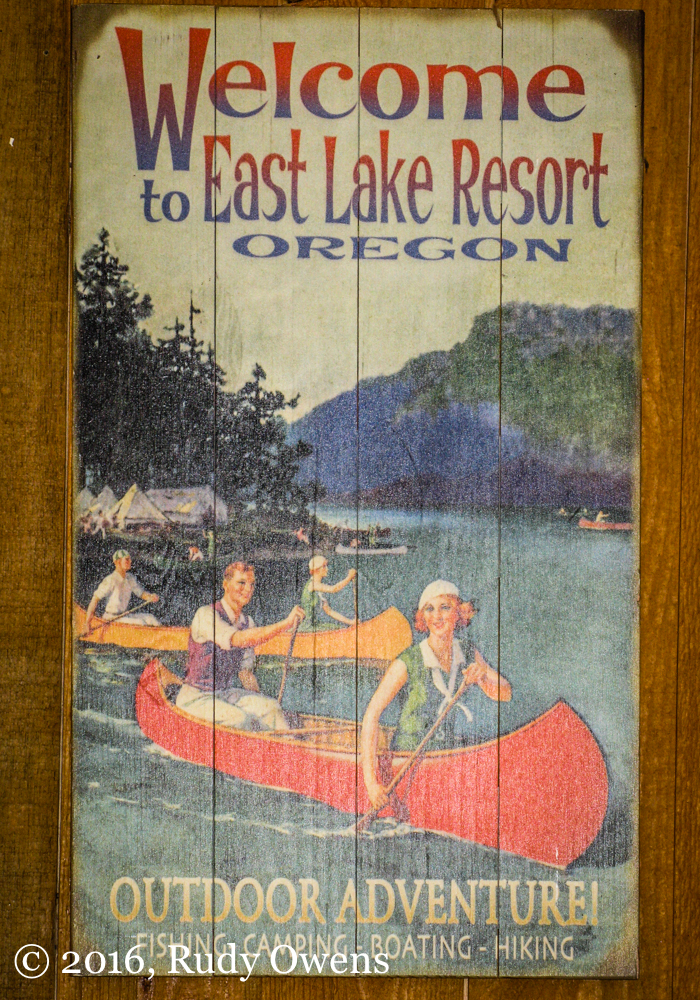
In their misguided wisdom decades earlier, U.S. Forest Service planners built a road to its top–evoking the lyrics of Joni Mitchell: “They paved paradise and put of a parking lot.” Hardy hikers can walk up. Everyone is rewarded with one of the greatest views in all of Oregon. You can see the vast expanse of high desert in all directions and the beautiful volcanic peaks of central Oregon: Mts. Bachelor, the Sisters, and Jefferson.Welcome to East Lake Resort Poster
I first came here in 2014, biking up from Highway 97. I pedaled up the steep climb and was rewarded by two clean mountain lakes (Paulina and East), a massive field of obsidian, photo-perfect lakeside campgrounds, and decades-old lodges on both lakes that seemed right out of the 1950s. I finally came back in August 2016. There is something for everyone here.

The four campgrounds are well-maintained, fronting the two lakes. Anglers bring in boats casting for kokanee and several species of trout (watch out there is natural mercury contamination). Fly fishermen can find many empty beach spaces to practice. A set of hot springs bubbles out of the gravel on the north shore of Paulina Lake–the hike to the springs and around the lake is fantastic! Lots of kayakers bring in their boats to explore the rocky shores. There are more than 30 trails. For a trail runner, you can circumnavigate the entire rim, or climb Paulina Peak, lap Paulina Lake, and more. You can also take a trail from the valley of the Deschutes National Forest along Paulina Creek to the majestic Paulina Falls, pouring from Paulina Lake. If you visit, be sure to bring your mountain bike to get around.

Visitors, if you can characterize them, mostly have massive V-8 trucks and large camping trailers towed behind. I saw lots of families, and plenty of dogs. The only people who were not white were adopted kids of some family members. Hiking and camping in central Oregon is still not a diverse activity. I kept wondering, would an African-American family want to spend a summer trip here? Likely not.

At the beautiful East Lake resort, which has old cabins looking west on East Lake, I grabbed morning coffee and got to know a retired Gresham principal who has been coming here with three generations of his family for 16 years. He boasted his 14-year-old granddaughter caught 17 trout one morning.

I doubt Newberry Crater will ever become “cool.” I hope it stays old-fashioned and affordable for locals seeking a cool getaway from their homes in the Northwest.

Amid reported Turkish coup and chaos, a fond memory of ordinary people

(Click on the photo to see a larger picture on a separate picture page.)

The last 24 hours has seen some of the wildest news I can recall in a while, at least for modern nation states in Europe and its Asian-European neighbor, Turkey. I came home from work on July 14, 2016, only to be bombarded by images of a murderous rampage by a sole terrorist driver in Nice that took at last count 84 lives. Than not a day later, I returned from a walk and discovered a coup in Turkey. TurkeyCoup Report

Turkey is a modern state. It is a democracy, with rough edges. It is also a key European and U.S. ally, with a major military base (Incirlik) that serves vital Western and U.S. interests in a violent, civil-war torn region. And now there are reportedly tanks in Istanbul, helicopter gunfire ships strafing government sites in the capital, and people being shot during protests as part of a reported military coup to overthrow Prime Minister Recep Tayyip Erdogan. It is hard to know the full truth. There are many real and also fake Tweets, so I will just see how this plays out.

This all makes me think of the time I went to Nice in 1985, while studying in France. I walked the Promenade Anglais, where the horrific attack took place during a celebration of Bastille Day. I cannot imagine what happened in my mind’s eye. And I was in Turkey in 2000, in places now cropping up by the second on the latest Tweets from the front lines of a reported coup. So today I just decided to publish a picture that brings me a sense of calm. It is a picture I took just before I left Turkey, taking a boat to Samos, Greece. This was a family I met at a local restaurant. We enjoyed each other’s company. They were not that different from me. They were struggling to run a small business and live a good life. I am wondering about them and the many other people I met in Nice and in Turkey right now.

Steady leadership is now needed from the people entrusted to lead. I have faith in my leader now to do that. But these times are straining democracies and reason, I am concerned cooler heads will be challenged to prevail.


North St. Louis, a gentrification-free zone

(Click on each photo to see a larger picture on separate picture page.)

I recently visited St. Louis, to see my family. I normally use my visits to tour historic sections of the once proud and fourth-largest U.S. city in the late 1800s. But those are the long-gone glory days.

Today, the city is struggling to define itself in the post-NAFTA, post-industrial reality of the “new economy” that has led to the greatest level of income inequality the nation has seen since before the Great Depression.

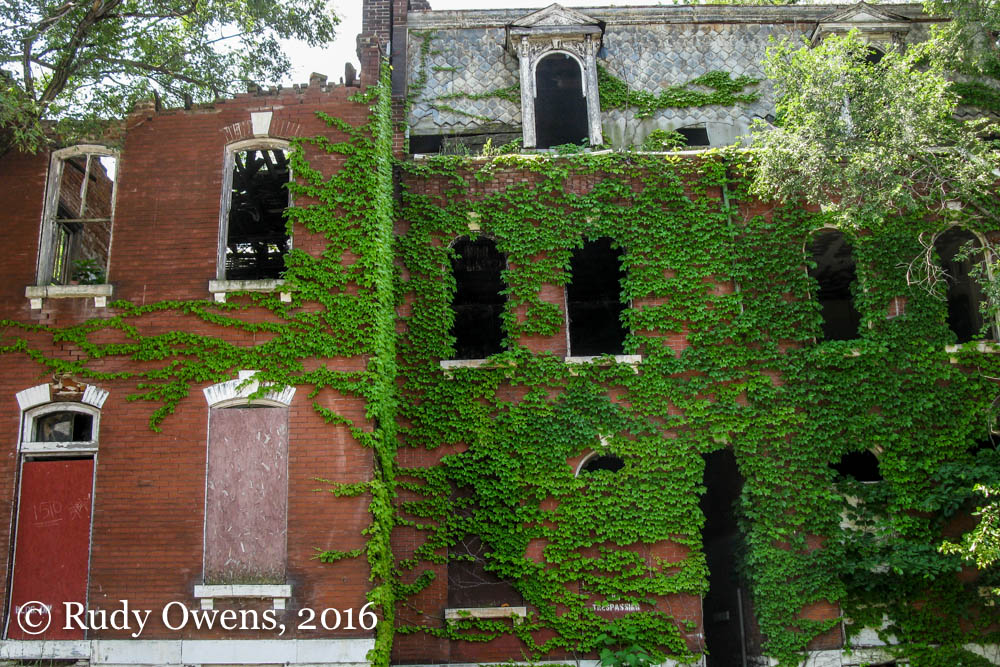
The pain and fragments of this change are visible everywhere in the city, mainly in the form of shuttered factories and feral and abandoned houses that almost give Detroit a run its money as the epicenter of U.S. urban decay. They are most pronounced on the city’s north side, historically the racially demarcated home to the city’s poorer African-American residents for more than eight decades. That is the story I went out to photograph this trip, in June 2016.

Love can be in short supply in north St. Louis.

Love can be in short supply in north St. Louis.

St. Louis experienced what many Midwest, industrial cities confronted during and after World War II. The U.S Interstate System promoted out-migration to the surrounding county. White flight rapidly accelerated population losses following the 1950s. (See a superb illustration of that white flight here: http://mappingdecline.lib.uiowa.edu/map/.) The population dropped from 880,000 residents at the start of the 1950s to a mere 315,000 souls in 2015, according to the most recent U.S. Census Bureau estimate.

Industry, including automobile manufacturing and other sectors, began a long slide to obsolescence. St. Louis and the surrounding region were once major players in automobile manufacturing and home to several “Big Three” plants: one Ford, two Chrysler, and one General Motors. The city’s world-famous Corvette plant closed its doors in 1981 after a 37-year run. At its peak it had a payroll of more than 13,000 employees. Since then, Ford shuttered its plant in nearby Hazlewood in 2006, and Chrysler closed two plants between 2008 and 2009 (north and south plants), costing the region about $15 billion, according to one study. (GM still has an assembly plant 40 miles from St. Louis in Wentzville.)

I wanted to see first hand how things look on the city’s infamous north side, or “home” as it is known to its residents. It had been years since I did such a trip. I was startled by the lack of businesses except gas stations, beauty shops, food and restaurant establishments, and garages.

I met a sixty-something man on a street just off Vandeventer Avenue and North Market Street. He told me he had worked for Chrysler until being laid off in 2009, when the Fenton plant was shuttered for good, before the factory was razed to the ground. A grandfather, he called himself T-Bone, and had just purchased his two-story brick home for $24,000. He hoped to acquire two adjacent lots through a process that allows property owners adjacent to vacated lots to acquire those lots at no cost after three years of maintenance. He told me he wanted to become more engaged in local politics to help restore his section of the city. He lived two houses down to a boarded up, abandoned home, one of several on his block.

Beautiful old brick homes have long gone feral in the economically challenged neighborhoods of north St. Louis.

Beautiful old brick homes have long gone feral in the economically challenged neighborhoods of north St. Louis.

Today, more than one in four St. Louis residents live in poverty. The U.S. census puts the median household income in the Gateway City at $35,000, well below the U.S. average of $53,000. Racially, the city is as divided as ever with blacks and whites evenly divided, and now Hispanics and Latinos numbering (officially) under 5 percent.

All of these numbers mean that the city, and its poorest residents, are struggling. That struggle can be seen on just about every block north of Delmar Avenue, all the way to the city’s borders with adjacent and also struggling municipalities like Jennings. Anyone visiting the city should soak its charms—the Gateway Arch, the amazing churches, the historic downtown, and especially charming and historic Lafayette Square.

Then they should take a drive for an hour or two and see what life in the new urban, post-industrial America looks like. Gentrification is not a problem that is displacing residents in the city’s north side. No urban, yuppie, or tattoo-covered and scrappy millennial pioneers from the affluent suburbs are rushing to create art centers or startups in old factories sites. This is the place people leave if they can.

This is not Portland, Seattle, or Boston. This is a much tougher, more violent, and grittier place. It is also in many ways a more friendly place too, where people will still say hello if you have street cred and give them respect. This is St. Louis, and the recovery, if it comes, is still a long ways off. Without long-parted industry, that future is still not certain.

Sunset and morning light in Encinitas

A week ago I was watching the sun go down and catching up with a great friend from college. I think the ocean is a good antidote to whatever heavy may be weighing on your soul and in your mind, if just for a few hours. I felt months of weariness wash away in these waves. (Click on each photo to see a larger picture on a separate picture page.)

Life really is great when you are in the ocean, and in the moment

This photo, taken at South Ponto Beach in San Diego County, came courtesy of mediocre and now very old camera. Who cares. the picture does the talking. Yeah, life can be real, real, real good! Click on the picture to open a larger photo on a separate picture page.

Me, I like herding dogs most of all

Ever since I traveled to Omak, Washington, in 2012 and met a couple of amazing Texas heelers adored by their owner, I have been smitten by this breed. Herding dogs just have that certain special something. Hey good boy, you are looking might fine. Click on the picture to see a larger photo on a separate picture page.

Wandering the streets of Assisi and San Vitale

One of my favorite stops in Italy was in the ancient hill city of Assisi, famous as a pilgrim’s destination to the Basilica of St. Francis of Assisi. There are also Roman ruins in the town’s center. I also visited a neighboring hill town called San Vitale. I loved walking the cobblestone streets closed to all motor vehicle traffic, all dating from the medieval era. (Click on each photograph to see a larger picture on a separate picture page.)


Hopewell Mound, Ohio

The Hopewell Cultural National Historic Park in central Ohio showcases one of the country’s greatest collections of mound building. Native Americans from Mississippi, to Illinois, to Ohio, to Alabama, left a lasting legacy still visible today in the form of burial mounds. The Hopewell mound builders of central Ohio built their mounds almost 2,000 years ago. According to archaeologists, Hopewellian people gathered at mounds for feasts, funerals, and rites of passage.  The greatest collection of Hopewellian mounds can found be near Chillacothe, Ohio. (Click on the photos to see larger pictures on a separate page.)

Bottoming out in Spokane

During a recent trip to one of my favorite cities in the United States, Spokane, I toured lots of neighborhoods. I was struck by the degree of poverty I did not recall seeing before. There are pockets of despair in any city in the United States, but Spokane surprised me because of how close some of these neighborhoods with high numbers of foreclosures were to downtown. The number of foreclosed properties is reportedly higher in Spokane than either Washington State or the United States, according the company Realtytrac.com.  January 2016 alone saw 200 foreclosed properties in the city of 484,000 residents. As of 2014, the U.S. Census reports that more than 15 percent of all residents in the city alone lived below the poverty line.

Click on each photo to see a larger picture on a separate picture page.

Holy Trinity Serbian Orthodox Church of St. Louis

Every time I return to St. Louis, I find new gems and treasures that continue to shine in this once grand, older Midwest City. In January, I stumbled very accidentally on Holy Trinity Serbian Orthodox Church, just south of Lafayette Square. The more than century old church continues to be a part of the community, inviting residents to Friday fish fries and events like Serbfest. Other Midwest cities, such as Detroit and Cleveland, also have churches and communities halls that highlight the history of ethnic settlement in the now decaying industrial cities. I recommend a quick visit if you are in St. Louis. It is a short walk or drive from Lafayette Park.