Photography

The former ‘King of Beers’

My photographic safaris in my former home town of St. Louis inevitably lead to beer. You cannot tell the story or show the story of St. Louis without focusing on the suds that made the city a world-famous beer epicenter.

As I have published on this blog before, St. Louis became the leading center of American brewing. German-American families became the barons of the new American industry that brought beer to the masses. The Anheuser-Busch dynasty conquered the local market and then the country, producing brands like Budweiser and Busch that were both bland and iconic at the same time.

The Anheuser-Busch complex occupies several city blocks, in the southeast corner of the city, overlooking the mighty Mississippi River. Globalization finally brought the King of Beers to its knees.

Anheuser-Busch became a lowly American subsidiary in 2008 to the Belgium brewing conglomerate InBev, which turned to massive debt financing to acquire the American industrial icon for $52 billion. The sale generated allegations from locals of “traitor” toward billionaire investor Warren Buffet.

The plot thickened in September 2016, when shareholders approved the $104 billion merger of Anheuser-Busch Inbev and SABMiller, another global beer conglomerate, based in London. The announcement was followed by reports of job cuts. The earlier merger had led to nearly 2,000 job cuts in the St. Louis facility between 2011 and 2016, according to local news reports.

Looking at this beautiful industrial facility, sculpted in classic St. Louis brick by great craftsmen, I see a great American business that helped create this city. Now I feel both nostalgia and sadness knowing that this uniquely American corporation has turned into a satellite facility of a company that knows nothing about the city or people who made the brand famous.

Yup, there is a tear in my beer, and I’m crying for you dear.

‘The Hill’ neighborhood of St. Louis

The Hill is one of St. Louis’ most sturdy working-class neighborhoods. It has maintained its Italian roots over many decades, even when ties to the mother country are now fading with time. The Hill‘s two most famous sons are baseball legends Joe Garagiola and the inimitable Yogi Berra. The two grew up on the same street and are celebrated as heroes, like so many other great St. Louis natives who went away.

Bisected by Interstate 44, which barreled through and destroyed many of St. Louis’ historic neighborhoods, the plucky Hill persevered, thanks primarily to its famous eateries. It is located just south of Forest Park and west of the Missouri Botanical Gardens. Compared to other historic St. Louis neighborhoods, it is a much lower-income area, without the elegant brick architecture and stately homes and churches that define classic late 1800s and early 1900s St. Louis. Instead it offers shotgun housing and walkable blocks that are carefully branded with the The Hill moniker and Italy’s national colors. It truly is a model in effective branding and identity building. The Hill also is typical of the racial divide in the city–this neighborhood is white in a city that has long promoted segregated neighborhoods.

I remember first coming here in the early 1970s for Italian celebrations with my family as a kid. I recall a lot of drunk St. Louisans eating food on a typically hot St. Louis summer day. It did not feel that special to me. In high school, my mother bought me a hero sandwich from one of the delis as a special birthday treat. It was delicious. I would occasionally visit the local stores with my mom over the years to buy Italian spices. I have even celebrated a wedding dinner at one of the classic family eateries. I am glad it keeps up its plucky ways.

In a city with so many historic and amazing sights, I probably would not put it in my top five places to visit, mainly because the competition is fierce in that city. But I would swing through if I had a weekend. The Hill is conveniently located, and you might enjoy a nice meal here as well. Buon appetito, amico.

Wind and rain at the Oregon Coast

A week ago I made the mistake of trying to surf in very poor conditions. So now I honor and respect the forecast. Today the forecast was for wind like you see in the Cannon Beach shot But even on a terrible day at the Pacific, it is still very fun to try and get in a ride. I had it all to myself at Indian Beach, and I managed to get some good practice rides in really nasty cross winds. On a bad day, a novice can practice and learn. But I prefer optimal days when the sets are predictable.

Revisiting an abandoned Detroit public school

(Click on each photo to see a larger picture on a separate picture page.)

A year ago, in September 2015, I visited my birth city, Detroit. I saw things I could not imagine were possible in the supposedly most powerful country in the world. I toured the city and observed impoverished neighborhoods, shuttered factories, empty homes in every corner of the community, and the omnipresent ruins from arson that have made the Motor City the arson capital of the United States. Detroit had a surreal feel. I called it City of the Future and published several photo essays and a photo gallery on my web site. The most memorable and heart-wrenching place I visited was the now shuttered Crockett Technical High School, at the corner of St. Cyril and Georgia Street.

The trashed and gutted Crockett Technical High School was listed for sale in September 2015 by the Detroit Public Schools, which failed in every sense to protect the school from destruction by scrappers and vandals.

The trashed and gutted Crockett Technical High School was listed for sale in September 2015 by the Detroit Public Schools, which failed in every sense to protect the school from destruction by scrappers and vandals.

In my last photo essay on this gutted and neglected facility of learning, I recounted that Detroit Public Schools (DPS) recently had implemented a painful round of massive school closures, carried out by DPS emergency manager Roy Roberts. In sum, 16 school buildings were closed permanently. In the previous decade, enrollment in the system had fallen 100,000 students, and by 2012-13, enrollment was about a third of what it was a decade earlier.

What I learned during my visit to Crockett from two friendly neighbors who were across the street would have been intolerable in nearly any other major U.S. city. I wrote in my September 2015 photo essay, “They noted that the DPS police did nothing to stop the scrappers once the schools alarm system failed. First the scrappers busted the windows and ripped out the metal. Then they went to work on the interior. One of the men, who said he had lived on that corner much of his life, said he even tried to follow the criminal scrapper and his accomplice once. His calls went unanswered by the school district, he said, and the scrappers did their destruction mostly at night.” The tragedy was compounded, according to one of the neighbors, because the school had been recently fitted with high-speed internet connections to promote a science and technology curriculum.

When I jumped into the old school, I saw newly built science labs completely trashed, eerily similar to how ISIS extremists would destroy monuments of culture and civilization in Iraq and Syria. But in Detroit’s case, the vandals were not crazed religious radicals, they were local residents, scavenging for scrap and destroying either for pleasure, anger, or both.

You can watch this June 2015 Detroit area news report on the scrapping at Crockett–all caught on live footage, with impunity. As one resident trying to protect abandoned public schools said, “How we can we hold off scrappers when we don’t have a license to arrest.”

Today, the DPS is rated the worst in the nation for test scores. In May 2016 The Atlantic reported, “… the country has probably never witnessed an education crisis quite like Detroit’s.” And, then to no one’s surprise and certainly not to anyone in Detroit, no one really gave a crap. What happens in Detroit no longer seems to matter, no matter how awful and absurd.

After my trip to Detroit, I spent about four months trying to get respected Portland universities to host a lecture and photo show (click on the link to see how I presented the concept) on the decline of Detroit and how it looked in 2015. I was turned down by Portland State University, my alma mater Reed College, the University of Portland, and the Multnomah County Library. I made repeated requests to multiple faculty and these organizations.

The topic may just be too depressing or impossible to comprehend. Even worse, the story about mostly black Detroit and its current woes, like the simple destruction of one fine public schools by the community itself, did not fit a narrative of race that is preferred many people at this time. A dominant narrative will always defeat an alternative story, particularly one that is rooted in ugly reality. I suspect this yawning disinterest was a combination of all of these factors.

To accept the reality of what Detroit is requires confronting painful issues about the United States that have not been addressed by our national political system. What we see instead are two candidates vying for the presidency who have used Detroit as a prop and photo-op to tell an economic story that does not resonate with the lives of people struggling in the city. Those two candidates, Donald Trump and Hillary Clinton, know little to nothing about the ordinary people in Detroit and have never stepped into any neighborhood where schools are abandoned, houses are burned, and blocks have gone feral. If one day one of them or any presidential candidate actually visit a place like Crockett, then I will retract this judgement

But let’s be honest. No one running for the nation’s highest office will ever see or want to see the real Detroit.

Note, I published the same essay on my I Wonder and Wander policy blog on Sept. 30, 2016.

Scenes from bike adventures in urban Portland

Portland, Oregon has a lot of urban rides. Many will take you by jammed freeways, grain elevators, a working port, a refinery, and over and under bridges. I took these photos over the last three months. There is not a grand unifying theme other than the impression of what one sees when you get out of your car and on two wheels.

(Click on each photograph to see a larger picture on a separate picture page.)

The makings of a great day

One type of great day happens when you pursue your passions and let your worries slip away. For me, this happens easiest when I connect with nature and tune out the crazy world.

Yesterday, Sept. 16, 2016, I had one of those classic “great days.” The weather was warm, Indian summer style. The sunrise over the farms of Washington County generated warm, William Turner-esque light.

Early Morning, Coast Band

A good surfing day begins with rising in darkness and knowing amazing waves and the smell of the ocean await you.

The winds were mild and the surf was gentle (two- to five-foot swells) at the Oregon Coast. Indian Beach in Ecoloa State Park offered amazingly clean sets that rolled in sweetly from the Pacific Ocean. I managed to get a few more rides–slowly I am building my skills and confidence. I felt that amazing serenity that only comes with being in the ocean, smelling and tasting the salt, and feeling the power of nature as I bob like a tiny bubble. Everyone surfing that day smiled and was in a good mood. I made some nice personal connections with people who gave me some tips about the surf.

Ecola State Park was as breathtaking as ever with its moss-covered semi-rain forest and coastal views. I had an absolutely perfect run after my surf at Cannon Beach. The dogs made me smile immensely. I seemed to pick up steam on the last three miles and felt stronger than I have in weeks. The 20 oz. IPA from Gigantic Brewing Company in Portland tasted better than ever. And my ratatouille tasted divine. Yeah, what a great day!

Alaska fall colors, as good as it gets

The past few days of news just totally sucked the wind out of my sails. Syrian conflict and refugees. Remembrances of 9-11 and how our country responded to this challenge. Global warming. It just goes on–argh!

So what to do? Remember, there is nature, nature, nature. I miss what Alaska could give me on a crisp, clear fall day. The colors and the cold air are without peers. Though, I would love to see what the fall colors in Kamchatka look like–I bet as pristine. So, in honor of tuning out the world and turning on to nature, I present for you fall in Alaska. All the shots were taken in Chugach State Park and one of the moose in the driveway next to my house in urban Anchorage. (Click on each photo to see a larger picture on a separate picture page.)


Fifteen years since 9-11, a brief remembrance

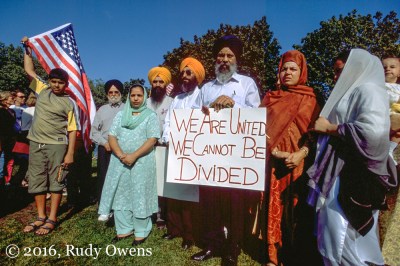
It is hard to believe 15 years has passed since the most important recent historic event in my country took place on the beautiful September day in 2001. I remember everything about it. I watched the replays on the TV and yelled, waking my housemate. I remember our nation’s ability to come together in the days and hours after this attacked, as demonstrated in my home of Seattle, where thousands gathered to express sorrow, unity, and hope. I grew concerned seeing how laws were passed by Congress that were never even read by some members, notably the Patriot Act, all in the name of national security. And then there were the two wars, and conflicts still rage in Afghanistan and Iraq.

The Seattle Sikh community gathered days after 9-11 at the Seattle Center to express both their loyalty and concern in the aftermath of the attacks.

The Seattle Sikh community gathered days after 9-11 at the Seattle Center to express both their loyalty and concern in the aftermath of the attacks.

Yes, the day completely changed history, in the United States and more dramatically in the Middle East, especially for millions of innocent Iraqi civilians.

I dug these pictures out of my archive. I visited New York City in April 2005, to see Ground Zero and to see the scope of what happened. Work had already begun to build One World Trade Center. It was a silent place amid the bustle of the Big Apple. I am so glad I went.

(Click on each photo to see a larger picture on a separate picture page.)

Wind, wheat, and windy roads near The Dalles

(Click on each picture to see a larger photo on a separate picture page.)

I finally did a bike ride I had been meaning to complete for several years. The area near The Dalles, about 80 miles east of Portland on the Columbia River, is wheat country. There are lovely, rolling hills, old and working farms, and the occasional abandoned home. All of this makes for great cycling. A group of friends got together over the Labor Day weekend and explored the hills southeast of the city. This area is considered some of the best for cycling in Oregon. You are greeted with few cars and lonely, two-lane black-top roads that lead, well, to nowhere and also beautiful places.


Crazy kaleidoscope of colors at Oaks Amusement Park

During the summer, I head down to Oaks Amusement Park, the small, privately owned play land near my house. This is probably the most diverse place in all of Portland on any given Saturday and Sunday. There are families and people from every possible background here, and likely none of them very wealthy, because rich people do not visit carnie land places. It is also a lot of fun, even if you do not get on the old-school rides.

When I come down the hill to the noisy, colorful place I often bring my GoPro camera and experiment with different shots. Here is one I like. It captures the spirit of the place. You can see more photos and read more about the amusement park on my photo essay page.

Click on each photograph to see a larger picture on a separate picture page.