History

Has it been 20 years already, Machu Picchu?

Yes, Machu Picchu, with a llama munching on grass, is a complete photographic cliché. I do not care. I snapped this photograph in the very very early morning hours at this great Inca hill city in late August 1995. I hiked the Machu Picchu Trail to get here, passing six ruins. It was a highlight of my life, mainly because of the incredible mountain topography, the historic footprint of the now-gone Inca culture, and the fulfillment of a dream of mine to mix my passions for mountains, long-distance trekking, and archaeology-history. The negative for this photo was damaged by the developer, as I made a big mistake entrusting my film to a shop in Santiago. But with a little Adobe magic, it turned out OK.

When I arrived at Machu Picchu, it was smoked out from fires on the Amazon basin, where farmers and cattle owners were burning land. I had camped out at Intipunku (Sun Gate), which looks down on the ruins from a nearby pass. That was not, ahem, entirely allowable, but I practiced low-impact camping and had zero impact. And I know my footprint was radically less than the organized tours, some of whom were leaving trash at camp sites. I am now glad the trail is more regulated. There simply is no other way with such a globally popular destination.

(Click on the photo to see a larger picture on a separate picture page.)

Washington Park Cemetery, the forgotten burial place

In the completely overlooked and unknown north St. Louis County community of Berkeley, Missouri, lies an overgrown, forgotten, and largely abandoned cemetery. Washington Park Cemetery was founded in the 1920s as a burial place for the St. Louis area’s black residents. It lies just off Natural Bridge Road, about 1.5 miles from Lambert International Airport.

Today, few if anyone knows about this place. It has been the subject of news stories throughout the years, mainly involving land use controversies that led to cemetery land and graves being removed to make way for an interstate and more recently in 1993 for the MetroLink light rail, which connects the urban center with the airport. Literally thousands of former bodies were removed to make way for major public infrastructure.

I knew about this battered resting place ever since I was a kid. I could see the graves literally right next to Interstate 70, and read stories in the 1990s about the light rail and airport expansion disputes. When I stayed in a hotel literally just across from this cemetery in July, I instantly knew what the place was, even though I found no signs. All I found were grave markers, names of African-American residents who were interned and the weeds, trees, and brush that were taking over the place. It reminded me of Jewish cemeteries I found in Poland, now abandoned since the tragedy of the Shoah in the 1940s.

Here are a few shots that I took wandering around on my last night before flying back to Portland. It was hot, humid, and eery. In the distance in one shot is the Renaissance Hotel, a luxury airport accommodation that looms over the cemetery. I doubt a single guest at that place ever wanders in the back to see the history that is now slowly being taken over by the Missouri bush.

(Click on each photograph to see a larger picture on a separate picture page.)

Historic Lemp Brewery, in St. Louis

At the time of the St. Louis World’s Fair in 1904, the Lemp Brewing Co of St. Louis was the third largest brewery in America. Founded by a German-American entrepreneur, Adam Lemp, in the city’s south central area, the brewery proved to be an innovator up until the time of Prohibition. Family misfortunes and the Temperance movement took their toll. In response to the outlawing of booze, the Lemp facility attempted to brew a non-alcoholic beverage called Cerva, which flopped. The company could not sustain the factory operations.

In 1922, the family owners sold the complex, covering an entire city block, to the International Shoe Co. for practically nothing. The ISCO in turn finally sold the complex in 1992, leaving it without major tenants. The old brewery and factory site is considered an archtecturally and historically significant site in St. Louis, and the Lemp Hall is still used for catered events.

If you find yourself in St. Louis, a visit to Cherokee Street, which ends at the Brewery’s doorstep, is well worth your time. I lived nearly two decades in St. Louis and knew nothing about this place until I came back recently. Proves to me how ignorant I was as a teen and how wonderful older American cities can be if you bother to spend time exploring.

For the brew historians among you, and there are many I think, here are some interesting anecdotes:

  • Lemp brewed the first successful lager beer in the United States.
  • Lemp used natural underground caves in St. Louis to allow its beer to ferment and produce a superior product.
  • Lemp was the first shipping brewery to establish a national shipping strategy.
  • It was the first brewery to run its own railroad, the Western Cable Railway Company, that connected all of the plant’s main buildings to shipping yards near the Mississippi River.
  • The mansion of the Lemp Family is included on many haunted homes and buildings lists, if you believe in ghosts.

A wonderful documentary that does not use a distorted fisheye lens, like a GoPro I used here, can be found on the Built St. Louis web site.

As beautiful and grand as architecture get, all in St. Louis

I grew up in Metro St. Louis until I was 18. I did a fabulous city architecture tour in my senior year of high school and was blown away by the depth and richness of St. Louis’ architectural past. I learned it was misfortune and visionary legislation that made this possible.

A disastrous and deadly fire in 1849 led the city passing an ordinance preventing the construction of wooden buildings. The easy access to clay deposits led to a boom in brick buildings that provide a richness almost unparalleled in any American city. The money from the industrial era and real-estate speculation allowed for the construction of amazing homes and neighborhoods, even though slums were widely prevalent. Those gems from the golden era of St. Louis remain today. The pictures here are from the historic Cherokee Street area, near the river in South St. Louis, and the Lafayette Square area, in south central St. Louis. In racial terms, those remain mostly white, but that is also changing. Cherokee Street now hosts Hispanic celebrations, due to their large presence.

A web site dedicated to St. Louis’ diverse architectural styles provides a nice overview for those who do not have a background in architecture, with a nice sample of the gems any visitor can find with a map and simple curiosity. The styles I have captured are mostly Second Empire, inspired by French designs, and one Neoclassical design for the Chatillon mansion.

Memorial to the masterminds of the Armenian genocide

Fourteen years ago I traveled in Turkey and worked on a documentary project photographing the legacy of Armenia’s culture in modern-day Turkey and historic locations associated with Armenians’ long history in Anatolia. I also photographed locations linked to the genocide of Armenian citizens of the Ottoman Empire, between 1915 and 1922. About 1.5 million civilians were slaughtered in the first documented case of genocide in the 20th century. This fact is still disputed today by the Republic of Turkey, and I outright discount that argument because of the overwhelming evidence, from documents, first-person accounts, and mountains of evidence.

The Talaat Pasha Memorial in Instanbul proved to be the hardest place for me to find and photograph. There was no guidebook showing me the way, and no map called it out. Even its name was in dispute. I called it the Talaat Pasha memorial, and that is what some Turks I met called it when I finally tracked it down in the Caglayan neighborhood of Istanbul. It was gated, not well-marked, and overgrown with weeds. It was not the safest place to go, and photographing the monuments in the square likely would have caused me problems. So, I made a fast job of it, snapped some photos, and left quickly.

Currently web sites are now publishing pictures of the site, more than a decade later.  Here are photos by a Turkish photographer from 2011. Web sites I found, including the Wikipedia entry (whose facts may not be fully accurate), also show contemporary photos of the location. I have found the plaza square to be dubbed the Monument of Liberty Cemetery and Hürriyet Şehitleri Abidesi, or “Freedom Martyrs Monument.” There is apparent agreement of online sources that the site was originally built before World War I to honor reformers, who died or were killed.

It is perhaps famous or infamous today becuase it has the graves of the remains of two of the three leaders of the Ottoman Empire, Enver Pasha and Talaat Pasha, who organized the genocide against civilian Armenians. (You can read my detailed story here about the genocide and my trip to Turkey; note the file is large, so please allow time for it to download.)

Current photographs of those memorials honoring these leaders is even published by the official Government of Turkey web site. That site clearly shows the memorials of these two leaders and notes, almost ironically, the massive Palace of Justice of Istanbul that has been built behind the memorial plaza: “Hailed as the biggest courthouse in Europe by the government, it overlooks the park and the Monument. It almost seems like the justice system is entrusted to the watch of the Committee whose members used to pledge alliance to it with a rifle and Quran. Whether this has any connection with justice let alone liberty is of course another question.”

Symbolism and language matter, as do monuments. Enver Pasha’s remains were returned here in 1996, and Talaat Pasha’s remains in 1943, during World War II. When Enver Pasha’s remains were feted in a ceremony in 1998, one news account noted that thousands attended, including President Suleyman Demirel, ministers, deputies, and Turkey’s top generals, and the former war minister. Enver Pasha was proclaimed a martyr. “Enver Pasha, with his faults and merits, is an important symbol of our recent history,” Demirel said. “We have no doubt that history will reach the proper judgments through evaluating past events.”

The photo evidence published online today and the Government of Turkey’s web site that shows a spruced up memorial  clearly signal that the current government of Turkey shows no interest in backing away from its denial that the last leaders of the former Ottoman Empire were masterminds of a massive human rights violation, which still causes controversy today.

(Click on each photograph to see a larger picture on a separate picture page.)

A story for every stone

My explorations of Portland’s historic Lone Fir Cemetery found lots of fascinating headstones. Each represents a life, a full story, a story that intersects with hundreds of other stories. And how do we remember these former residents, who are now but forgotten. Cemeteries remain a good place to contemplate one’s life and what one does with one’s life. Because ultimately we all return to the earth, and our life is but a speck in the passage in time in an infinite universe. (Click on each photograph to see a larger picture on a separate picture page.)

Two sides of a historic coin and wrestling with the past

The debates over the public and state-sanctioned display of the flag of the slave-holding Confederacy point to the United States’ not-so recent past. No country is pure, and the United States’ evolution is marked by great accomplishments, great divisions, and also some historic acts that leave a painful legacy. Our history of conflict in the 1800s stretches the entire century, from the War of 1812, through the Mexican-American War, dozens of conflicts with Native American bands across the continent, overseas expansion and trade wars (the Opium War), and the Spanish-American War.

in 1902, Portland area residents and war veterans erected a statue honoring the nation’s war veterans at the city’s historic Lone Fir Cemetery in Southeast Portland. The cemetery is filled with graves of many white, Christian early settlers from the 1800s, and latter-day residents of all persuasions. I stumbled on the cemetery accidentally at a staging of Macbeth last weekend.

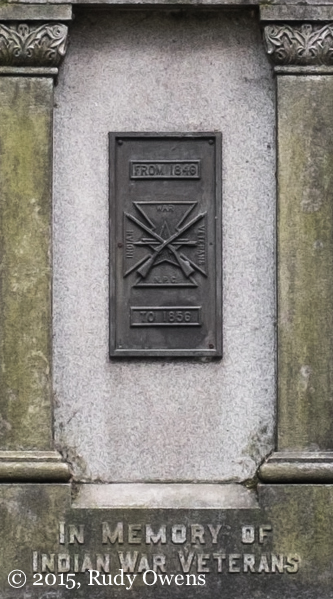
Close up of memorial honoring soldiers who fought for the United States against Native Americans.

Close up of memorial honoring soldiers who fought for the United States against Native Americans.

I looked up and saw this statue of a Civil War soldier, with memorials plaques honoring veterans of Spanish-American War of 1898, the Civil War, the Mexican-American War, and the American Indian Wars from 1846 to 1856, which saw most of Oregon and Washington occupied and appropriated as U.S. territory from many native tribes.

There were conflicts, but many of the original inhabitants were perishing en masse due to diseases like smallpox that accompanied the arrival of new settlers. Even after land was ceded by treaties and tribes were resettled on reservations, hostility was pronounced. Eleven years before this statue was erected, in 1891, the Oregon Legislature was passing resolutions with language that characterized the state’s Native residents as “a wild man.”

State lawmakers signed their names to a measure that stated: “… it would only be a fact of evolution to call him a wild animal on his way to be a man, provided the proper environments were furnished him. While the instincts and perceptions are acute, the ethical part of him is undeveloped, and his exhibitions of a moral nature are whimsical and without motive. Brought into contact with white men. whether of the lowest or of the highest, he is always at a disadvantage which is irritating, and subject to temptations which are dangerous.”

Today, what are we to do with such legacies to this time when these attitudes prevailed, and good people erected monuments to their fellow soldiers who fought for their country, and many doing so believing they were in the right and doing it for the best of intentions?

(Click on each photo to see a larger picture on a separate picture page.)

Suitcase display, Auschwitz Birkenau Memorial Museum

Today I wanted to show a picture that for me demonstrates why I believe that war is not an answer. It is during war when the worst happens. It is under the cover and guise of war, when “things” go wrong. It is in the name of patriotism and country or religion and ethnicity, when humans can operate outside the bounds of civilization. The death camp of Auschwitz, near Krakow, Poland, is a good place to contemplate why peace matters.

I visited here in July 2000, working on a project documenting sites related to Nazi crimes committed during World War II, when the world was truly at war. These exhibits, at the main camp of Auschwitz (Auschwitz 1), were extremely hard. These are suitcases of likely Jewish prisoners who were murdered here. They were stacked as a display, behind a glass case.

You can see more of my documentary work on German camps on my web site.

Click on the photograph to see a larger picture on a separate picture page.

Google Street View tells a story of Detroit’s struggles


Last night, I discovered a story how Google Street View can be used to tell the story of cities, including the agony of my home city, Detroit. I wish I had discovered this earlier, because it is a great tool to document change, despite the weirdness of Google’s spy cam on all of us, in our neighborhoods. I decided to use the time machine portal to see how the former home of my Michigan relatives fared between 2007 and 2013. So this is a very personal issue for me.

What I found was not surprising, and I had reported on this on an earlier post. What I discovered today was a more rich visual tale of the decay that really is the story of Detroit’s ills over the past six years (2007-’13). I think this kind of storytelling should be used in the face chirpy “Detroit on the rebound” news coverage that some want to promote that seeks to ignore the full story.

About a month ago, I published a blog about my reaction to seeing parts of Detroit that had fallen into disturbing decay, complete with ravaged neighborhoods, arson-torched homes, and the collapse of communities. This sparked a bit of a backlash by a group of current and former Detroit area advocates (all white, like me by the way) who rushed to Detroit’s defense and said negative storytelling ignores the “good people” and “good stories” and tales of the recovery. I then reviewed the data, and think rose-colored perspectives can be naive at best given the indicators of crime, poverty, employment, population health, and more. I do think balance is critical, but you cannot ignore what you see, particularly with tools like Google Street View, and in the work of recent documentary photographers.

This is an American story and an American tragedy, with many villains, many victims, and a still uncertain future. Recovery will take decades. Right now many people are struggling, and many people have just walked away–like my relatives did decades ago. Many in leadership positions in our country  would prefer to have our country spend tens of billions to preserve our strategic priorities in foreign lands and willfully ignore a once great city that is, by all definitions, an “African American” community that many in this country care very little about.

I talked about this with an old public health classmate of mine and how young Americans go overseas to address global issues of poverty and development. He wryly commented, maybe some new grads can work on “third world” issues in our country. I think he is right.

Meeker and the Utes’ last gasp

The story of Meeker, Colorado, where a white agent working as a missionary and Indian agent and 10 white men were killed by the Utes in 1879, is captured in Dee Brown’s epic Bury My Heart at Wounded Knee. Ultimately U.S. cavalry forces defeated one of the last remaining bands of unconquered Native Americans in the central west, leading to their expulsion from their homeland to the barren, hot scrub of eastern Utah, where they remain today on a mostly impoverished reservation. When I stopped here two years ago, during the Memorial Day weekend in 2013, I found an older historic marker referencing the “massacre” and a newer interpretive sign noting the expulsion of the Utes from their ancestral land. The story of the West and its settlement remains constantly in flux.

Click on each photo to see a larger picture on a separate picture page.