Economy

Abandoned, east Detroit

Since coming back from Detroit in late September, I have reached out to five Portland area universities if they or their student groups might like a multimedia show on the realities facing Detroit. So far, I have not had any bites. I do not think the topic is of much interest to Portland area residents, as Detroit is nearly 2,000 miles away, and the realities facing a city with tens of thousands of abandoned properties and continued problems with public safety, poverty, and economic revitalization just do not register here. The Rust Belt and its many ills I think matter very little beyond the region that is experiencing continued economic decline for decades. But, I will keep working on this.

It still startles me how little people know and care about the pockets of distress in the United States, even though we still share the same country. This is not true all the time and everywhere, but for those pockets of intense decline and multi-generation poverty, it is as if we write them off as failed mini-states, doomed forever to failure. There seems to be an unwritten decision that just says, you are no longer worth it. And, for many in east Detroit, that looks a bit like what you see here.

(Click on each photo to see a larger picture on a separate picture page.)

And now the house is gone, too

I recently visited Detroit, to see where parts of my biological family (I am adopted) once lived. I previously reported on what I had discovered about the neighborhood where my grandparents once called home, in west Detroit, on Stout Street, not far from River Rouge Park. Using historical snapshots with Google Maps street view between 2007 and 2013, I learned that the old house that my grandparents called home for decades up until the mid-1960s had fallen into decay, like literally tens of thousands of other abandoned homes in the Motor City. My grandparents left Detroit for the suburbs in 1968. That was a year after the devastating riots that marked a turning point moment in Detroit’s recent history defined by economic decline, white flight, and population loss that outpaces any similar decline experienced by any major American city.

This picture is taken from a Google Maps street view, for the purposes of editorial comment.

The Stout home in 2013; this picture is taken from a Google Maps street view, for the purposes of editorial comment.

On my return visit in September 2015, I found the spot where the house used to stand. It is now a cleared lot, on property now owned by the Detroit Land Bank public authority, which manages the thousands of distressed properties in the 139-square-mile city. Based on photographs I saw on Google Maps street view, the tearing down of the house and its neighboring homes was inevitable. Arson and looting was visible in feral houses still on the street, across from the now closed Kosciusko Elementary School, itself an abandoned property and among dozens of public schools now vacated and being gutted by scrappers citywide.

I took a look inside one of remaining burned and abandoned homes on the block. It is a cookie-cutter house, built for the emerging lower-middle class of Detroit in its industrial heyday. Tract houses like this run for blocks in all directions, either of wood or brick construction. It was disturbing to see what was once a home where families once lived in such a state of destruction, brought on by economic decline. There were still spices in the kitchen cabinet, along with a bottle of Aunt Jemima syrup. About a quarter of a century earlier, when I first saw this street, it was still a home for the people who lived there. They, like my grandparents, had left too.

This was the small piece of real-estate where my family’s story intersected that the bigger narrative of decline that has proven stubbornly hard to turn around. And now there is no trace of that history to be found except a cleared lot.

ArcelorMittal steel plant, Cleveland

Cleveland’s industrial legacy still lives. As one drives into Cleveland from the south, it is almost impossible not to see the massive ArcelorMittal steel plant on the Cuyahoga River. This plant covers more than 950 acres, with 7 million square feet of building space and nearly 2,000 workers. The company, based in Luxembourg, accounts for about 10 percent of all steel production globally, and also has been attacked for its environmental standards by critics. Iron and steel production in Cleveland and other northern Ohio towns have been a part of the economic landscape since the mid-1800s. The complex here dates to the turn of the 20th century, to the Charles A. Otis Steel Co., and has undergone a series of ownership changes until the current owners acquired the facility in 2004.

I have always been fascinated by the power embodied in these facilities, which belch out exhaust and steam and churn raw materials into the building blocks of our modern world. Cleveland is a place where such facilities still function, as heavy raw material production has moved from the United States abroad. (Click on each photo to see a larger picture on a separate picture page.)

Finding mini-treasures in central Ohio

Ohio is likely not on most Americans’ list of tourist destinations, which is a shame. There are some stunningly beautiful places, particularly in the foothills of the Appalachia Mountains in southeast Ohio, stretching from Gallipolis all the way to New Philadelphia, and even further north in the Cuyahoga Valley National Park, south of Cleveland. I found some hidden gems and surprises here. Cambridge was particularly fun. Its historic courthouse, built in 1881, is the centerpiece to a lovely old downtown, unfortunately surrounded by highway developments and Walmarts and dollar stores that are too common everywhere.

Exploration and drilling crews filled up the hotel where I stayed in Cambridge, Ohio

Exploration and drilling crews filled up the hotel where I stayed in Cambridge, Ohio

I found a lot of roughnecks at a local hotel here. They were crews working in the Marcellus oil and gas formation, which stretches into eastern hill country of Ohio. Where there is energy, there are men ready to do hard work.

I would have loved to have had a half day to bike some of the back roads around here. Maybe in another life. (Click on each photo to see a larger picture on a separate picture page.)

Skylines of the Midwest, Cleveland and Detroit

Detroit and Cleveland, once proud Midwest cities that defined America’s economic might, now symbolize what has become of America’s industrial economy. Both cities have lost residents by the tens of thousands (in Detroit’s case by more than 1 million residents in five decades). They have seen industrial production shift overseas, and now are struggling to define themselves in the new American economy. Wonks label cities such as these as part of the “rust belt,” in part to diminish what industrial production meant and means to America’s overall economic health.

The jobs that once accompanied heavy manufacturing are not coming back. There is still a lot of heavy industry in both cities, including steel plants and in Detroit’s case, automobile assembly and manufacturing, among many others. But the future is likely more tied to firms like Quicken Loans, owned by billionaire Dan Gilbert, who has properties in both cities and sees declining Detroit as a bargain for real-estate acquisition. (He recently raised hundreds of millions in junk bonds for his Detroit property schemes.)

I also have ties to both cities through my adoptive and biological families. I was born in the Motor City. I spent a fair bit of time in Cleveland over the years because of my adoptive father’s family ties.

Here is how the two former majestic American metropolises look today, in a way they would like the country to perceive them: strong, modern and proud. But behind that facade, there is a lot of struggle, felt by the people trying to re-invent their lives in the “new economy.”


Detroit public schools, abandoned and left to the scrappers

(Click on each photo to see a larger picture on a separate picture page.)

While driving in east Detroit, near the long-abandoned Packard Plant, I stumbled on another abandoned building, the recently shuttered Crockett Technical High School, originally known as the John Burroughs Intermediate School. It sits on the corner St. Cyril and Georgia Street. As recently as 2011-12, it was a functioning high school. Then, it was closed, and within less than three years, a perfectly fine and even upgraded school, dating from 1925, was left the scrappers and vandals and plundered beyond any reasonable repair.

In 2012, amid Detroit’s fiscal woes, the Detroit Public Schools (DPS) announced a round of massive school closures, carried out by DPS emergency manager Roy Roberts. All told, 16 schools building closed permanently. The Detroit Free Press reported that the DPS had lost about 100,000 students in the past decade, and 2012-13 enrollment was expected to be about a third of what it was a decade earlier.
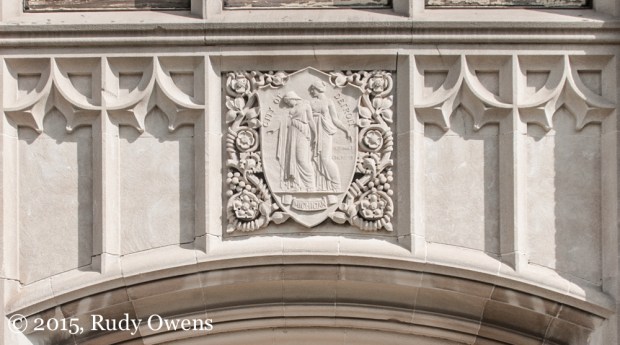
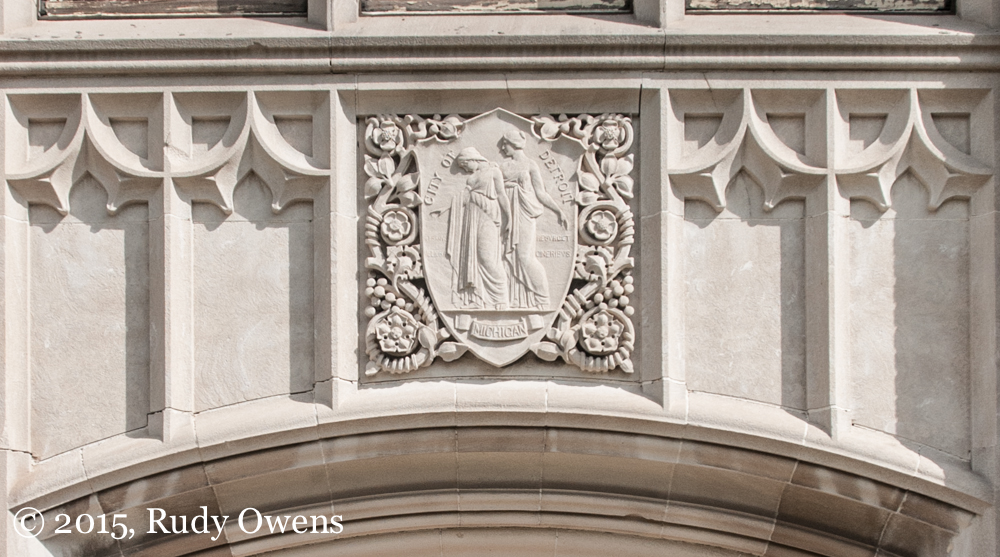
Seal of the City of Detroit on the front of the now closed building

Seal of the City of Detroit on the School Entrance

As recently at 2011-12, the Detroit Public Schools released an annual report on Crockett, noting, “Crockett High School made adequate yearly progress (AYP) in the tested subjects (mathematics, reading, science).” The same report noted, “Parents and community members are an integral part of the school program at Crockett High School. Parents and community members are included in decision making at the school levels through their involvement on committees and special programs. The Local School Community Organization (L.S.C.O.), provides programming for parents/guardians and the entire community.”

Another high school, Finney, also was slated to closed, and students from there and Crockett were to be sent to a new $46.5-million East English Village Preparatory Academy being constructed on the former Finney site. Meanwhile, the DPS allowed Crockett to fall into total disarray and be gutted and destroyed by scrappers.

I spoke to two guys working on a car across the street from Crockett, who told me this story. They noted that the DPS police did nothing to stop the scrappers once the schools alarm system failed. First the scrappers busted the windows and ripped out the metal. Then they went to work on the interior. One of the men, who said he had lived on that corner much of his life, said he even tried to follow the criminal scrapper and his accomplice once. His calls went unanswered by the school district, he said, and the scrappers did their destruction mostly at night.

I casually walked around the school. It was easy to enter it. I jumped in a window. I couldn’t believe what I saw. Perfectly good school furniture was left to rot in the elements. Science labs were ripped apart. The structure of the building, however, looked perfectly sound, appearing better than public schools I attended growing up and have seen elsewhere in the country. The neighbors I met with said the school had even been recently fitted with high-speed internet connections to promote a science and technology curriculum.

It reminded me eerily of the film Children of Men, in a future world where humans are sterile and are unable to reproduce, and schools are left to rot without children to fill them. Crockett was one of the saddest things I saw in Detroit. In nearly any other major American city, such a situation would provoke outrage and activism. Here, no one seemed to care. Meanwhile, the DPS–whose motto is “see it, believe it”–is looking for a buyer for a school it decided it could not even protect. And another piece of Detroit slides into decay, without much fanfare to accompany the fall.

A garden in the rough, and I mean rough

The urban gardening scene in Detroit has been making waves for a while, far beyond the city. It has been written up in thoughtful tomes about the city–books by good authors describing the challenges of a city that painfully downsized in the last 40 years. I met a Detroiter, an African-American musician, who talked a fair bit about them too, positively and with a smile of pride. The Kellogg Foundation has made a passionate effort to improve healthy food access as well, funding gardens as a way to promote health and community.

I am glad these are happening, here and everywhere. As to whether a once and still industrial city can be transformed into an urban gardening hub in the 21st century, I find that about impossible to imagine without some corporate-run farm scheme. What I do imagine are local efforts by residents to promote community pride and good food. Gardens will never restore Detroit to its former status, and they will not create a middle class that is disappearing. They do represent a good thing, that diamond in the rough, and hope is always a good thing.

For more on Detroit’s illustrious urban garden history that precedes all urban gardening movements by a century, read up on Mayor Pingree’s Patches (great story, and history is now repeating itself).

Click on each picture to see a larger photo on a separate photo page.

Honoring those who work for a living

I have been fortunate to see how many people work around the world. I have seen flower pickers running at breakneck speed in the pre-dawn hours to their jobs in greenhouses around Kenya’s Lake Naivasha. I have met Mexican migrant farm workers in central Washington state, who pick all of the apples, cherries, and other fruits and vegetables we eat around the country. I have met the men who do the hard labor building roads and buildings in Vietnam. And there are so many more. The work I have seen humbles me in its physical intensity and also brute reality. But people have to work, to make better lives for themselves and their families. So, today, on Labor Day, a moment to honor those who have to use their bodies to eek out a living, where ever they call home.

Click on the photo to see a larger picture on a separate picture page.

Historic Lemp Brewery, in St. Louis

At the time of the St. Louis World’s Fair in 1904, the Lemp Brewing Co of St. Louis was the third largest brewery in America. Founded by a German-American entrepreneur, Adam Lemp, in the city’s south central area, the brewery proved to be an innovator up until the time of Prohibition. Family misfortunes and the Temperance movement took their toll. In response to the outlawing of booze, the Lemp facility attempted to brew a non-alcoholic beverage called Cerva, which flopped. The company could not sustain the factory operations.

In 1922, the family owners sold the complex, covering an entire city block, to the International Shoe Co. for practically nothing. The ISCO in turn finally sold the complex in 1992, leaving it without major tenants. The old brewery and factory site is considered an archtecturally and historically significant site in St. Louis, and the Lemp Hall is still used for catered events.

If you find yourself in St. Louis, a visit to Cherokee Street, which ends at the Brewery’s doorstep, is well worth your time. I lived nearly two decades in St. Louis and knew nothing about this place until I came back recently. Proves to me how ignorant I was as a teen and how wonderful older American cities can be if you bother to spend time exploring.

For the brew historians among you, and there are many I think, here are some interesting anecdotes:

  • Lemp brewed the first successful lager beer in the United States.
  • Lemp used natural underground caves in St. Louis to allow its beer to ferment and produce a superior product.
  • Lemp was the first shipping brewery to establish a national shipping strategy.
  • It was the first brewery to run its own railroad, the Western Cable Railway Company, that connected all of the plant’s main buildings to shipping yards near the Mississippi River.
  • The mansion of the Lemp Family is included on many haunted homes and buildings lists, if you believe in ghosts.

A wonderful documentary that does not use a distorted fisheye lens, like a GoPro I used here, can be found on the Built St. Louis web site.

Swan Island and downtown Portland

One of my favorite views of Portland is from the overlook along North Willamette Boulevard, looking at the Swan Island shipyards to downtown Portland. It is always worthwhile checking what ships are getting work here. This shipyard keeps our economy ticking, and to date we have not found a way to outsource the jobs and industry to Indonesia or Brazil, but I know people are working hard to do that. I want this shipyard to stay.