Architecture

The former ‘King of Beers’

My photographic safaris in my former home town of St. Louis inevitably lead to beer. You cannot tell the story or show the story of St. Louis without focusing on the suds that made the city a world-famous beer epicenter.

As I have published on this blog before, St. Louis became the leading center of American brewing. German-American families became the barons of the new American industry that brought beer to the masses. The Anheuser-Busch dynasty conquered the local market and then the country, producing brands like Budweiser and Busch that were both bland and iconic at the same time.

The Anheuser-Busch complex occupies several city blocks, in the southeast corner of the city, overlooking the mighty Mississippi River. Globalization finally brought the King of Beers to its knees.

Anheuser-Busch became a lowly American subsidiary in 2008 to the Belgium brewing conglomerate InBev, which turned to massive debt financing to acquire the American industrial icon for $52 billion. The sale generated allegations from locals of “traitor” toward billionaire investor Warren Buffet.

The plot thickened in September 2016, when shareholders approved the $104 billion merger of Anheuser-Busch Inbev and SABMiller, another global beer conglomerate, based in London. The announcement was followed by reports of job cuts. The earlier merger had led to nearly 2,000 job cuts in the St. Louis facility between 2011 and 2016, according to local news reports.

Looking at this beautiful industrial facility, sculpted in classic St. Louis brick by great craftsmen, I see a great American business that helped create this city. Now I feel both nostalgia and sadness knowing that this uniquely American corporation has turned into a satellite facility of a company that knows nothing about the city or people who made the brand famous.

Yup, there is a tear in my beer, and I’m crying for you dear.

‘The Hill’ neighborhood of St. Louis

The Hill is one of St. Louis’ most sturdy working-class neighborhoods. It has maintained its Italian roots over many decades, even when ties to the mother country are now fading with time. The Hill‘s two most famous sons are baseball legends Joe Garagiola and the inimitable Yogi Berra. The two grew up on the same street and are celebrated as heroes, like so many other great St. Louis natives who went away.

Bisected by Interstate 44, which barreled through and destroyed many of St. Louis’ historic neighborhoods, the plucky Hill persevered, thanks primarily to its famous eateries. It is located just south of Forest Park and west of the Missouri Botanical Gardens. Compared to other historic St. Louis neighborhoods, it is a much lower-income area, without the elegant brick architecture and stately homes and churches that define classic late 1800s and early 1900s St. Louis. Instead it offers shotgun housing and walkable blocks that are carefully branded with the The Hill moniker and Italy’s national colors. It truly is a model in effective branding and identity building. The Hill also is typical of the racial divide in the city–this neighborhood is white in a city that has long promoted segregated neighborhoods.

I remember first coming here in the early 1970s for Italian celebrations with my family as a kid. I recall a lot of drunk St. Louisans eating food on a typically hot St. Louis summer day. It did not feel that special to me. In high school, my mother bought me a hero sandwich from one of the delis as a special birthday treat. It was delicious. I would occasionally visit the local stores with my mom over the years to buy Italian spices. I have even celebrated a wedding dinner at one of the classic family eateries. I am glad it keeps up its plucky ways.

In a city with so many historic and amazing sights, I probably would not put it in my top five places to visit, mainly because the competition is fierce in that city. But I would swing through if I had a weekend. The Hill is conveniently located, and you might enjoy a nice meal here as well. Buon appetito, amico.

Revisiting an abandoned Detroit public school

(Click on each photo to see a larger picture on a separate picture page.)

A year ago, in September 2015, I visited my birth city, Detroit. I saw things I could not imagine were possible in the supposedly most powerful country in the world. I toured the city and observed impoverished neighborhoods, shuttered factories, empty homes in every corner of the community, and the omnipresent ruins from arson that have made the Motor City the arson capital of the United States. Detroit had a surreal feel. I called it City of the Future and published several photo essays and a photo gallery on my web site. The most memorable and heart-wrenching place I visited was the now shuttered Crockett Technical High School, at the corner of St. Cyril and Georgia Street.

The trashed and gutted Crockett Technical High School was listed for sale in September 2015 by the Detroit Public Schools, which failed in every sense to protect the school from destruction by scrappers and vandals.

The trashed and gutted Crockett Technical High School was listed for sale in September 2015 by the Detroit Public Schools, which failed in every sense to protect the school from destruction by scrappers and vandals.

In my last photo essay on this gutted and neglected facility of learning, I recounted that Detroit Public Schools (DPS) recently had implemented a painful round of massive school closures, carried out by DPS emergency manager Roy Roberts. In sum, 16 school buildings were closed permanently. In the previous decade, enrollment in the system had fallen 100,000 students, and by 2012-13, enrollment was about a third of what it was a decade earlier.

What I learned during my visit to Crockett from two friendly neighbors who were across the street would have been intolerable in nearly any other major U.S. city. I wrote in my September 2015 photo essay, “They noted that the DPS police did nothing to stop the scrappers once the schools alarm system failed. First the scrappers busted the windows and ripped out the metal. Then they went to work on the interior. One of the men, who said he had lived on that corner much of his life, said he even tried to follow the criminal scrapper and his accomplice once. His calls went unanswered by the school district, he said, and the scrappers did their destruction mostly at night.” The tragedy was compounded, according to one of the neighbors, because the school had been recently fitted with high-speed internet connections to promote a science and technology curriculum.

When I jumped into the old school, I saw newly built science labs completely trashed, eerily similar to how ISIS extremists would destroy monuments of culture and civilization in Iraq and Syria. But in Detroit’s case, the vandals were not crazed religious radicals, they were local residents, scavenging for scrap and destroying either for pleasure, anger, or both.

You can watch this June 2015 Detroit area news report on the scrapping at Crockett–all caught on live footage, with impunity. As one resident trying to protect abandoned public schools said, “How we can we hold off scrappers when we don’t have a license to arrest.”

Today, the DPS is rated the worst in the nation for test scores. In May 2016 The Atlantic reported, “… the country has probably never witnessed an education crisis quite like Detroit’s.” And, then to no one’s surprise and certainly not to anyone in Detroit, no one really gave a crap. What happens in Detroit no longer seems to matter, no matter how awful and absurd.

After my trip to Detroit, I spent about four months trying to get respected Portland universities to host a lecture and photo show (click on the link to see how I presented the concept) on the decline of Detroit and how it looked in 2015. I was turned down by Portland State University, my alma mater Reed College, the University of Portland, and the Multnomah County Library. I made repeated requests to multiple faculty and these organizations.

The topic may just be too depressing or impossible to comprehend. Even worse, the story about mostly black Detroit and its current woes, like the simple destruction of one fine public schools by the community itself, did not fit a narrative of race that is preferred many people at this time. A dominant narrative will always defeat an alternative story, particularly one that is rooted in ugly reality. I suspect this yawning disinterest was a combination of all of these factors.

To accept the reality of what Detroit is requires confronting painful issues about the United States that have not been addressed by our national political system. What we see instead are two candidates vying for the presidency who have used Detroit as a prop and photo-op to tell an economic story that does not resonate with the lives of people struggling in the city. Those two candidates, Donald Trump and Hillary Clinton, know little to nothing about the ordinary people in Detroit and have never stepped into any neighborhood where schools are abandoned, houses are burned, and blocks have gone feral. If one day one of them or any presidential candidate actually visit a place like Crockett, then I will retract this judgement

But let’s be honest. No one running for the nation’s highest office will ever see or want to see the real Detroit.

Note, I published the same essay on my I Wonder and Wander policy blog on Sept. 30, 2016.

Scenes from bike adventures in urban Portland

Portland, Oregon has a lot of urban rides. Many will take you by jammed freeways, grain elevators, a working port, a refinery, and over and under bridges. I took these photos over the last three months. There is not a grand unifying theme other than the impression of what one sees when you get out of your car and on two wheels.

(Click on each photograph to see a larger picture on a separate picture page.)

Historic monasteries of Egypt and challenges that face Egypt’s Copts

In 2004, I visited Egypt. This was a dream come true. There is so much history in that land, one cannot appreciate its diversity in just one visit.

My trips usually focus on projects and themes. On this trip, I wanted to explore Coptic and Christian monasteries, having recently seen and visited monasteries in the Occupied West Bank and Turkey a few years earlier. I also was influenced by William Dalrymple’s superb travel and history narrative of the monasteries and Christians of the Mideast called From the Holy Mountain.

On this trip I visited the historic Coptic Egyptian monasteries of: Bishoi and Suriani near Cairo, St. Anthony and St. Paul near the Red Sea (only made it to the entrance of St. Paul), the long-abandoned St. Simeon near Aswan, and St. Tawdros Monastery near Luxor. I also visited and stayed at St. Catherine’s Monastery, the Greek Orthodox monastery founded during the reign of the Byzantine Empire and sacred to Jews, Moslems, and Christians. Some are 1,600 years old, and all but one of those seen here is still functional today.

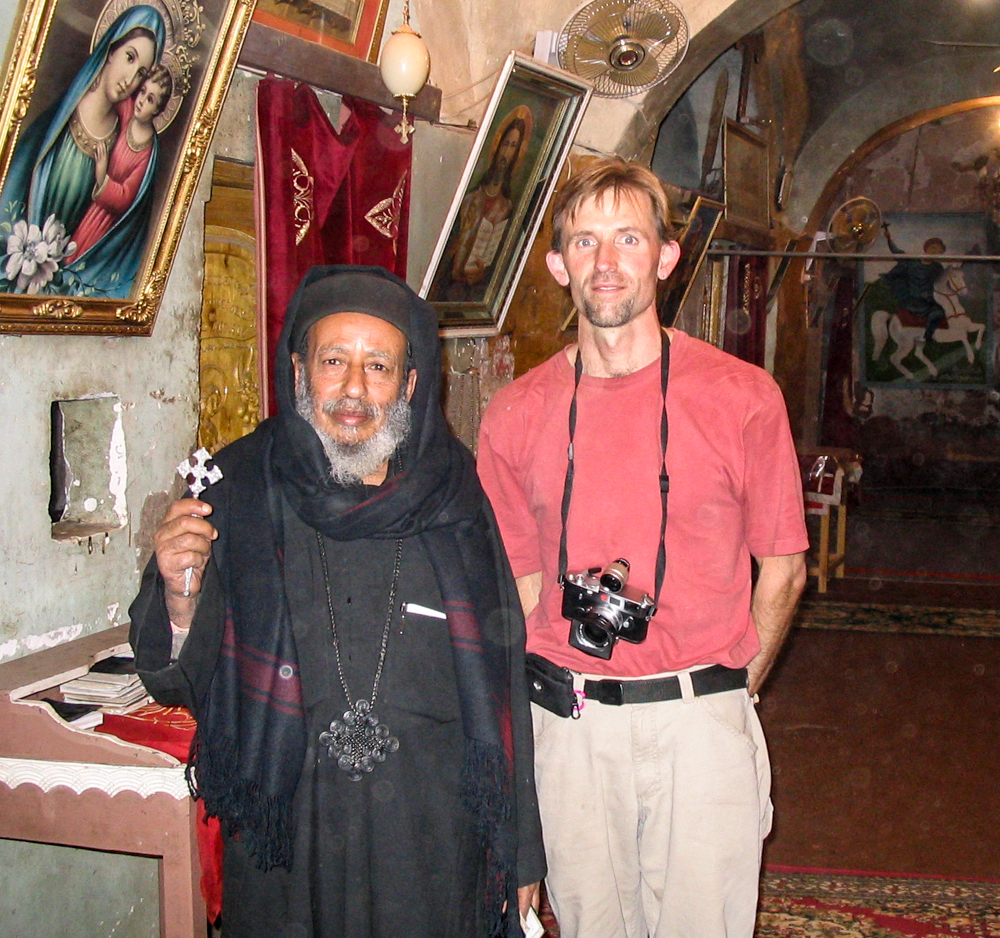
My host at St. Tawdros Monastery gave me a tour of the historic site, just outside of Luxor. My visit required the permission of the local security detail, who also joined me. This was one of several times Egypt's security forces went out of their way to both help me and perhaps ensure I did not do anything suspcious. This visit was one of my highlights.

My host at St. Tawdros Monastery gave me a tour of the historic site, just outside of Luxor. My visit required the permission of the chief for the local security detail, who also joined me. This was one of several times Egypt’s security forces went out of their way to both help me and perhaps ensure I did not do anything suspcious. This visit was one of my highlights.

Visiting the monastery in Luxor required official approval of the head of local security. It was a tense time at any Christian site, and across the country it got worse after my trip. There were terrorist attacks on Copts before the start of the Arab Spring, when military protection of Christian sites began to melt away. Copts, one of the world’s oldest Christian sects, faced and still face systematic discrimination by the Moslem-dominated Egyptian government. This only became worse with the fall of the Mubarak dictatorship, (Read my essay on the persecution of Copts in modern Egypt.)

Still, everything about my 2004 trip was memorable—from meeting with Coptic monks to seeing pilgrims from Africa, South Korea, and other locations file through St. Catherine’s Monastery in the Sinai, where Moses reportedly found the burning bush. While getting to each of these places proved dangerous, difficult, and expensive, I was rewarded by having a deeper appreciation of Christianity’s monastic traditions that represent some of the best elements of the faith that remain very much alive today.

You can read a history of Egypt’s ancient monasteries and Christian monasticism in Egypt in Michael McClellan’s book: Monasticism in Egypt: Images and Words of the Desert Fathers. There are also some wonderful historic photographs of monastic life from the first decades of the 20th century on this  blog published by Diana Buja. You can also buy Gawdat Gabra’s Coptic Monasteries: Egypt’s Monastic Art and Architecture.

Sometimes, it is all about ‘right place, right time’

I have taken thousands of pictures with my point and shoot Canon PowerShot A2000 camera. I originally bought it after my last camera died in Indonesia in 2009. It is still working like a champ. I often can get great pictures with that never required anything more than me pointing and shooting. What mattered was the moment and knowing that the moment was telling me to capture it forever. This is one such shot I took at the base of St. John’s Bridge in Portland a few days ago. It has no meaning beyond being a moment, and a rendering of form and design, but in the most simple terms through that of a child. I love it, actually.

A City of Catholic Saints and Churches

Scene above: The world-famous King St. Louis IX statue on Art Hill in Forest Park, Sts. Peter and Paul Church, St. Anthony of Padua Church. Click on each picture to see a larger photo on a separate picture page.

St. Louis’ namesake comes from French King Louis IX, one of France’s few pious rulers who ruled in the 13th century and died in 1270. The city’s European origins can be traced to French traders on the Mississippi River. One, Pierre LaClede, gave the trading post its name after the revered ruler 252 years ago. That name stuck, and the city of St. Louis was born (on ground inhabited for thousands of years by Native Americans).

The city’s name also helped to attract many Catholic European immigrants, from Italians to Germans to Irish. Many of the city’s strongest and most powerful education and social institutions, from hospitals to orphanages to private schools to St. Louis University, were also founded by Catholics. The Archdiocese of St. Louis virtually runs the city’s homelessness programs and non-profit social service sector.

For a visitor to St. Louis, one of first things one sees are brilliant and beautiful church spires rising tall above old neighborhoods. These institutions still play a vital role in many depressed areas of the fading, formerly great industrial city. Every time I visit my family in neighboring University City, I always take a tour and rediscover this amazing legacy. I still am dazzled by the skill and confidence with which St. Louis’ earlier residents built their community purposefully, to live up to the city’s name.


North St. Louis, a gentrification-free zone

(Click on each photo to see a larger picture on separate picture page.)

I recently visited St. Louis, to see my family. I normally use my visits to tour historic sections of the once proud and fourth-largest U.S. city in the late 1800s. But those are the long-gone glory days.

Today, the city is struggling to define itself in the post-NAFTA, post-industrial reality of the “new economy” that has led to the greatest level of income inequality the nation has seen since before the Great Depression.

The pain and fragments of this change are visible everywhere in the city, mainly in the form of shuttered factories and feral and abandoned houses that almost give Detroit a run its money as the epicenter of U.S. urban decay. They are most pronounced on the city’s north side, historically the racially demarcated home to the city’s poorer African-American residents for more than eight decades. That is the story I went out to photograph this trip, in June 2016.

Love can be in short supply in north St. Louis.

Love can be in short supply in north St. Louis.

St. Louis experienced what many Midwest, industrial cities confronted during and after World War II. The U.S Interstate System promoted out-migration to the surrounding county. White flight rapidly accelerated population losses following the 1950s. (See a superb illustration of that white flight here: http://mappingdecline.lib.uiowa.edu/map/.) The population dropped from 880,000 residents at the start of the 1950s to a mere 315,000 souls in 2015, according to the most recent U.S. Census Bureau estimate.

Industry, including automobile manufacturing and other sectors, began a long slide to obsolescence. St. Louis and the surrounding region were once major players in automobile manufacturing and home to several “Big Three” plants: one Ford, two Chrysler, and one General Motors. The city’s world-famous Corvette plant closed its doors in 1981 after a 37-year run. At its peak it had a payroll of more than 13,000 employees. Since then, Ford shuttered its plant in nearby Hazlewood in 2006, and Chrysler closed two plants between 2008 and 2009 (north and south plants), costing the region about $15 billion, according to one study. (GM still has an assembly plant 40 miles from St. Louis in Wentzville.)

I wanted to see first hand how things look on the city’s infamous north side, or “home” as it is known to its residents. It had been years since I did such a trip. I was startled by the lack of businesses except gas stations, beauty shops, food and restaurant establishments, and garages.

I met a sixty-something man on a street just off Vandeventer Avenue and North Market Street. He told me he had worked for Chrysler until being laid off in 2009, when the Fenton plant was shuttered for good, before the factory was razed to the ground. A grandfather, he called himself T-Bone, and had just purchased his two-story brick home for $24,000. He hoped to acquire two adjacent lots through a process that allows property owners adjacent to vacated lots to acquire those lots at no cost after three years of maintenance. He told me he wanted to become more engaged in local politics to help restore his section of the city. He lived two houses down to a boarded up, abandoned home, one of several on his block.
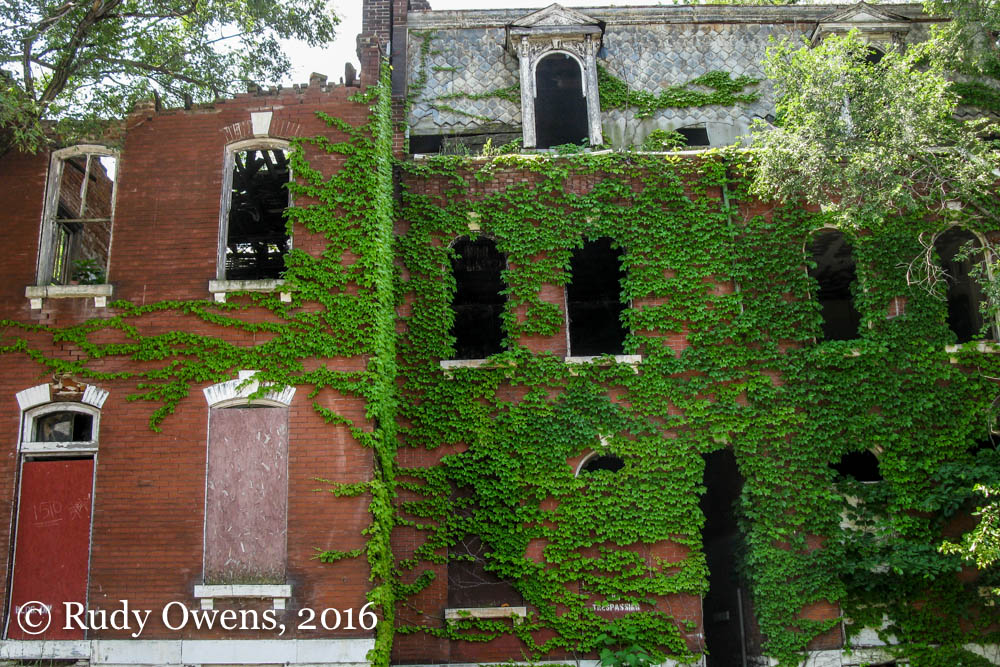
Beautiful old brick homes have long gone feral in the economically challenged neighborhoods of north St. Louis.

Beautiful old brick homes have long gone feral in the economically challenged neighborhoods of north St. Louis.

Today, more than one in four St. Louis residents live in poverty. The U.S. census puts the median household income in the Gateway City at $35,000, well below the U.S. average of $53,000. Racially, the city is as divided as ever with blacks and whites evenly divided, and now Hispanics and Latinos numbering (officially) under 5 percent.

All of these numbers mean that the city, and its poorest residents, are struggling. That struggle can be seen on just about every block north of Delmar Avenue, all the way to the city’s borders with adjacent and also struggling municipalities like Jennings. Anyone visiting the city should soak its charms—the Gateway Arch, the amazing churches, the historic downtown, and especially charming and historic Lafayette Square.

Then they should take a drive for an hour or two and see what life in the new urban, post-industrial America looks like. Gentrification is not a problem that is displacing residents in the city’s north side. No urban, yuppie, or tattoo-covered and scrappy millennial pioneers from the affluent suburbs are rushing to create art centers or startups in old factories sites. This is the place people leave if they can.

This is not Portland, Seattle, or Boston. This is a much tougher, more violent, and grittier place. It is also in many ways a more friendly place too, where people will still say hello if you have street cred and give them respect. This is St. Louis, and the recovery, if it comes, is still a long ways off. Without long-parted industry, that future is still not certain.

Industrial architectural icons of St. Louis

St. Louis has more than its magnificent Gateway Arch to showcase the city’s rich industrial and economic past. During my recent visit, I caught a few of the city’s most iconic structures: the old Falstaff Beer plant in North St. Louis, the Union Electric Company energy plant in the city’s industrial riverfront, and the massive grain silo facility in central St. Louis, now owned by the Ray-Carroll County Grain Growers Inc. cooperative.

Click on each photo to see a larger picture on a separate picture page.

St. John’s Bridge, Icon of the Northwest

(Click on each photograph to see a larger picture on a separate picture page.)

St. John’s Bridge in Portland is one of the most recognized icons in the region. It was built using local dollars at the height of the Depression, taking two years to build. The steel suspension bridge connects the Northwest and Northeast quadrants of the city. Its towering Gothic inspired towers create a feeling of awe. When it opened, apparently elephants walked across it (if one is to believe the information posted in the park below).

It is showing real signs of decay too, with its concrete foundations crumbling in plain view. Cathedral Park at its base on the northeast side of the Willamette River is an ever popular destination for residents. Everyone always seems to marvel at the design.

The base of the bridge was once home to the region’s Native Americans, who lived on the river banks, harvesting the river’s bounty. Most of the region’s Native residents perished during the 1800s due to the apocalyptic impact of communicable disease and malaria introduced with the arrival of European and American travellers and settlers.