I have been coming to Cannon Beach now for more than three decades. It always leaves me calm and in awe of the beauty of the Oregon Coast and the magnificent Pacific Ocean. I took every one of these photos was a consumer-grad point and shoot, and still I captured that Cannon Beach magic. (Click on each photograph to see a larger picture on a separate picture page.)
Photography
Historic monasteries of Egypt and challenges that face Egypt’s Copts
In 2004, I visited Egypt. This was a dream come true. There is so much history in that land, one cannot appreciate its diversity in just one visit.
My trips usually focus on projects and themes. On this trip, I wanted to explore Coptic and Christian monasteries, having recently seen and visited monasteries in the Occupied West Bank and Turkey a few years earlier. I also was influenced by William Dalrymple’s superb travel and history narrative of the monasteries and Christians of the Mideast called From the Holy Mountain.
On this trip I visited the historic Coptic Egyptian monasteries of: Bishoi and Suriani near Cairo, St. Anthony and St. Paul near the Red Sea (only made it to the entrance of St. Paul), the long-abandoned St. Simeon near Aswan, and St. Tawdros Monastery near Luxor. I also visited and stayed at St. Catherine’s Monastery, the Greek Orthodox monastery founded during the reign of the Byzantine Empire and sacred to Jews, Moslems, and Christians. Some are 1,600 years old, and all but one of those seen here is still functional today.

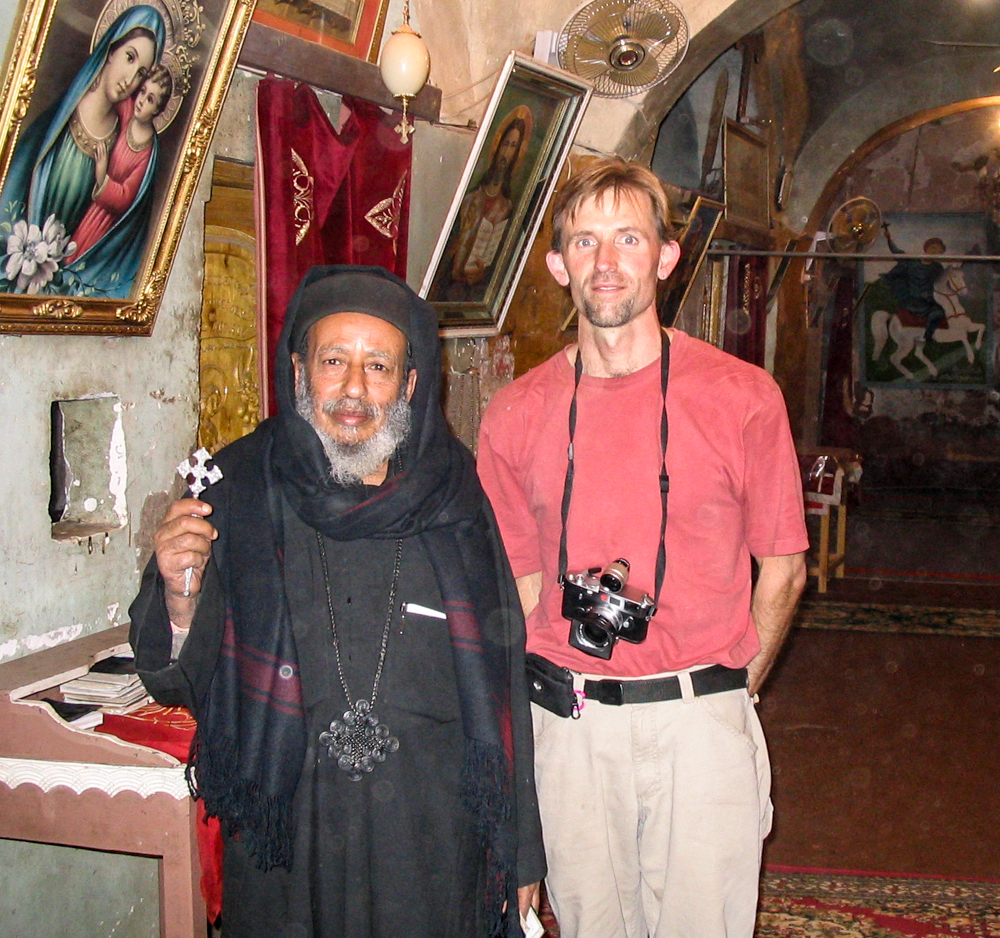
My host at St. Tawdros Monastery gave me a tour of the historic site, just outside of Luxor. My visit required the permission of the chief for the local security detail, who also joined me. This was one of several times Egypt’s security forces went out of their way to both help me and perhaps ensure I did not do anything suspcious. This visit was one of my highlights.
Visiting the monastery in Luxor required official approval of the head of local security. It was a tense time at any Christian site, and across the country it got worse after my trip. There were terrorist attacks on Copts before the start of the Arab Spring, when military protection of Christian sites began to melt away. Copts, one of the world’s oldest Christian sects, faced and still face systematic discrimination by the Moslem-dominated Egyptian government. This only became worse with the fall of the Mubarak dictatorship, (Read my essay on the persecution of Copts in modern Egypt.)
Still, everything about my 2004 trip was memorable—from meeting with Coptic monks to seeing pilgrims from Africa, South Korea, and other locations file through St. Catherine’s Monastery in the Sinai, where Moses reportedly found the burning bush. While getting to each of these places proved dangerous, difficult, and expensive, I was rewarded by having a deeper appreciation of Christianity’s monastic traditions that represent some of the best elements of the faith that remain very much alive today.
You can read a history of Egypt’s ancient monasteries and Christian monasticism in Egypt in Michael McClellan’s book: Monasticism in Egypt: Images and Words of the Desert Fathers. There are also some wonderful historic photographs of monastic life from the first decades of the 20th century on this blog published by Diana Buja. You can also buy Gawdat Gabra’s Coptic Monasteries: Egypt’s Monastic Art and Architecture.
Warm Springs on a summer day
Eight months ago, I made a quick stop in the Warm Springs Indian Reservation, about two hours east of Portland. The reservation, managed by the Confederated Tribes of Warm Springs, is bisected by Highway 26, which stretches from Mt. Hood to central Oregon. Mountain forests give way to the high desert as one passes to the reservation’s main hub, Warm Springs. You’ll find the local casino and beautiful cultural center. Almost no one stops to see the community.
I did a drive through. I found quite a few houses in somewhat run-down condition, which is not unusual in rural areas of the West. The reservation also has what I consider to be classical reservation architecture. I have seen similar designs in Washington State, Montana. Alaska, and Kansas. There is a school, administrative buildings, and older government buildings that are now shuttered and closed. This is the older part of the community. The modern health center is found further away from the highway. You can read my old post to see the controversy that has roiled the reservation and its members concerning the alleged overspending of nearly $100 million in funds in the last 10 years.
I stopped on the highway to photograph the Warm Springs billboard that captures in beautiful simplicity the symbology of the tribe’s identify–a circle with four features, stretching out from the center. I have always found Native American design powerful for the references to tribal history, the earth, nature, and tribal beliefs. This is one of the best. The flag for the reservation actually shows eight tribes who make up the reservation, as well as the natural landmarks and native wildlife.
White River Tells a Story of Climate Change at Mt. Hood
The receding glaciers around the world are a clear reminder of the impact of climate change. The year 2016 is already reported to be the hottest year ever in recorded weather-keeping history.
Yesterday, I drove around that eternally beautiful volcano near Portland called Mt. Hood. The impact of climate change is quite visible in the drainage of the start of the White River, on the peak’s southeast side. It is more than a pretty picture. It is a compelling story, and it is one that is cause for great concern.
Sometimes, it is all about ‘right place, right time’
I have taken thousands of pictures with my point and shoot Canon PowerShot A2000 camera. I originally bought it after my last camera died in Indonesia in 2009. It is still working like a champ. I often can get great pictures with that never required anything more than me pointing and shooting. What mattered was the moment and knowing that the moment was telling me to capture it forever. This is one such shot I took at the base of St. John’s Bridge in Portland a few days ago. It has no meaning beyond being a moment, and a rendering of form and design, but in the most simple terms through that of a child. I love it, actually.
Fourth of July, Alaska style…ah the memories
(Click on each photo to see a larger picture on a separate picture page.)
Fourth of July is always a great time to enjoy the outdoors and the incredible nature in Alaska. Many Alaskans who live in its largest city, Anchorage, celebrate by going to Seward for the annual Mt. Marathon race. This is a 3.1-mile race, with an elevation gain of 3,022 feet, and slopes average 34 degrees. This all takes place above the breathtaking scenery of Resurrection Bay, where sea otters and orcas can be spotted from the boat and even the shore.
Up to 10,000 people will gather in the city’s historic downtown for the start and finish of the state’s most famous mountain race–and there are many mountain races. This contest is the shortest of the state’s “official” mountain races, but one of the most grueling, because of the sheer verticality of the climb and the risk of injury.
One year an older male racer who likely never should have competed went missing and his body was never recovered. Another year a man suffered brain trauma during a terrible fall near the end of the descent. So this is not a race for sissies and people who do not respect and understand the mountains. A bunch of my friends always competed, and I went a number of times during my six years living in Anchorage.
The race pictures seen here are from 2009 and 2010. The 2010 shot features the top three female runners: hometown favorite and champion Cedar Bourgeois, Olympic skier Holly Brooks. and Olympic skier Kikkan Randall. That year, Bourgeois won her sixth race in a row (tieing a course record), with a personal best of 51:48. All three of these racers are among the state’s finest athletes ever. Randall and Brooks have competed for the United States Nordic Ski Team in the Olympics.
The other pictures shown in the gallery come from the Forest Fair, a laid-back carnival and craft fair held during the Fourth of July weekend in Girdwood, the scenic town at the base of the Chugach Mountains about 45 miles from Anchorage. It celebrates its 41st year right this summer. I loved this event. The setting is unbelievably gorgeous.
Sadly, in past years, the local yahoos–and they are many, and awful–became so rowdy and engaged in so many drunken and destructive behaviors, organizers wisely shut the event down. If you go the the Greal Land (aka Alaska), don’t worry about the bears. Make a lot of noise, and you will be perfectly fine. Happy Fourth of July, Alaska!
A City of Catholic Saints and Churches
Scene above: The world-famous King St. Louis IX statue on Art Hill in Forest Park, Sts. Peter and Paul Church, St. Anthony of Padua Church. Click on each picture to see a larger photo on a separate picture page.
St. Louis’ namesake comes from French King Louis IX, one of France’s few pious rulers who ruled in the 13th century and died in 1270. The city’s European origins can be traced to French traders on the Mississippi River. One, Pierre LaClede, gave the trading post its name after the revered ruler 252 years ago. That name stuck, and the city of St. Louis was born (on ground inhabited for thousands of years by Native Americans).
The city’s name also helped to attract many Catholic European immigrants, from Italians to Germans to Irish. Many of the city’s strongest and most powerful education and social institutions, from hospitals to orphanages to private schools to St. Louis University, were also founded by Catholics. The Archdiocese of St. Louis virtually runs the city’s homelessness programs and non-profit social service sector.
For a visitor to St. Louis, one of first things one sees are brilliant and beautiful church spires rising tall above old neighborhoods. These institutions still play a vital role in many depressed areas of the fading, formerly great industrial city. Every time I visit my family in neighboring University City, I always take a tour and rediscover this amazing legacy. I still am dazzled by the skill and confidence with which St. Louis’ earlier residents built their community purposefully, to live up to the city’s name.
North St. Louis, a gentrification-free zone
(Click on each photo to see a larger picture on separate picture page.)
I recently visited St. Louis, to see my family. I normally use my visits to tour historic sections of the once proud and fourth-largest U.S. city in the late 1800s. But those are the long-gone glory days.
Today, the city is struggling to define itself in the post-NAFTA, post-industrial reality of the “new economy” that has led to the greatest level of income inequality the nation has seen since before the Great Depression.
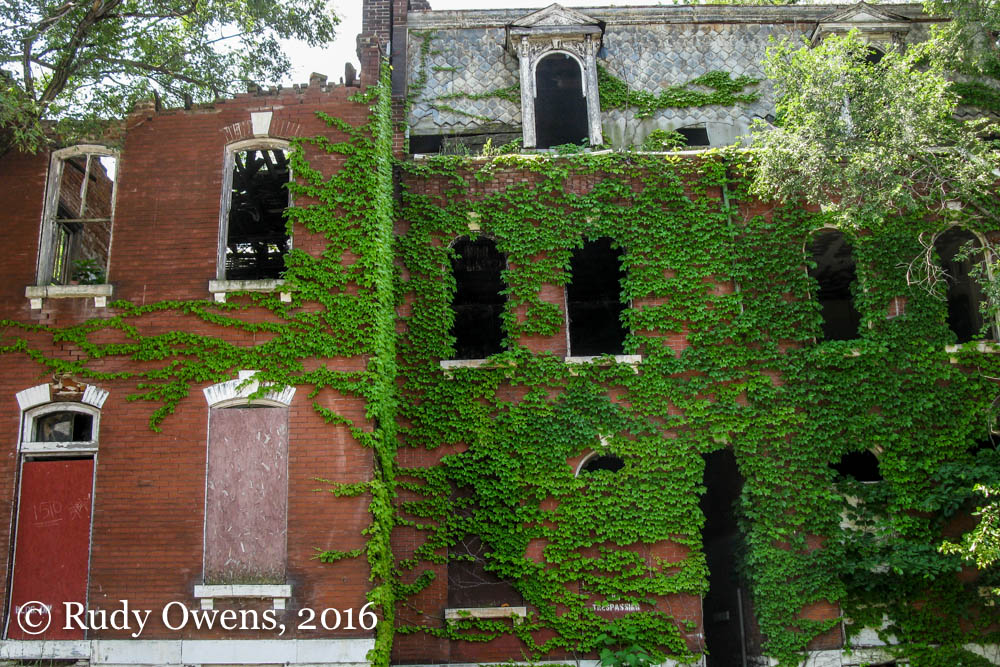
The pain and fragments of this change are visible everywhere in the city, mainly in the form of shuttered factories and feral and abandoned houses that almost give Detroit a run its money as the epicenter of U.S. urban decay. They are most pronounced on the city’s north side, historically the racially demarcated home to the city’s poorer African-American residents for more than eight decades. That is the story I went out to photograph this trip, in June 2016.
St. Louis experienced what many Midwest, industrial cities confronted during and after World War II. The U.S Interstate System promoted out-migration to the surrounding county. White flight rapidly accelerated population losses following the 1950s. (See a superb illustration of that white flight here: http://mappingdecline.lib.uiowa.edu/map/.) The population dropped from 880,000 residents at the start of the 1950s to a mere 315,000 souls in 2015, according to the most recent U.S. Census Bureau estimate.
Industry, including automobile manufacturing and other sectors, began a long slide to obsolescence. St. Louis and the surrounding region were once major players in automobile manufacturing and home to several “Big Three” plants: one Ford, two Chrysler, and one General Motors. The city’s world-famous Corvette plant closed its doors in 1981 after a 37-year run. At its peak it had a payroll of more than 13,000 employees. Since then, Ford shuttered its plant in nearby Hazlewood in 2006, and Chrysler closed two plants between 2008 and 2009 (north and south plants), costing the region about $15 billion, according to one study. (GM still has an assembly plant 40 miles from St. Louis in Wentzville.)
I wanted to see first hand how things look on the city’s infamous north side, or “home” as it is known to its residents. It had been years since I did such a trip. I was startled by the lack of businesses except gas stations, beauty shops, food and restaurant establishments, and garages.
I met a sixty-something man on a street just off Vandeventer Avenue and North Market Street. He told me he had worked for Chrysler until being laid off in 2009, when the Fenton plant was shuttered for good, before the factory was razed to the ground. A grandfather, he called himself T-Bone, and had just purchased his two-story brick home for $24,000. He hoped to acquire two adjacent lots through a process that allows property owners adjacent to vacated lots to acquire those lots at no cost after three years of maintenance. He told me he wanted to become more engaged in local politics to help restore his section of the city. He lived two houses down to a boarded up, abandoned home, one of several on his block.
Beautiful old brick homes have long gone feral in the economically challenged neighborhoods of north St. Louis.
Today, more than one in four St. Louis residents live in poverty. The U.S. census puts the median household income in the Gateway City at $35,000, well below the U.S. average of $53,000. Racially, the city is as divided as ever with blacks and whites evenly divided, and now Hispanics and Latinos numbering (officially) under 5 percent.
All of these numbers mean that the city, and its poorest residents, are struggling. That struggle can be seen on just about every block north of Delmar Avenue, all the way to the city’s borders with adjacent and also struggling municipalities like Jennings. Anyone visiting the city should soak its charms—the Gateway Arch, the amazing churches, the historic downtown, and especially charming and historic Lafayette Square.
Then they should take a drive for an hour or two and see what life in the new urban, post-industrial America looks like. Gentrification is not a problem that is displacing residents in the city’s north side. No urban, yuppie, or tattoo-covered and scrappy millennial pioneers from the affluent suburbs are rushing to create art centers or startups in old factories sites. This is the place people leave if they can.
This is not Portland, Seattle, or Boston. This is a much tougher, more violent, and grittier place. It is also in many ways a more friendly place too, where people will still say hello if you have street cred and give them respect. This is St. Louis, and the recovery, if it comes, is still a long ways off. Without long-parted industry, that future is still not certain.
Industrial architectural icons of St. Louis
St. Louis has more than its magnificent Gateway Arch to showcase the city’s rich industrial and economic past. During my recent visit, I caught a few of the city’s most iconic structures: the old Falstaff Beer plant in North St. Louis, the Union Electric Company energy plant in the city’s industrial riverfront, and the massive grain silo facility in central St. Louis, now owned by the Ray-Carroll County Grain Growers Inc. cooperative.
Click on each photo to see a larger picture on a separate picture page.
A field of strawberry dreams
Memorial Day for me now has become my strawberry picking day. Two years in a row makes a tradition. I drove to Sauvie Island, just north of Portland on the Columbia River. It has several U-pick farms. This year I picked my berries at Sauvie Island Farms.
Half of the people around me were speaking a language other than English. I heard Hindi, Cantonese, Mandarin, and Japanese. Family fruit picking clearly is popular with Portland’s East and South Asian families. Strawberries signal the end of spring and beginning of summer, and they taste so darn good.
Looking at all the little kids being pulled by their well-off moms and dads made me think of all the kids who are not that much older working in the fields with their families in our land of plenty, for up to 10 hours a day. Sometimes, it is fate of birth that separates one world from another. I am glad I never had to and do not have to do this for a living. It is incredibly hard work bending over, sorting through fruit, gently picking it one by one. Something to think about as you pick out your fruit at your local store. Someone always had to pick it.
(Click on each photo to see a larger picture on a separate picture page.)