A statue of Captain James Cook, who explored the waters known as Cook Inlet, stands on a bluff overlooking the waters where he set anchor (2010).
It was about 10 degrees below 0 (fahrenheit) when I snapped this picture at Kincaid Park’s beach, in January 2010.
In Anchorage I was amazed the ladies could still sport the heels with ice and snow, not to mention the skirts, when the mercury went south of zero. Northerners are hardy folk (2010).
I found these pictures among the many hundreds I took while living in Anchorage. These were all taken during a bitter cold spell in 2009-10, when temperatures plummeted to about minus 10 fahrenheit and colder. It was great for taking images. I remember getting some skin damage on my extremities on one outing. Now that it is spring in Seattle, I shutter to think I lived through this year after year, even with the beauty. That is my feeling today. It is one of joyous happiness.
North of Reykjavik sits a house of God, alone in the loneliness of the north Atlantic.
I visited Iceland in 1998 and did a drive around the island with an outrageously overpriced rental car. I enjoyed it, but was not overwhelmed by it. This location, about an hour north of the capital, Reykjavik, was among the most memorable spots. Here, at the edge of the world, sat an empty house of worship, battered by the wind and rain. I guess I have a fondness for remote sanctuaries. (Click on the photo for a larger image on a separate page.)
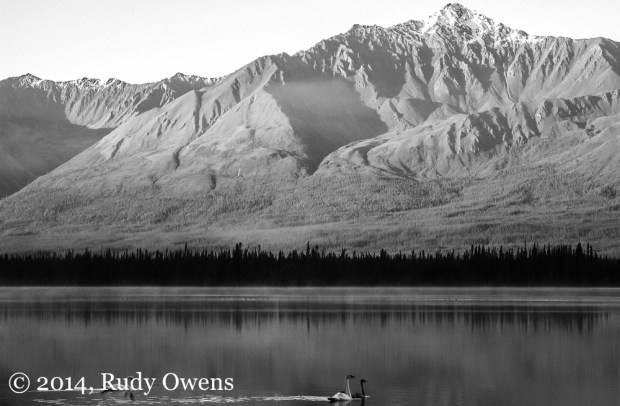
On my way out of Alaska in 2010, I had perhaps one of the most perfect days one could ask for in the North, driving down the AlCan through the Yukon Territory (2010).
In 2007, I attended the Inuit Circumpolar Conference in Barrow, which brought together the different Inuit groups, spanning the circumpolar north from Russia, to Alaska, to Canada, to Nunavut, to Greenland. The Inuit are distinct culturally, linguistically, and historically. Having traveled widely in Greenland and Alaska, this was abundantly clear in many of the ways these cultures express their identity and relation to the sea. Here are two perspectives on how closely linked Inuit culture is to its traditional hunting lifestyle, in this case hunting, killing, eating, and utilizing whales. You can also find other photos I have taken of Greenland and Alaska on my web site (www.rudyowens.com).
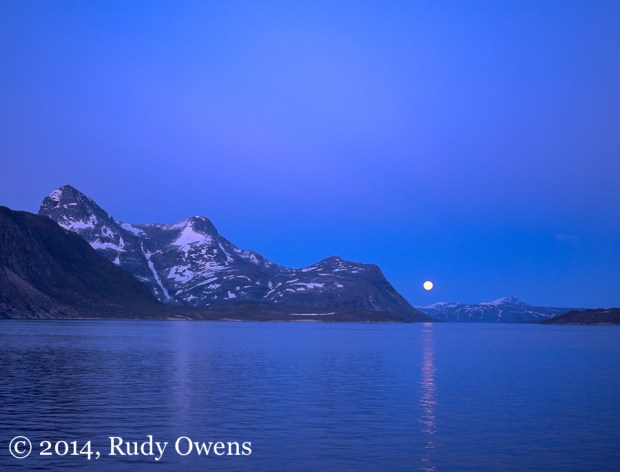
Full moon rising on a summer night near Nuuk, capital of Greenland (1998)
On my second night in Greenland, on the first of my three trips, I sat in a state of utter bliss. I watched a full moon rise over the rocky, mountainous coast of west Greenland outside the capital, Nuuk. It was around 10:30 p.m. I don’t think I have seen other natural events as serene or calm as this. More of my Greenland photos can be found on my Greenland gallery, on my web site.
I used a very low-tech Canon hand-held digital which was breaking down on this trip. Even then, it still performed like a champ. Use a few Lightroom tools, and voila, something completely different. Needless to say, I loved my time in Indonesia. These are, admittedly, touristy, but I was, admittedly, very much a happy tourist.
Balinese temple
Mosque drum (bedug), Java
Temple flower petals, Bali
Kecak performers, Ubud, Bali
Traditional Javanese classical dancers, Yogyakarta
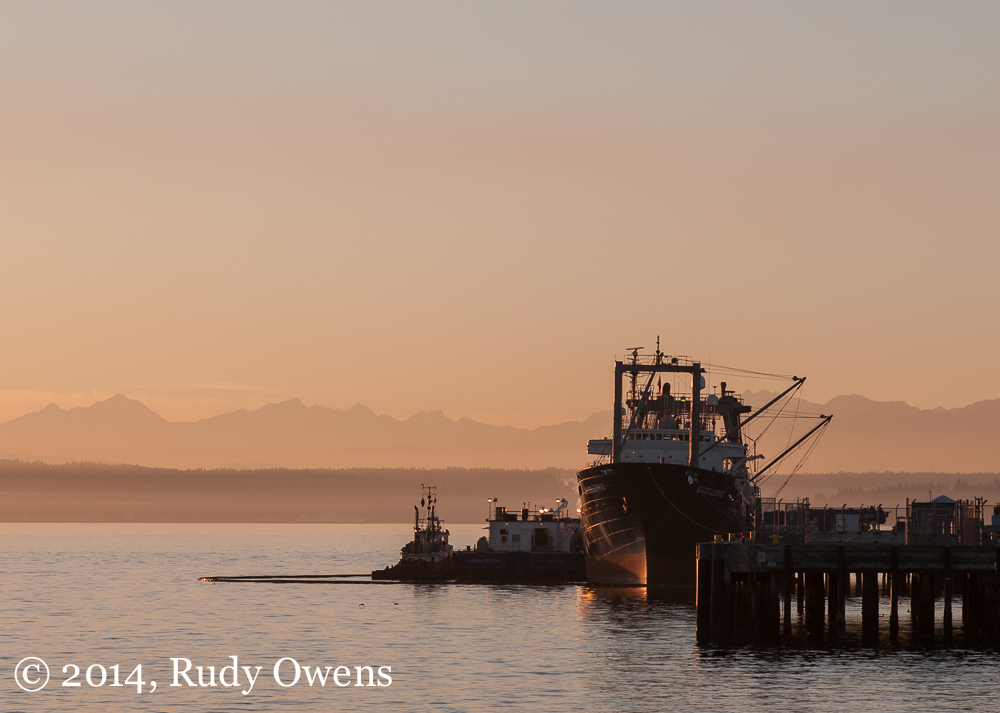
A couple of months back, I took a late afternoon photo outing to capture some industrial scenes in Seattle’s Interbay railyard and the always photogenic Elliott Bay and Puget Sound, adjacent to Seattle. More of this ongoing series can be found on my photo gallery.
BNSF Locomotives, Interbay Railyard
Pier 91 at Elliott Bay, Looking on to the Olympic Mountains
One of many grain ships filling its hull for the global market
My current expression through still photography, at this moment in time, remains heavily influenced by the highly acclaimed German photographers Bernd and Hilla Becher. The husband-wife duo (Bernd has passed on) influenced perhaps the most acclaimed and financially successful photographers of the past 20 years, through their late-in-life work at the “Dusseldorf School of Photography.” The Bernds’ now famous protégés/students include Thomas Ruff and Andres Gursky. The latter is now on record for selling the world’s most expensive photographic print.
The Bernds were deeply enmeshed in showcasing industrial forms, which they arranged later in books and exhibitions as typologies. (Please read my post about their work and their influence.) They also were telling a story of the economy of the times and the industrial West, just as at was on its downward spiral, before the rise of industrial China and India.
My most recent photographic series on Tacoma and the Duwamish River industrial area of Seattle are in some ways indebted to this thinking, about how the industrial ports of the Pacific Northwest are the lands devoted to the overwhelming power of global trade, the last vestiges of Northwest industrial activity, and the world of high-paid blue collar work that is on the verge of extinction in the United States.
Here is the first of two provocative YouTube videos on the Bechers’ work and thinking, in their own words (you can see part two after part one finishes).
I an enamored with the incredibly diverse ecosystem, economies, landscapes, and topographies of my home state, Washington. This is a compilation I put together of scenery between Winthrop, Wash., and Wenatchee, crossing the many-times-over-dammed Columbia River in mid-February 2014. I filmed this using my GoPro Hero 3, which I had affixed to the roof of my car.