In Warsaw, ghosts of World War II are all around. In July 2000, I found this one, Monument to the Fallen and Murdered in the East. It honors victims of Soviet atrocities to Polish prisoners who died in captivity in camps in the former U.S. S.R. during that insane war that only ended 70 years ago today. Seems like an appropriate day to honor the memory of ghosts. (Click on the photo to see a larger picture on a separate picture page.)
History
And then there were the ruins … 1989 and today
My recent visit to Detroit still lingers in my mind, particularly in light of some recent comments I have heard back in Portland. One person said, oh, I heard there are some innovative community gardens there. Such comments, which mean well, reveal a distressingly strong disconnect from the painful reality that still faces hundreds of thousands of residents that is beyond Detroit’s ability alone to fix. Even Mark Binelli, author of the 2012 portrayal of his ancestral home, Detroit City Is the Place to Be, does not hold punches when trying to frame the efforts to revive the city in positive light. “And then there were the ruins,” writes Binnelli of the 90,000 abandoned structures as of 2012. “When it comes to the sheer level of decay, Detroit is a singular place … .”
So it was inevitable I had to look up where my relatives once lived. What I found took the air out of my lungs. This is a home of relatives from my biological family (I am adopted) as it appeared in in 1989, when I took the picture. The home is a tract house on the city’s westside, not far from River Rouge Park. It was an OK looking neighborhood when I stopped to take the photo. I did not, perhaps thankfully, visit it during my trip. I did find the Google Maps street view, which I provide for comparison. The Wayne County Tax Assessor’s office now lists the owner as the Detroit Land Bank Authority, meaning the emptied and gutted structure is in receivership waiting to be sold at auction with thousands of other distressed properties. The value is pegged under $50,000 according to numerous real-estate web site, but I doubt anyone will live here again. It looks dead.
This is hardly anything new for residents. This was a street where working-class couples could buy into the middle-class dream, which is what my relatives did. This was before the ending of redlining that segregated African-Americans from these areas, before integration, and before upheavals of the 1960s. Then they left, as the city began its downward slide, for reasons I still do not know. Racial issues, global trade, outsourced industrial jobs, NAFTA, white flight, and more all had a part to play on this street, not to mention a host of other federal policies that transformed cities like Detroit.
What is troubling for me is to know that a public park and now-closed school are across the street. Lives were lived in this neighborhood. Lives are still lived here. And this home is now a corpse, among many in this once great city. Now when I look at abandoned homes I think of the lives of those who had all their dreams wrapped into them. This just happens to be part of my own family story. I simply want to cry.
Thousands of them a year, bro
Charlie LeDuff, author of Detroit, An American Autopsy, has provided one of the most painful descriptions of nihilistic self-destruction I have ever read. It is a brutally honest dissection of Detroit. While working as a reporter for the Detroit News, he became close to a company of the city’s beleaguered firefighters, who have battled literally thousands of fires intentionally set by criminal arsonists throughout the metro area. LeDuff shared this comment from one of the firefighters who is asked to do the near impossible–save a city the residents are intentionally burning down.
“In this town, arson is off the hook. Thousands of them a year, bro,” the firefighter told LeDuff. “In Detroit, it’s so fucking poor that a fire is cheaper than a movie. A can of gas is three-fifty, and a movie is eight bucks, and there aren’t any movie theaters left in Detroit so fuck it. They burn the empty house next door and they sit on the fucking porch with a forty, and they’re barbecuing and laughing ‘cause it’s fucking entertainment. It’s unbelievable. And the old lady living next door, she don’t have no insurance, and her house goes up in flames and she’s homeless and another fucking block dies.”
In my entire life, during which I have visited dozens of countries, I have not witnessed anything as bizarre as this. I have seen worse than this, and things vastly more evil than this. But the utter pointlessness of this chaos, besides pure anger and loss of meaning, seem overwhelming. And people live with this, next to his, surrounded by this, engulfed by this. For those of you out there who may snicker and even enjoy this, take heed. LeDuff and many other chroniclers of the downfall of the American middle-class in cities like Detroit have a message for you. Detroit is not the past. Detroit is the future, coming to a place near you, and quicker than you think.
Most of these crime scenes are in what used to be called the Delray neighborhood, near Dearborn and Jefferson, by Zug Island. Hard to imagine that people still make the best of it here. It is home to someone. I often wonder what Canadians just across the Detroit River may have thought seeing flames, if they could see the smoke amid the heavy industry that surrounds this former Hungarian-American enclave. This is now called a “ghost town” within a city.
God has left Detroit
In April, I spent a couple of eye-opening days in my home town, Detroit. I was born here. My grandparents lived here for decades. My biological family (I am adopted) grew up here on my birth mother’s side. I only lived here a year, before my adoptive parents left in 1966, a year before the deadly race riots of 1967, one of several that have spanned more than 120 years.
Photographers who parachute into Detroit, like me, are rightfully accused of being disaster voyeurs. Photographing Detroit is now its own photo genre many dub “ruin porn.” Taking pictures of a dying place, where real people are struggling just to survive, is by definition schadenfreude.
I guess I have a saving grace. I am a native son. I really was born in a hospital here. My family, on my birth mother’s side, has true Detroit roots, and for that reason I feel a strong attachment.
I wrote a short essay about my trip in April, and I find myself feeling deeply unsettled now about how the last eight years of our Great Recession have been handled and the wars that preceded it. Going to Detroit you cannot ignore the massive impact of trade policies like NAFTA and the globalization of manufacturing in the years before and after its signing, when the United States began to export its manufacturing jobs overseas.
Jeez, here we are the wealthiest country on earth, and yet we let our great industrial center literally collapse before us, all while venturing overseas to preserve our strategic interests. We all watched and let the patient wither in agony, at times laughing at the patient’s demise. Today the lethal court clown of a city titillates us with reality TV that delights in the destruction of Detroit and the goofy exploits of its charismatic preachers, reality star cops, and wacky urban survivalists.
Fort Rock State Natural Area up close and from afar
This is the second in my series of images published on the Fort Rock State Natural Area. My first set of photos were taken near the entrance to the old volcanic caldera. A reply I received from a person who is an advocate for the Fort Rock Valley Historical Society wanted to be sure I noted that the Fort Rock Homestead Village is a citizen led effort and uses donated buildings, all of which are authentic to the area. Duly noted. A museum is open to the visiting public, and it is worth a story stop too. My only regret is not having done enough research in advance and learned more about the amazing footwear found near the crater–the world’s oldest known pair of shoes, or should I say sandals. Here are a few more angles of the area, as well as the village.
Click on each photo to see a larger picture on a separate picture page.
Fort Rock State Natural Area, a sacred place
This is the first of a couple of posts I will do on Fort Rock State Natural Area (formerly park), in the high desert of south central Oregon. I wanted to show its features today from the perspective given by my GoPro, which has a unique and very wide angle perspective (and distortion).

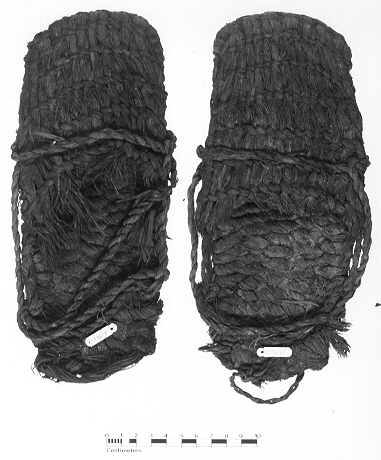
These sandals were found a mile from Fort Rock State Natural Area and are approximately 10,000 years old (photo courtesy of the University of Oregon). These sandals were found in 1938 by archaeologist Luther Cressman.
Fort Rock is a gem. It stands prominently on the floor of what was once a lake bed. The formation is an extinct volcano that blew about 1.8 million years ago. Archaeological evidence dates Native American habitation here for at least 10,000 years. A research expedition in 1938 unearthed dozens of sage bark sandals under a layer of volcanic ash about a mile from here that are carbon dated as 10,000 years old. So clearly the continent’s first peoples have been coming here for many millenia.
I felt a touch of the divine and sacred here. How can one not. Its circular formation, its prominence on a desolate landscape, its energy when one stands on the rim of the crater–all create a feeling of otherworldliness. I saw deer and jackrabbits, so clearly food could be hunted here. It is well worth a visit. The area is about 70 miles southeast of upscale retirement city Bend, and there is no entrance fee. The state has also erected a recreated historic pioneer village near the entrance.
Click on each photo to see a larger picture on a separate picture page.
Dalles Mountain Ranch
This is the final in my series of photos taken at Columbia Hills State Park, on the Columbia River Gorge, near The Dalles. This historic working ranch was deeded to the state as a vital piece of a park that stretches from the river’s edges to the ridge of the hills overlooking one of the nation’s most dramatic landscapes. Visitors can see historic petroglyphs and pictographs down below, and also drive up the hillside to the ranch, where a trailhead has been created for some outstanding open country hiking. Wildflowers are blooming now. Definitely worth a visit.
The Sistine Chapel of Native American art on the Columbia River Gorge
Native Americans, according to archaeology records, lived continuously on the banks of the Columbia River for more than 12,000 years prior to their near demise due to new diseases and the arrival of white settlers in the 1800s. Their culture thrived because of trade among tribes and the stable supply of one of the world’s most nutritious natural food sources: migrating salmon and other fish species in the Columbia River.
The many generations of Native inhabitants also left behind a legacy of artwork, in the form of petroglyphs (rock carvings) and pictographs (paintings). The latter were mostly with white paints, derived from bones, and red paints, derived from blood. The age of these pieces of art are not fully known. They can be found in the region roughly east of Hood River and eastward for the next 40 or so miles. The residents who lived here at the time Lewis and Clark made their journey in the early 1800s on the river were known as the Wishram people.
Sadly, most of the art, the paintings and rock carvings, were flooded when the U.S. Army Corps of Engineers built dams on the Columbia, flooding historic village sites that had been settled since well before the rise of ancient Rome. A number of rock art carvings were salvaged and then reassembled in 2004 for public display at Columbia Hills State Park, in Washington state, near The Dalles, Oregon. The location of the art today was once the site of a thriving Native settlement. Today, the Yakama, Umatilla, and Warm Springs bands hold ceremonies here by their ancestors’ art, which was once on their ancestors’ land.
There is no written record describing the purpose of the art. Current theories suggest the artwork provide guideposts for dream quests, connecting the people to the spirit world. Other pictures also depict elements of folk myth, the most famous painting of all, “Tsagaglalal” or She Who Watches, derived from a story about coyote and clan matriarch who was cast into the rock and stood watch over her people. (The painting is now used as the logo for the Columbia River Interpretive Center.) This is considered one of the finest examples of Native American art in all of North America.
The petroglyphs today are accessible to all for the price of admission to the state park. To see the rock art paintings in an area with limited viewing, you need to call the park in advance and sign up for a guided interpretive tour, led by a park cultural interpreter or a Native American guide. This was one of the highlights of my regional outings in the Pacific Northwest.
I would recommend this trip to anyone, of any age. You find yourself in one of the most scenic areas in North America, standing on land where countless generations stood before you.
You can see some photos of this area and its former Native inhabitants in the collection of Edward Curtis, famed photodocumentarian of Native American people (including staged photos). His work is archived on a superb Smithsonian photo media archive. Look for pictures marked “Wishham” (note spelling differences from above).
Click on each photo to see a larger picture on a separate picture page.
Jerusalem, winter morning’s light
This is one of my favorite places in the world. Despite the divisions that crash together among the believers of monotheistic faiths (Judaism, Christianity, and Islam), I felt something special here. Somehow the prejudices I saw and felt in and around Jersusalem were overcome by the feeling of the place. It’s Holy week for Christians, so I decided to did this one out of my old archive. This dates from 2004. You can see more pictures of Israel and the Occupied West Bank on my web site. (Click on the photo to see a larger picture on a separate picture page.)
Big house and the small house, and the dark history they tell
In May 2000, I took a road trip through Louisiana and Mississippi. I photographed a number of slave cabins and old plantations. My notes are buried somewhere, and one day I might dig them up. I do not recall getting the name of this old plantation home in southern Mississippi. I photographed it from the distance, from the road. If you look close, there are two cabins to the left. Those are the slave cabins. On many plantations, the “small house” stood very close to the “big house.” All of the plantation’s wealth was derived from using slave labor to grow cotton and other agricultural commodities sold to local, national, even international markets. It was a system built and sustained by the lash, as President Abraham Lincoln so eloquently referenced in his Second Inaugural Address.