
Author: Rudy Owens

I have a professional background in journalism (MA from UNC-CH), public affairs, and more recently public health (MPH, University of Washington). I publish several online properties, including my web site www.rudyowens.com. I also am an author of the first-ever memoir and public health examination of the U.S. adoption system ("You Don't Know How Lucky You Are," BFD Press, 2018).

A taste of the southwest coast of Finland

I spent two days on the southwest coast of Finland in late August 2025. My trip took me to Kimitoon, technically an island, in the region called Varsinais-Suomi, whose biggest city is the historic former capital Turku. It’s mostly rural with lots cottages and farms on the island. I then crossed over to the region Uusimaa, which includes the coastal cities of Tammisaari (also a “cottage hub” area) and Hanko. I visited both of those cities, and ended the day spending a lovely evening in Tammisaari. On my route, I stopped by the bridge connecting Kimitoon to the “mainland” by the small community of Strömma. It was raining. The fishermen were out. It was lovely.

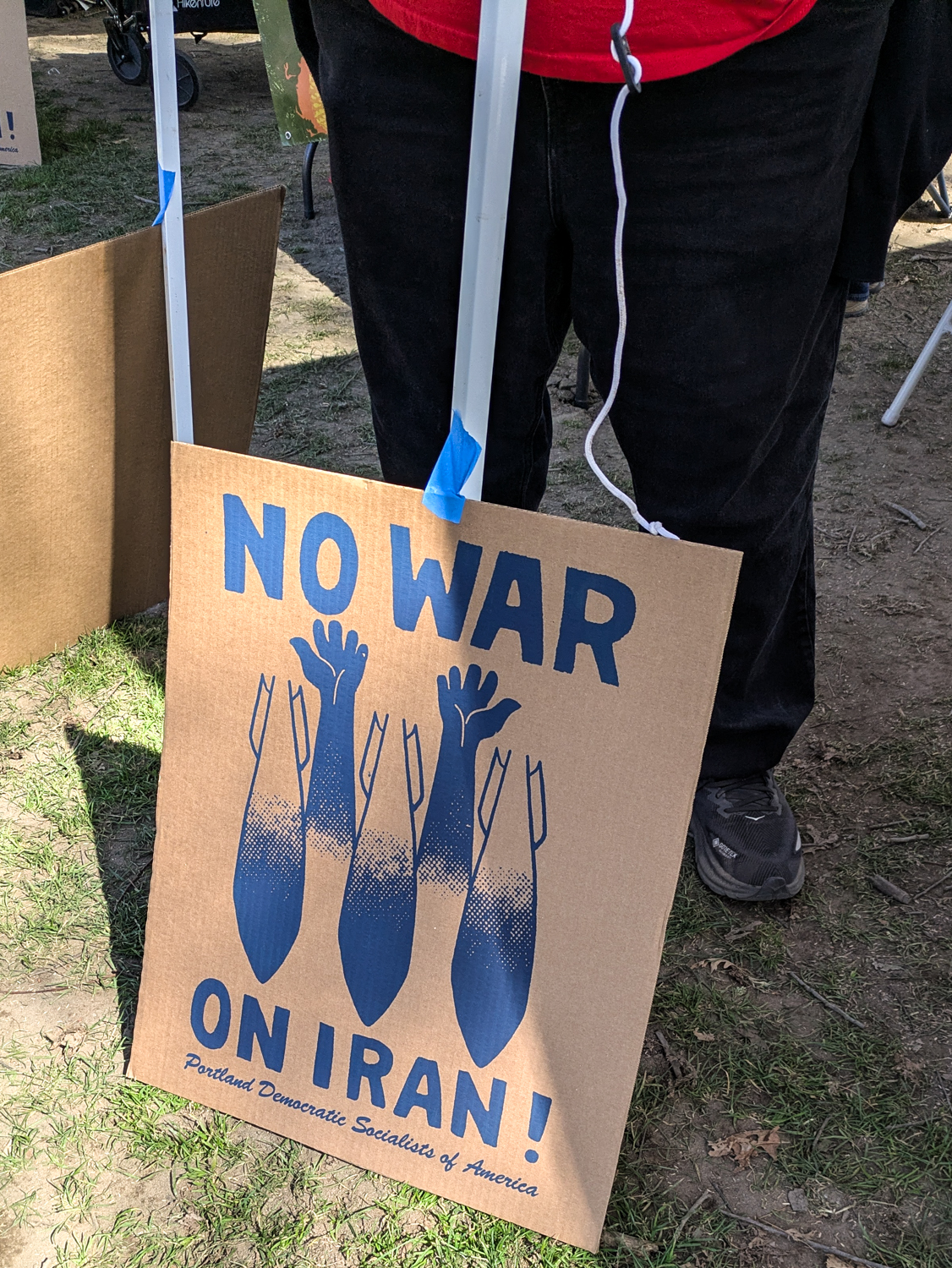
No Kings Day in Portland, a history making moment in U.S. democracy

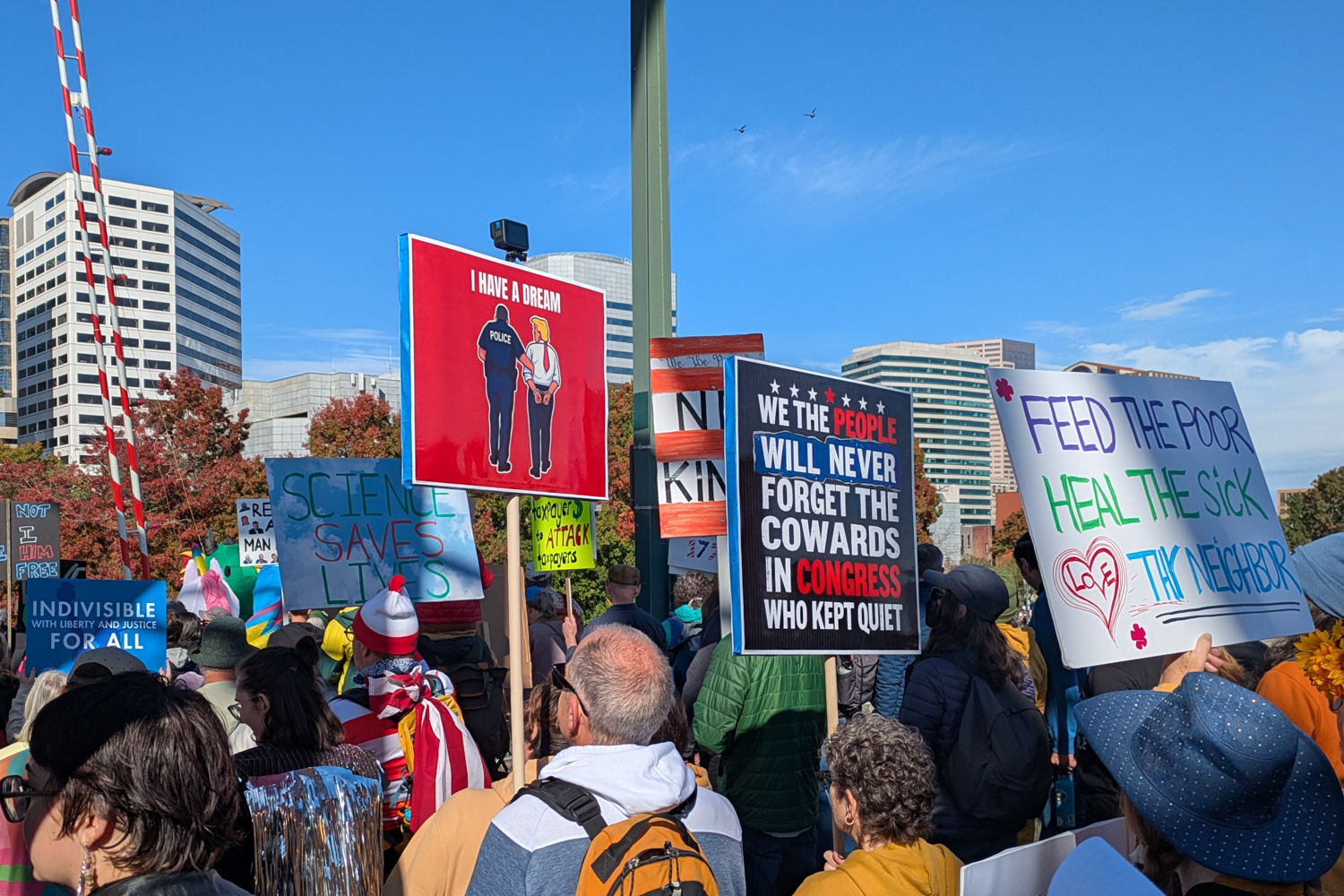
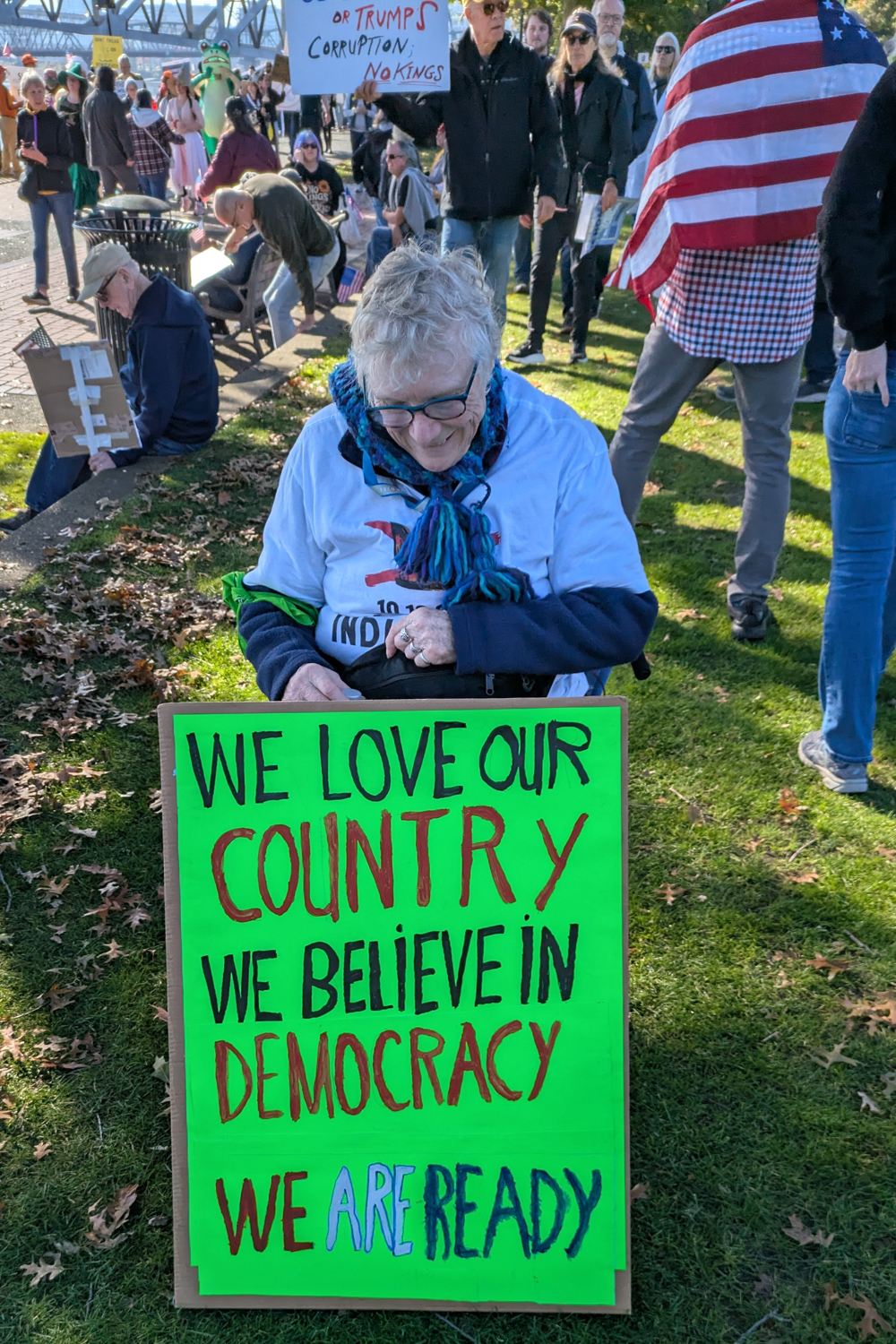
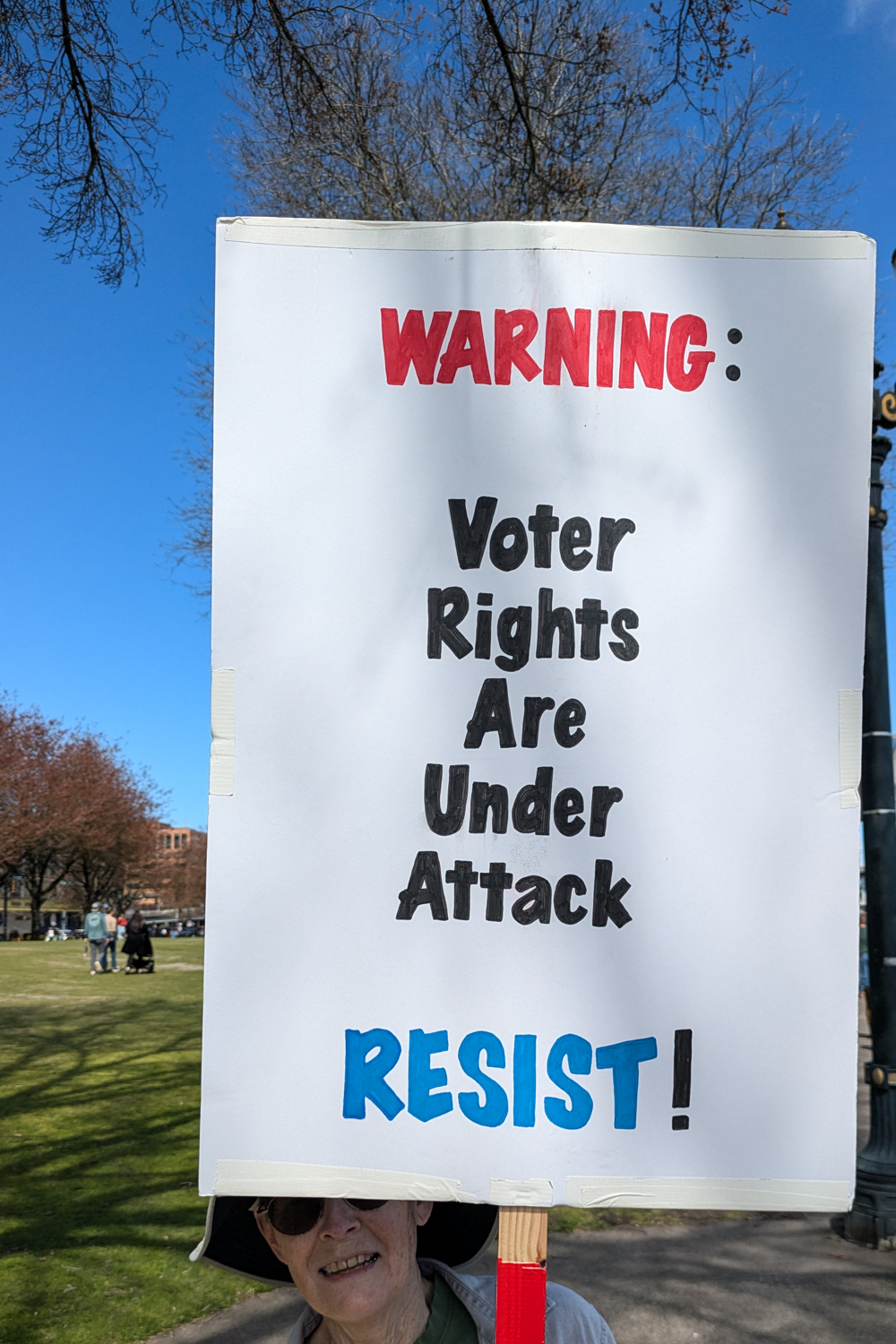
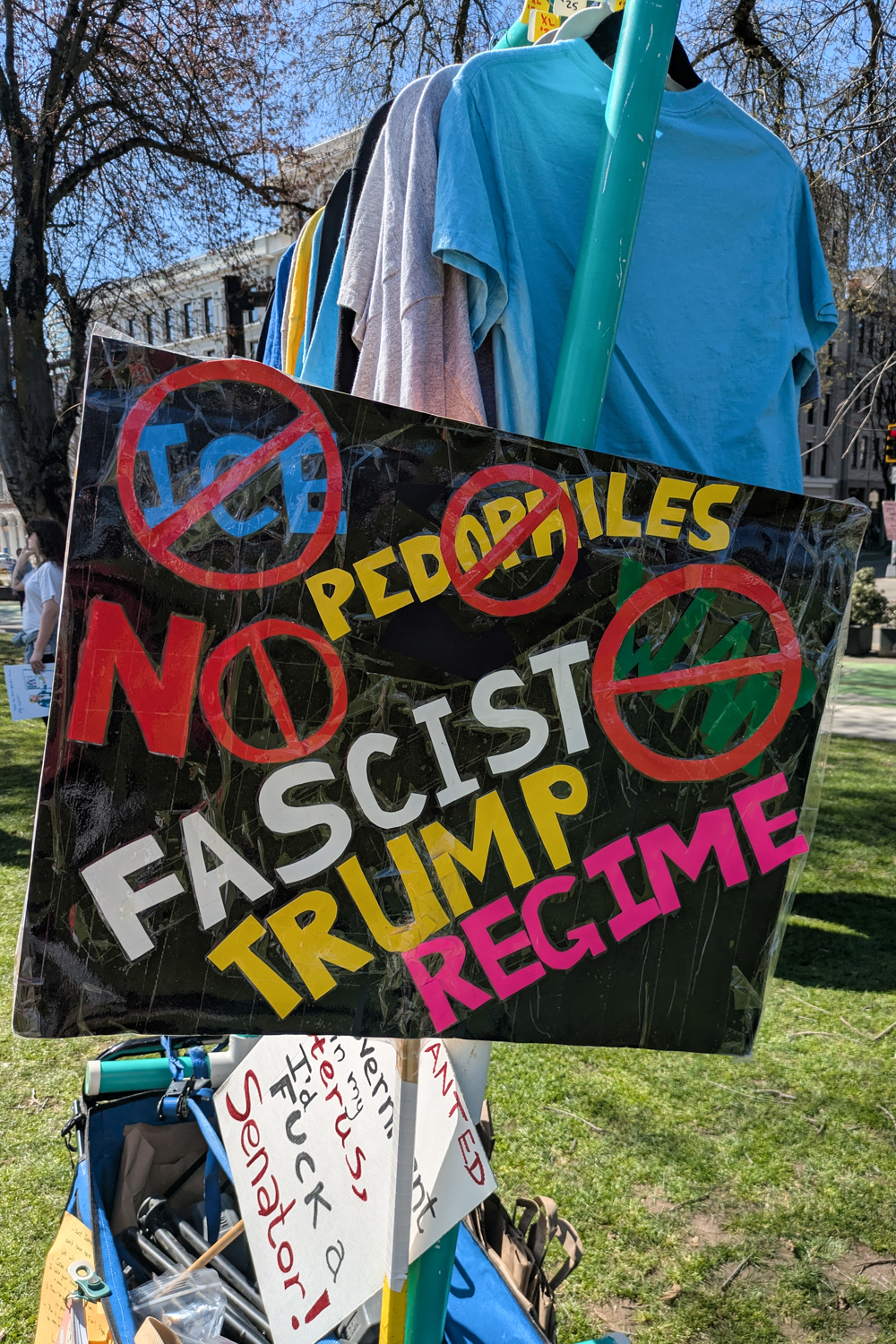
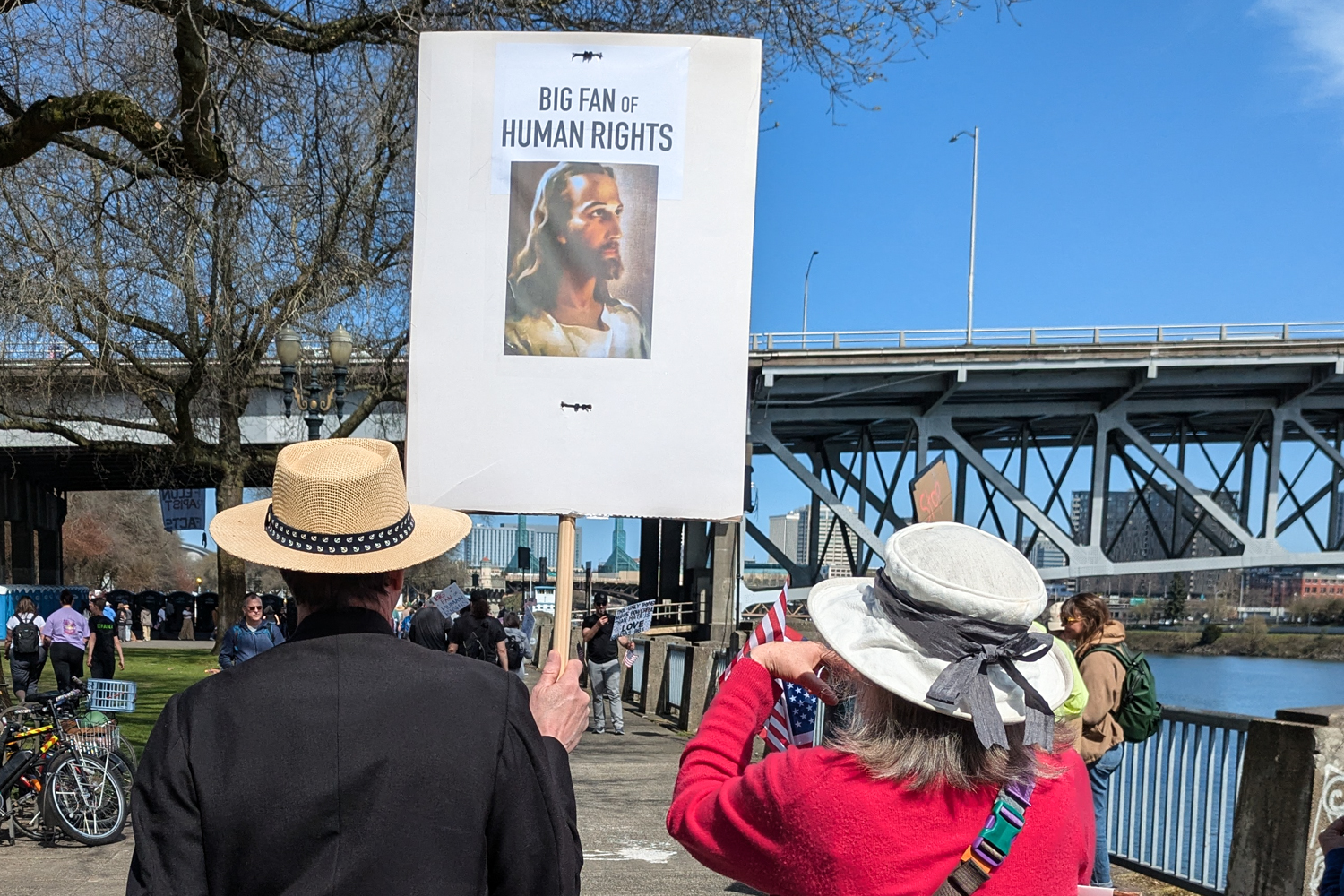
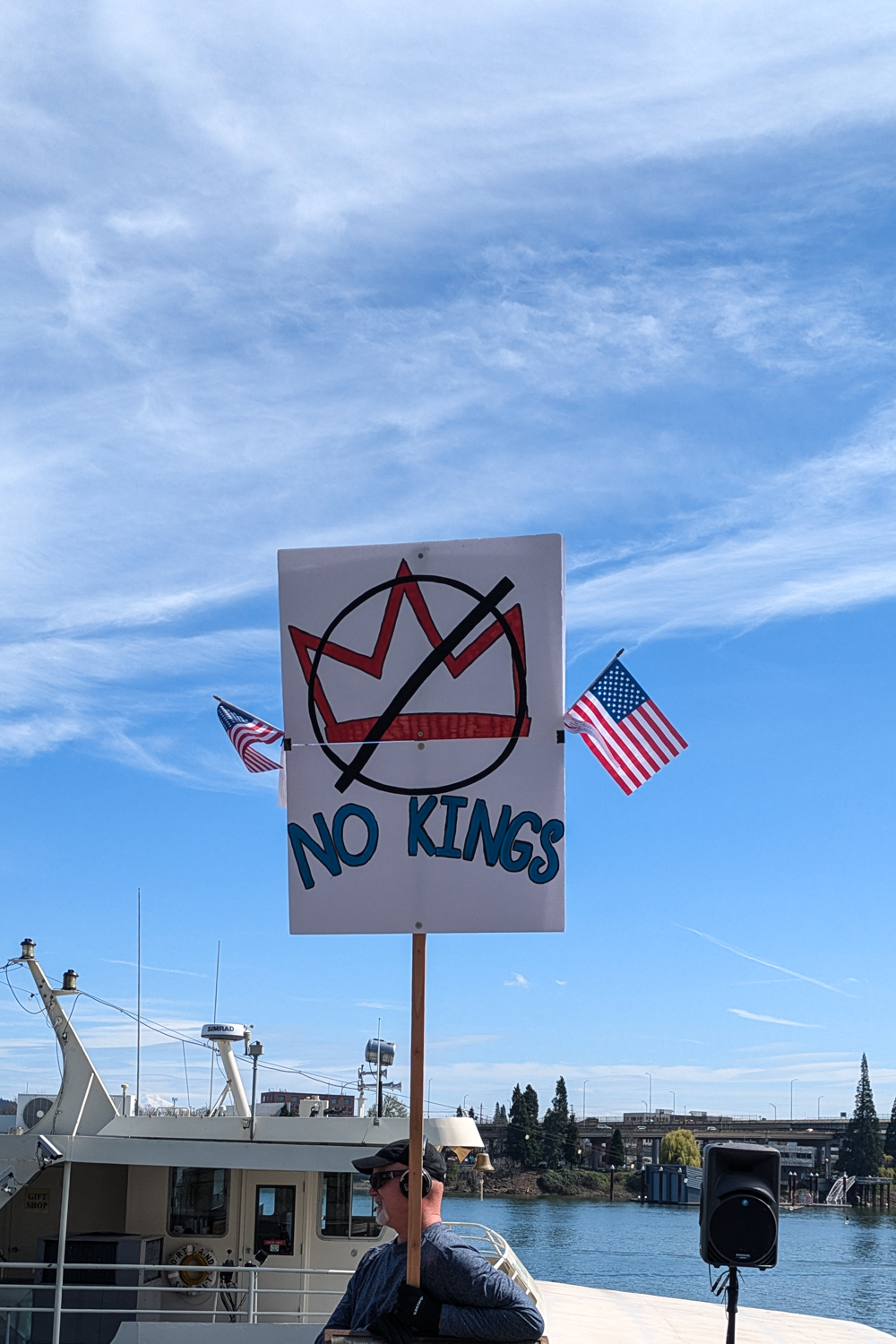
In the United States, we just witnessed the single largest collective and nonviolent and peaceful protests ever in the history of our country.

That’s right: October 18, 2025, “No Kings Day,” will go down in American history as a defining day for our troubled, imperiled democracy.

The protests were mobilized around one theme: that in the United States we have no kings. And they took place to challenge the authority of a sitting president and his administration that have falsely called peaceful American cities, like my hometown of Portland, Oregon, “war zones.”

Current estimates peg the number of protesters at 7 million, at least, in more than 2,600 locations, spread throughout every state.

VISIT MY POST ON MY WEBSITE TO SEE MORE PHOTOS AND READ MORE.

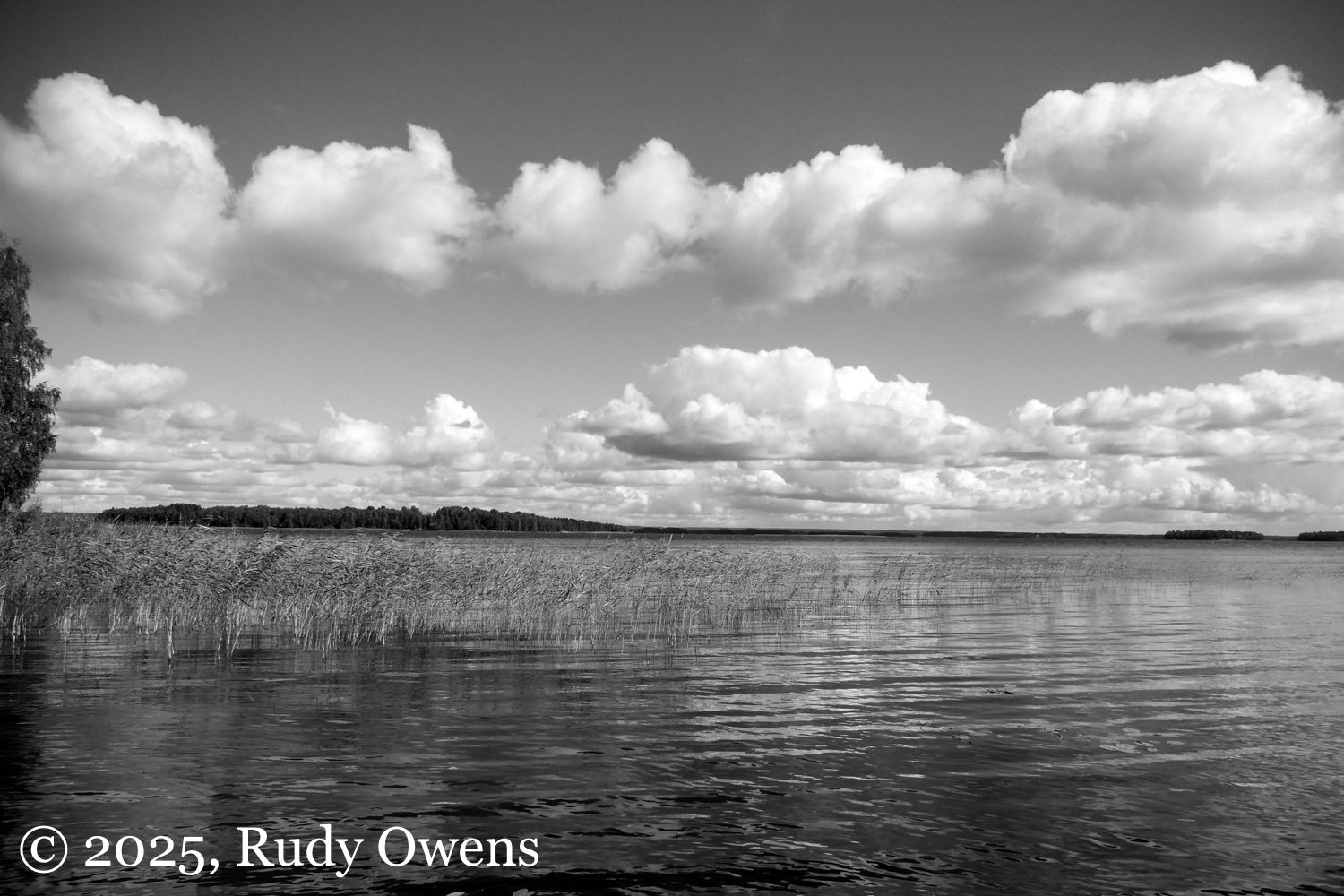
In praise of Finnish clouds

Even shopping malls look mighty under clouds that hang over South Ostrobothnia, Finland. (Shot taken in Seinäjoki, Finland, August 2025)

I will be posting a large update later to my Finnish photo gallery on Flickr and some batches here. It’s been a very busy time with historic events unfold in the United States that are having me prioritize issues relating the safeguarding of U.S. democracy, in its now battered form, and the U.S. Constitution.

I also maintain a larger collections of stories, videos, podcasts, and photos on my website section dedicated to my connection to this great country, a land of some of my biological ancestors.

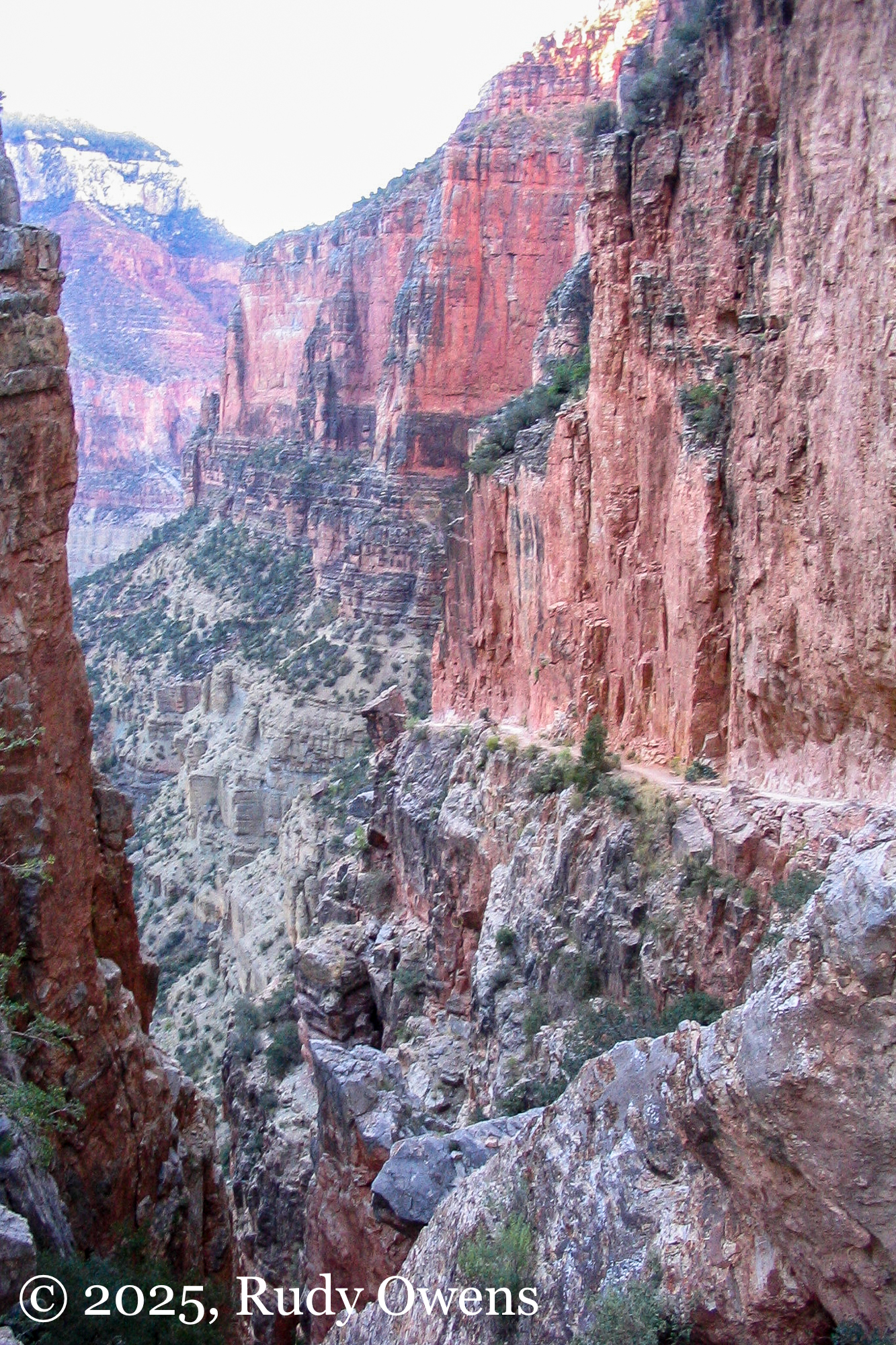
Memories of the North Rim, Grand Canyon

Today I learned, to my utter dismay, the historic Grand Canyon Lodge inside Grand Canyon National Park, on its North Rim, was destroyed by a wildfire.

There are few details outside of the initial announcement made the National Park Service the morning of July 13, 2025.

The lodge opened in 1937, and it has been run for years by the rapacious and problem-plagued Aramark concessionaire company, which for decades has poorly managed many national park public assets under government contract at parks like Grand Canyon.

A historic photo at the the the North Rim Lodge, taken in the late 1930s. (Photo courtesy of the U.S. National Park Service, for Creative Commons use only.)

The lodge had one of the finest viewpoints I’ve ever had at any United States National Park, which serve as cultural and natural institutions that remain national treasures of all the American people. Long before white settlers stepped foot on the North American continent, all the lands in what is now Grand Canyon Park were the domain of indigenous tribes, who continue to call the area home.

As of midday July 13, 2025, two wildfires are burning on the North Rim, having burned more than 45,000 acres. The White Sage fire has burned 40,126 acres (16,200 hectares) near the North Rim, and the Dragon Bravo fire, burning to the south within Grand Canyon national park, has scorched 5,000 acres, according to the InciWeb website.

The moment I read the story about the blaze and destruction of the historic Grand Canyon Lodge, my mind raced back to the one night I spent there in September 2005.

I had flown down to Arizona from my then home in Anchorage, Alaska, to visit my old grad school roommate from our years together at the University of North Carolina at Chapel Hill in 1991 and after. He and his family had settled in beautiful Flagstaff. The trip allowed us to catch up and do an adventure–running across the Grand Canyon, one of the most famous and world-class trail runs in North America.

My friend and host, Jeff, was very ambitious.

Jeff plotted a run from the South Rim, to the North Rim, and then back (called “Rim to Rim to Rim,” in trail parlance). I would meet him at the Grand Canyon Lodge for the night and do the simpler and shorter “Rim to Rim run” (about 24 miles) from the North Rim to the South Rim only. My run is the classic run. Jeff’s run is for the truly hardcore trail runner, which he was at the time.

We got incredibly lucky, scoring a room in a cabin by the lodge that had a vacancy open up before I arrived. We had been prepared to camp out in the elements on the North Rim, but I am not sure how that would have worked. Even in late summer, it can be freezing at night. But fate was good to us.

Everything worked out perfectly. Jeff ran across solo safely to get our cabin room. I took the shuttle bus to the Grand Canyon Lodge, arriving after a five hour drive, near sunset, after spending the first half the day on the South Rim doing a canyon rim hike. We both got about four to five hours of sleep, awaking around 4 a.m. I ate a terrible pizza at the lodge’s subpar cafeteria to load up on carbohydrates.

We awoke in near freezing weather and darkness under the stars. We grabbed a photo in the dark at the North Rim Trailhead, just where the 6,000 foot descent to the Colorado begins.

I had a nasty spill that day, cutting open my hand on some sharp rocks, but otherwise the day was pure magic. We made excellent time, stopping at Phantom Ranch, by the Colorado River, to refill our Camelback water pouches and buy some food, and we got to the top of the South Rim by mid-afternoon.

I continued to do trail runs for many years after this epic outing, but this adventure, with a good friend, Jeff, remains my most memorable trail run.

I’ll always have that memory of standing on the edge of the canyon, at sunset, gazing at 2-billion-year-old metamorphic rocks turning purple and dark orange hues as the sun slowly slipped over the horizon.

Nothing ever truly lasts, but this news still fills me with sorrow. The country lost something special today that we will never have back.

(I published most of these photos 11 years earlier, and wanted to share them again with this memory of what is now gone forever: Grand Canyon Lodge.)

‘Democracy is a verb’

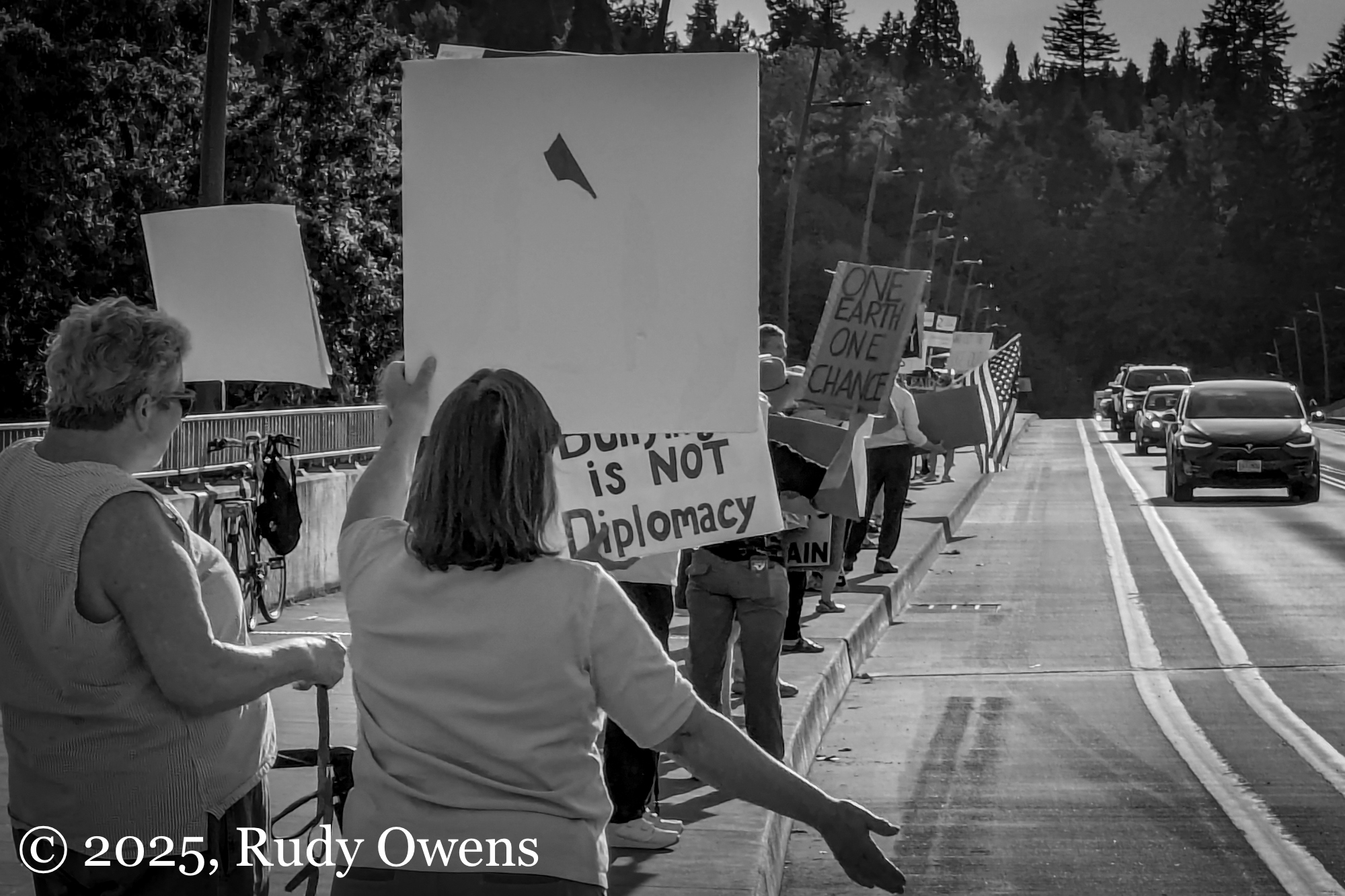
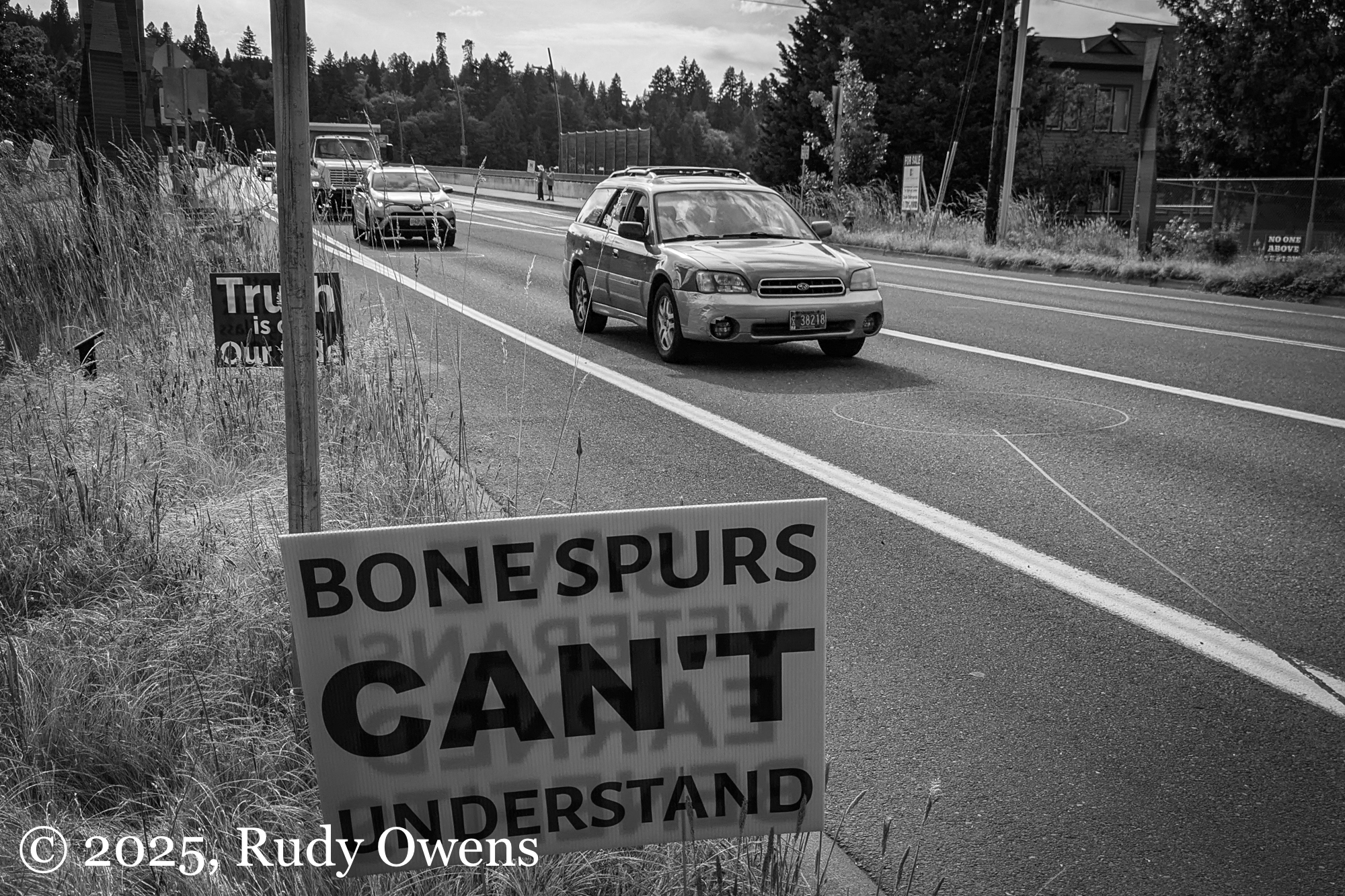
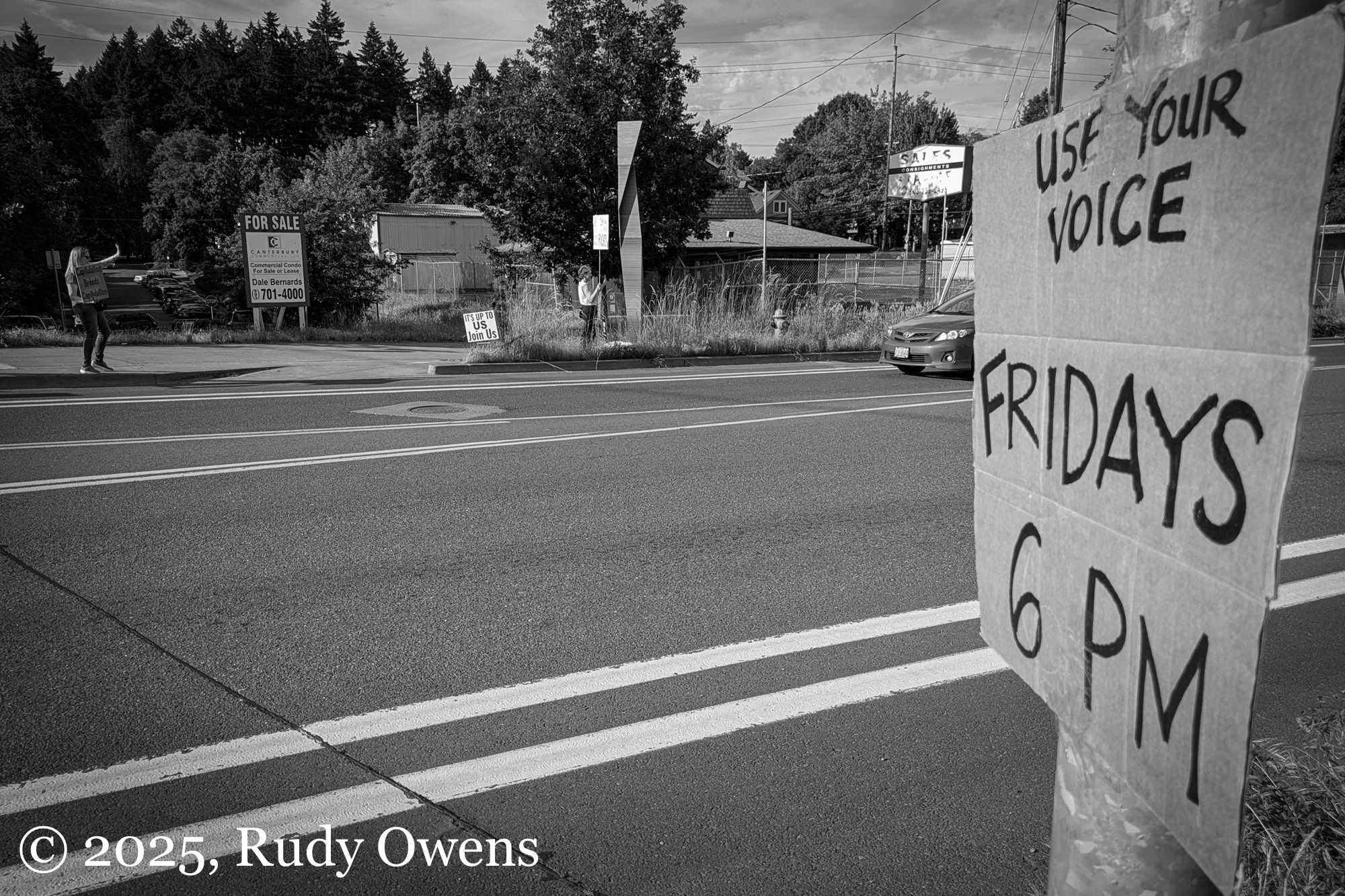
Every Friday since early April I have been joining a group of mostly older (like me) Portland residents at peaceful protests on Portland’s Sellwood Bridge during the Friday night, after-work rush hour.

The local organizers live in southeast Portland, like me, not far from Sellwood Bridge. The bridge is found on the south side of Portland, straddling the Willamette River. It’s a busy corridor for traffic heading from mostly Democratic and left-of-center leaning Multnomah County to a more evenly split jurisdiction politically, Clackamas County, which lies the south.

The organizers call their weekly civic event “Friday protests on the Sellwood Bridge.” It is an apt name. Their mission is simple too: “Our goal is to encourage our community to stay engaged and to use our voices and First Amendment rights to protest any erosion of our Constitutional freedoms or functioning government.” 

The last event took place on Friday, May 30, 2025. My photos, all intentionally hiding most of the faces of the participants, were taken at the protest under sunny, warm skies.

That night, from about 5:30-7 p.m., over 75 folks assembled on the Sellwood Bridge to defend our country, exercise protected speech, and engage hundreds and hundreds of rush-hour commuters. We come with our own signs—painted, drawn, or marked out with Sharpies. Participants can also use the many more professional signs and repurposed but evergreen cardboard signs brought by the organizers.

On the last Friday of May 2025, the horn energy was righteous under the early summer sun.

Supporters in the passing rush hour cars, and also cyclists, outnumbered the few angry white male bird flippers by about a ratio of 25-1. That was encouraging.

Like previous weeks, I saw the outrage and solidarity in people’s faces. They showed with their expressions they were all in on the resistance themes. I observed how they leaned into their horns, giving protesters  a thumbs ups, pumping their fists, and even yelling in support.

For the commuters, they see people engaged. They see protest happening. They see the signs focusing on: cuts to Medicaid, violations of due process, cuts to our federal health system, illegal firings of tens of thousands of federal workers, threats to the environment and education, the gutting of our federal bureaucracy, the illegal disappearance of lawful residents to gulags out of the United States, and more.

The drivers recognize that their frustration and outrage at the ongoing coup to the U.S. Constitution is not a personal assault, but one shared by their neighbors and our country. And man, were they laying in on the horns on May 30, 2025.

Graphic for Sellwood Bridge Protest
The Sellwood Bridge Protest logo

The importance of showing up, week after week

The protests each Friday on the Sellwood Bridge are all organic, with almost no coordination, outside of weekly email reminders.

A few people started the civil actions in February 2025, and they have grown. The entire purpose is to keep showing up, to keep calling out the violations of law by the current president, and to demand a restoration of law and the end of corruption and lawbreaking by the current administration of President Donald Trump, a convicted felon.

What’s important about the events each week is the consistency of civil disobedience and the act of protest.

Renown historian of 20th century tyranny, Professor Timothy Snyder of the University of Toronto, in an interview on May 31, 2025, with MSNBC’s host Ali Velshi, said, “Democracy is a verb.” It’s not a static thing. It’s action. When there is action, others engage, and the acts themselves become part of a system that is vital to human goodness.

I think Snyder described the value of action so perfectly: “But we also have to recognize that it’s not on any one of us to solve the whole thing. Right. So each of us does a little bit, and together that changes the whole landscape.”

I plan to keep going to these events as long as my democracy is under siege, and it looks like it will be a long and painful four years, at least.

Portland, Oregon rally against the Trump administration, April 19, 2025

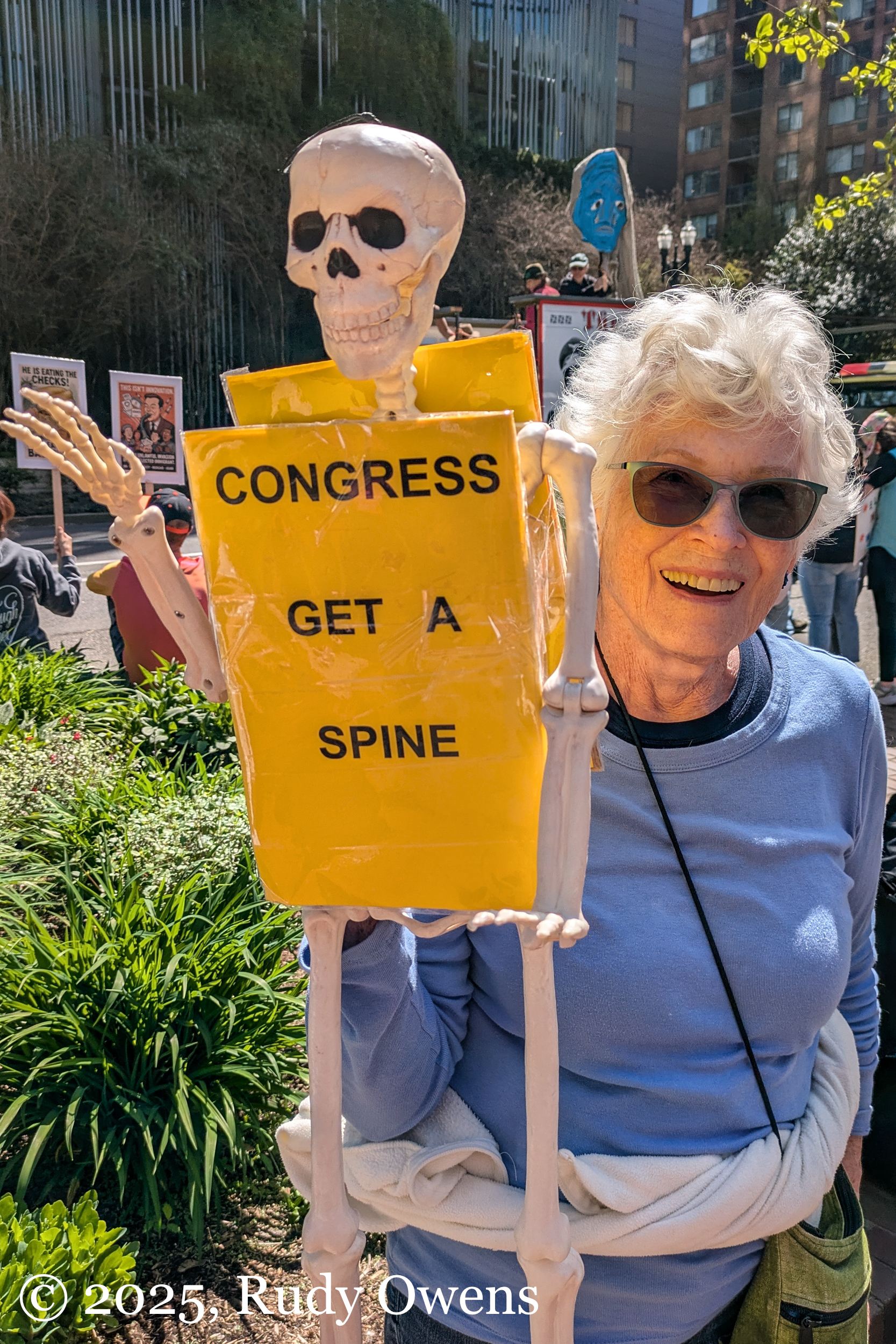
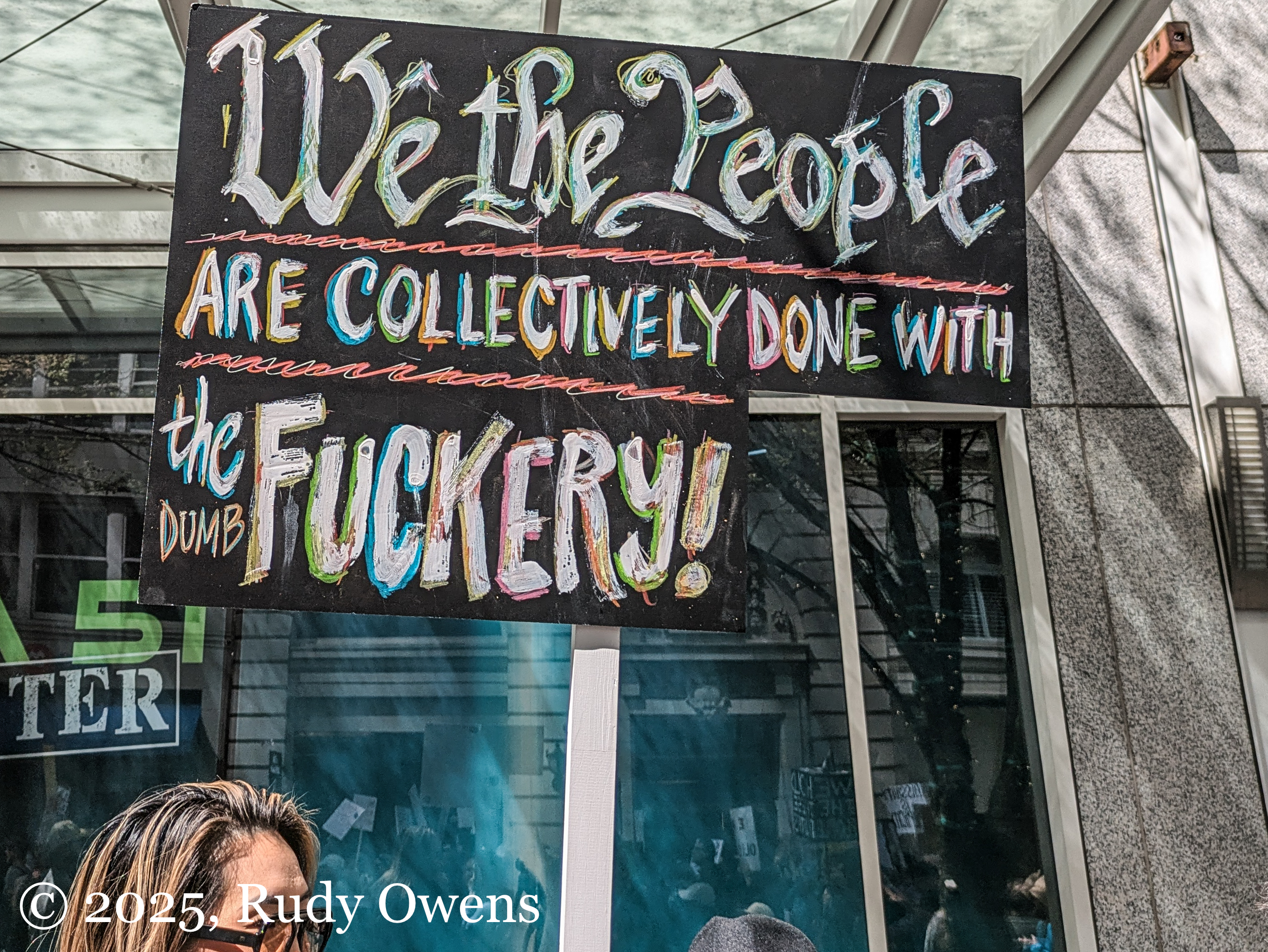
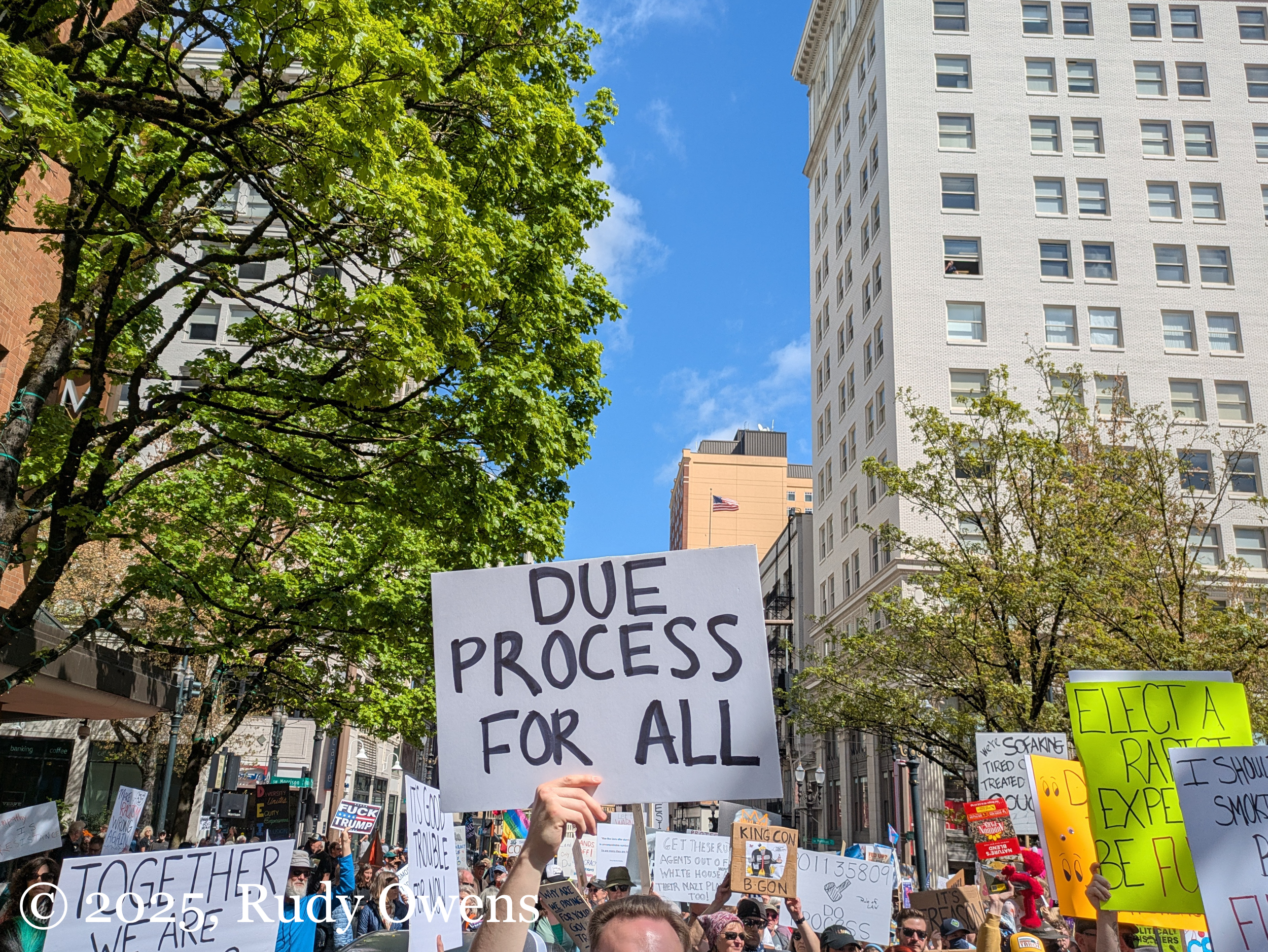
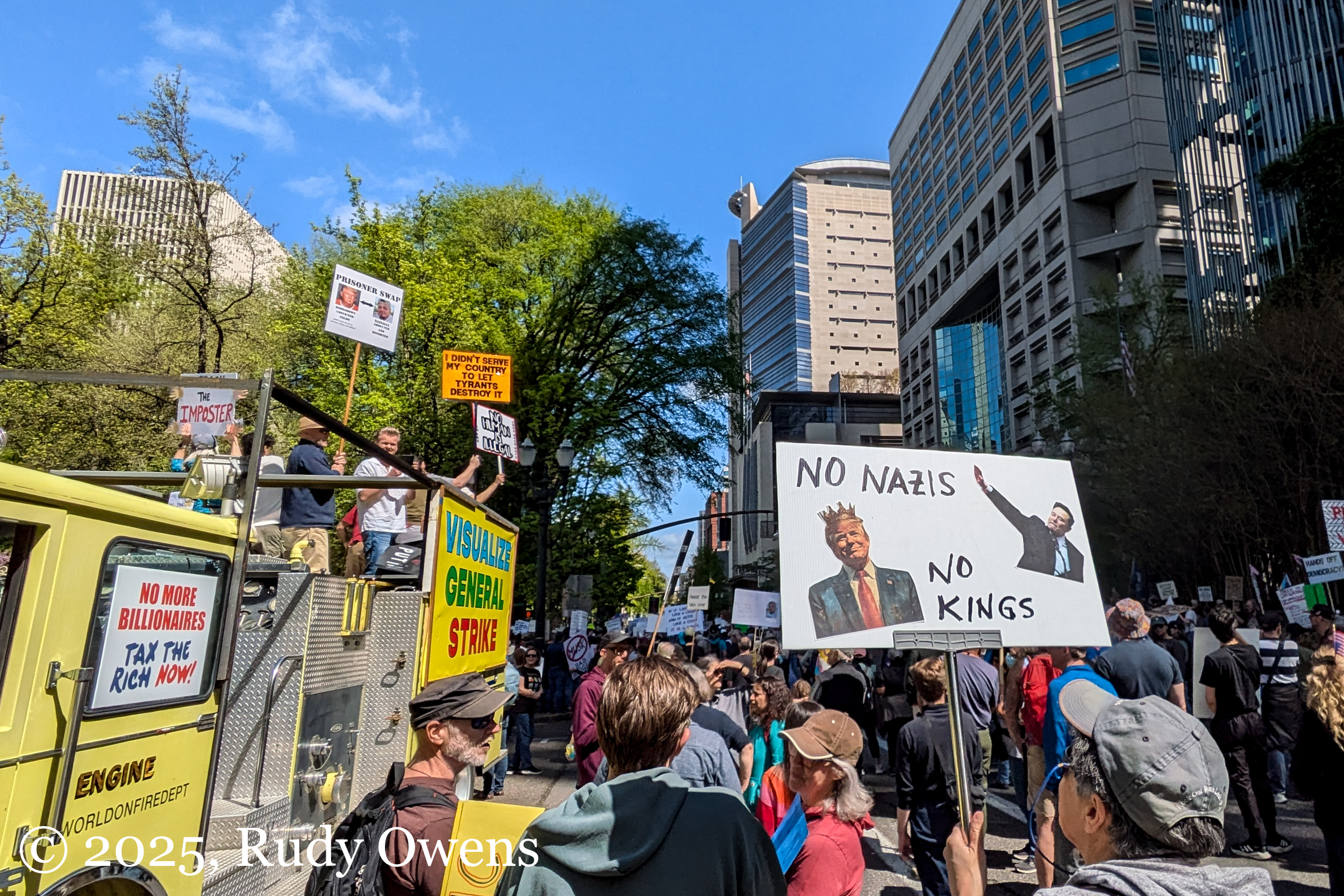
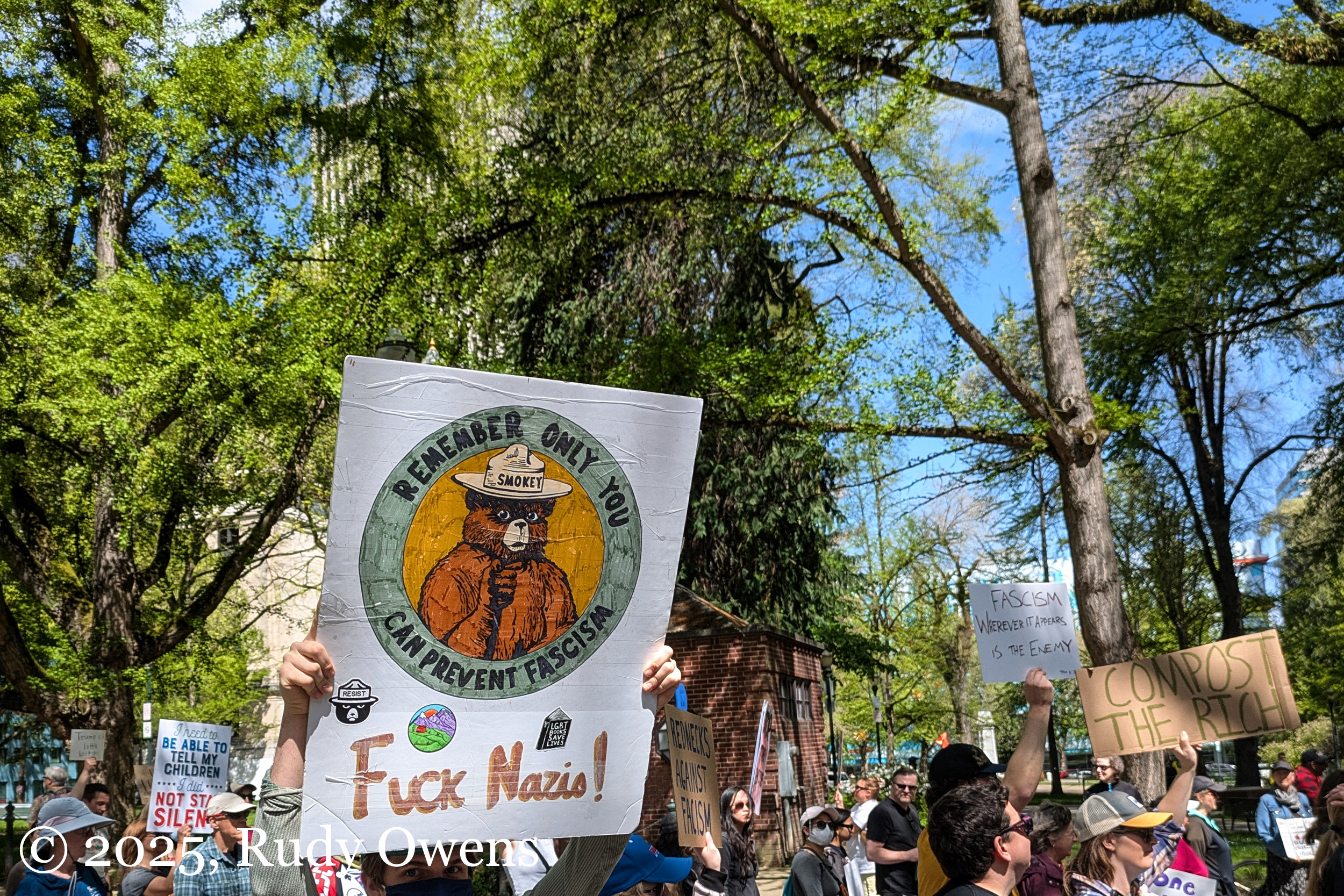
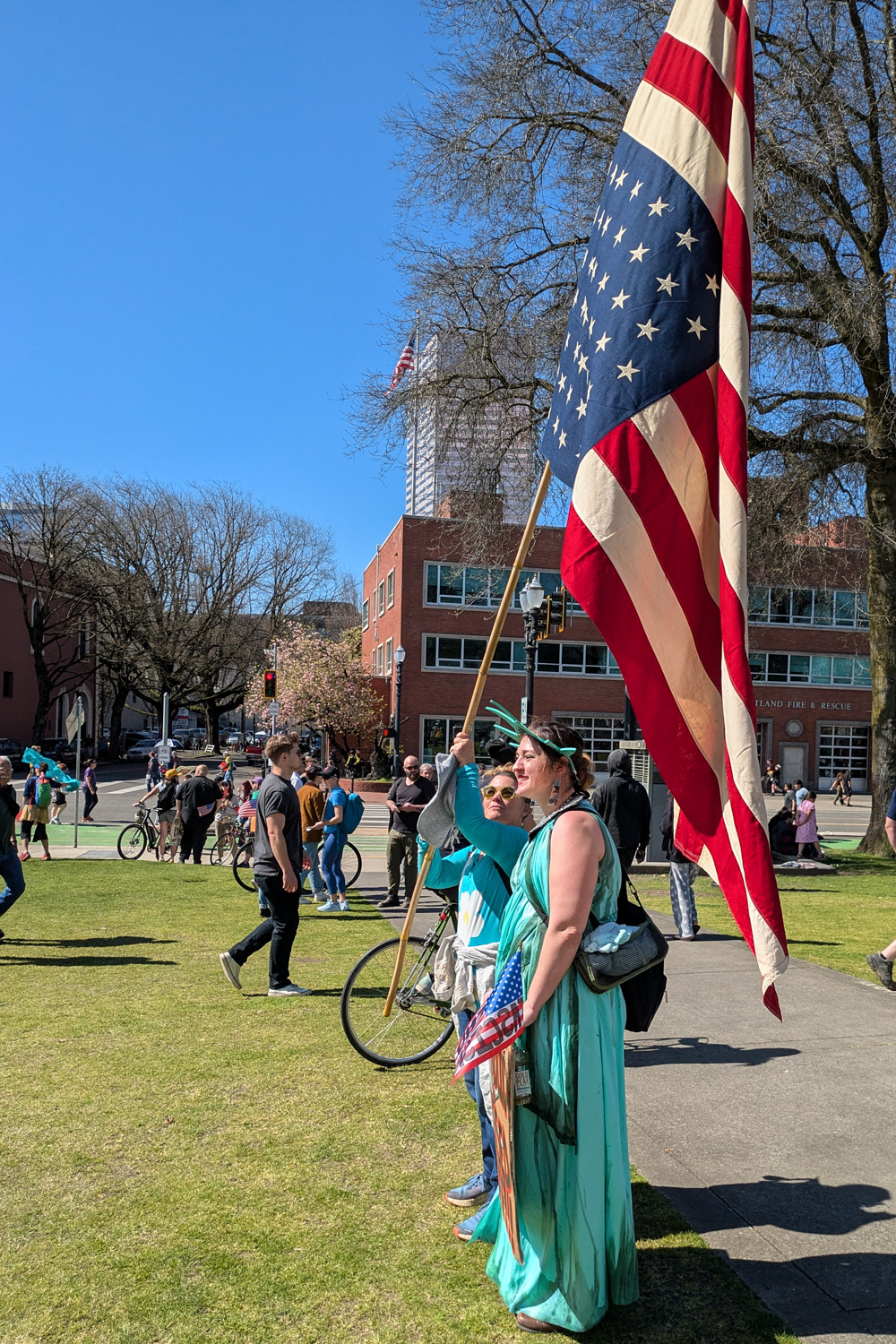
Protesters against the administration of President Donald Trump numbered at least 3,000 and shared a diverse range of creative protest signs, defending American democracy.

On the weekend marking the 250th anniversary of the first shots fired in the American Revolution against a tyrannical monarch and the British Empire, at least 3,000 people gathered in downtown Portland, Oregon to protest the administration of President Donald Trump.

The April 19, 2025 events kicked off at Pioneer Square, a gathering place for many public events in the city, and then the march took over the streets for over an hour. Protesters represented all ages and carried a wide array of colorful, creative, and biting signs criticizing Trump, Elon Musk, and the administration for its many actions. I saw about a dozen Portland police officers following on bikes, but mostly there was no visible law enforcement presence based on my observations.

There was no need for any police given the entirely peaceful nature of the civil action by thousands of people exercising their protected speech, as allowed by the First Amendment to the U.S. Constitution.

The day was a fitting one too.

Nationally some have dubbed collective national protests on April 19, 2025, as “No Kings Day, Part II.” The reasons for unrest today have a striking similarity to what happened two and a half centuries ago, as British forces gathered in Massachusetts to confront increasingly rebellious colonial residents.

The issues that led to the first conflict of the American Revolution—the right to self-determination, liberty, democracy, the rule of law, a life free from the power of kings—helped to forge a nation 13 years later, in 1788.

That year, the newly christened United States of America was created through the adoption of a founding charter, the Constitution. While revolutionary, it was also terribly marred and flawed by enshrining slavery, our country’s greatest sin. It would still take over two centuries to guarantee the document’s original promise for all persons.

This framework for a nation, set forth in the Constitution, called for a system of checks and balances by three branches of government: the executive, legislative, and judicial branches. On April 19, 2025, in Portland, people gathered with deep and profound concern that this sacred charter had been irrevocably broken by a man who has proclaimed himself to be a king.

At these protests in Portland, the residents who gathered to assemble recalled our original bold vision for a country with their calls for accountability, the rule of law, and the safeguarding of our democratic freedoms. Their demands reminded us all of our daring experiment to forge a more perfect union, stretching from 1775 to 1788, and grounded in our Constitution: “We the People of the United States, in Order to form a more perfect Union, establish Justice, insure domestic Tranquility, provide for the common defense, promote the general Welfare, and secure the Blessings of Liberty to ourselves and our Posterity, do ordain and establish this Constitution for the United States of America.”

Lastly, I observed few persons from a group being targeted for enforcement and deportation action by this administration: Latinos. There was a lot of chatter online by some of the organizers (I can’t confirm who the organizers are based on published posts), who said it would be safe for all people. However, many Latinos are fearful in Oregon, given the cancellations this month of upcoming Latino cultural events statewide. I believe they do not want to be seen, photographed, or filmed at these events. There were very few African Americans too. The lack of diversity at this event is telling and needs to be discussed.

Greenlanders: Nobody’s Fools

This is my friend, Lars, who I had the great pleasure of meeting in 1998 in Sisimiut, Greenland. He took me seal hunting with his family, at a fjord just north of the coastal city. I did this trip with his brother and father.

This past week, from March 23 to 28, 2025, the world again saw Greenland and Greenlanders at the center of a global security debate if the United States could assert control of Greenland, beyond longstanding and existing security arrangements that have seen U.S. military on the island continuously since World War II.

After the snow settled, one outcome was clear: Greenlanders are nobody’s fools.

The mostly ethnical Inuit population have called the more than 830,000-square-mile arctic island, the world’s largest, their home for nearly 5,000 years. Today, Greenlanders number about 57,000 residents, of which nearly 90 percent claim ethnic Inuit identity.

They are smart, resilient, and fiercely grounded in their identity as descendants for nearly five millennia of their homeland, what they call Kalaallit Nunaat in their Greenlandic language.

They are not pawns, patsies, or stupid.

I can say this based on my own experience, having befriended many residents there during my visits in 1998, 1999, and 2000. During my trips now more than a quarter century ago, I had lively discussions with Greenlanders who shared divergent views of becoming independent or staying aligned under semiautonomous status with Denmark.

What is clear is that Greenlanders made abundantly clear to the world they are opposed to coming under greater military and political control of the United States, as announced by the Trump administration.

(See my full story on the significance of Trump administration’s plan to take full control of Greenland on my website.)

Celebrating Finnish Independence Day: Itsenäisyyspäivä

Finland’s Independence Day, itsenäisyyspäivä, is celebrated each year on December 6. It commemorates the day the Finnish Parliament declared independence from Russia in 1917, as Europe was being torn apart by World War I and as Russia was convulsing in its own violent revolution. Finland would soon have its own bloody civil war soon after, in 1918, with the German-backed “whites” defeating the USSR-supported Finnish communist forces, the “reds,” with a decisive and destructive battle in Tampere led by Finnish war hero Carl Gustaf Emil Mannerheim.

For the Finnish people, it marked the first time ever that the country was finally free of foreign domination after more than 700 years of colonization, Christianization, and conquest and rule by Sweden, from the mid-12th century to 1809. It then endured 108 years of Russian domination and rule. It finally became a nation amid the chaos of World War I.

After the Tsar’s rule was toppled, the Parliament of Finland made its Declaration of Finnish Independence on December 6, 1917. The new Nordic nation sent requests to be recognized as a sovereign country to Sweden, Norway, Denmark, Germany, France, and the United Kingdom. The Bosheviks in what became the USSR formally acknowledged Finnish independence on December  31, 1917.

Many Finnish citizens in most communities commemorate their independence with formal and solemn events, often involving war memorials than can be found in every city and every community, no matter how small, throughout the Nordic country, like this event planned for December 6, 2024 in Kuopio, at a memorial, or at churches, like this event the same day in Helsinki.

My Finnish relatives, who I only met for the first time in September 2023, told me the day for most Finns has special significance as a remembrance of the war dead, who died in Finland’s three conflicts during World War II: The Winter War, against the USSR (1939-40); the Continuation War (1941-44), against the USSR; the Lapland War against Nazi Germany (former ally, 1944-45). Some of the pictures I’m seeing posted as day awakens in Finland on December 6, 2024, are of people reading the great Finnish war novel, Väinö Linna’s The Unknown Soldier/Tuntematon Sotilas.

It was a brutal time, when Finland, a much smaller nation, faced an adversary with vastly superior resources and weaponry and withstood an unprovoked attack at great cost. Finland ultimately lost more than 10 percent of its land, but was never brutally occupied by the USSR like Estonia, Lithuania, and Latvia, or like other Nordic countries, Denmark and Norway, by Nazi Germany. However, the Nazis fought a scorched earth campaign in late 1944 and early 1945 against Finland when Finland turned on them to reclaim their nation and make peace with the USSR. The Germans left a trail of ruin as they were driven from Lapland, where they once were stationed as allies. The harsh peace signed with the USSR ultimately saw Finland retain its territorial integrity and maintain its independence against heavy odds.

During my three trips to Finland since August 2023, I have been documenting the way the country and its people remember the trauma of these wars, taking photographs of its war memorials and markers for the dead. Nothing has shaped modern Finnish identity more than these conflicts that took 95,000 lives of its soldiers between 1939 and 1945. Finland’s remembrance of these traumatic experiences are found in nearly every Finnish community, no matter the size or location.

Every city and village I visited had memorials. All of them. So I would stop my rental car, get out, and document what I found. Flowers were always fresh. Always. Every memorial I saw everywhere had fresh flowers. Everyone I went to had visitors. The past was always remembered. If you look for Finnish news of itsenäisyyspäivä, inevitably there will a photo at a memorial.

You can see my full photo gallery of the memorials and markers at cemeteries and public spaces on my Flickr photo page dedicated to these places.

Cruising the Baltic Sea with old farts

I’m getting to be an old fart. As such, I actually want to do another Baltic Sea crossing between Sweden and Finland on these cruise ships. They are fun. On my trip from Turku to Stockholm on the Viking line, I met a fabulous German couple who even guided me nicely to downloading the right local transport app and picking the right bus and subways to the central station from the ferry terminal in beautiful Stockholm. How about that! Also, you get to behold old farts like me disco dancing in the discos, the mad rush to buy duty-free booze by huge crowds of Nordic travelers stocking up for months, and the wonderful upper deck views of this lovely part of the world.

In a sauna you won’t find a super model, but you will see a lot of sweaty flesh

(Click on each photograph to see a larger picture on a separate gallery picture page)

Freshly back from my glorious 11-day trip in Finland in September 2023, I have begun seeing a surprising number of articles on Finnish saunas.

On November 24, 2023, the BBC ran a multimedia spread under the banner “Saunas: The essence of Finland’s heartbeat,” featuring a refreshingly accurate video by Maria Teresa Alvarado, aided by producer by Natalia Guerrero. The video began showing a scene of a typical Finnish sauna, with a Finnish voice saying, “A Finn without a sauna is like a polar bear without ice and snow.”

A month earlier, on October 24, 2023, the famed British news service ran another glowing piece called “The 10,000-year-old origins of the sauna – and why it’s still going strong,” on this ancient Finnish tradition of taking hot air baths in wooden sheds that stimulate excessive sweating, often followed by immersion in cold water, snow, or cold weather.

Finland’s Baltic neighbor Estonia shares an equally old sauna tradition, and its sauna traditions this year are getting buzz thanks to the film “Smoked Sauna Sisterhood” (“Savusanna Sõsarad” in Estonian), a 2023 documentary on that country’s ancient sauna tradition and the women who partake in it. It just won the best documentary film award on December 9, 2023 at the European Film Awards.

Saunas: hot, hot, hot everywhere!

Yes, saunas are clearly the sweaty, hot ticket in many spaces.

Even in the U.S. medical establishment, which has never embraced practices that can’t be tied to for-profit enterprises that prioritize profit over health, some medical researchers are suddenly acknowledging the extensive and documented health benefits of saunas.

The modern Finnish sauna is but one of many “sweat lodges” and saunas that emerged globally, but none more famously than the Finnish sauna.

The BBC’s October 24, 2023 story by Clare Dowdy explored the history of the sauna in Finland and the Baltic region and its cultural significance to Finland, from the past to present: “In Finland, the sauna is ‘one of the key national symbols’, says [Dalva] Lamminmäki, precisely because it’s very much an everyday ritual for Finns, with 3.3 million saunas in a country of 5.5 million inhabitants. ‘Everyday practices are relevant to national identity also because over time they form a widely shared understanding of the culture and what it is like to be a citizen of a country,’ she adds, ‘It’s said that sauna creates a basis for understanding what Finnishness is.’”

This week, I stumbled on still another glowing article, published in The Guardian on December 6, 2023 , on the foundational importance of sauna’s to Finland’s enviable status as the “happiest country in the world” six years in a row.

Writer Miranda Bryant visited Tampere, “sauna capital of Finland,” and explored its well-known public saunas—the city boast almost five dozen of them. Bryant praised the tradition and suggested they are a foundation to Finland’s success creating national wellbeing.

“Unlike in other countries, where saunas are usually marketed as an expensive activity for the few, in Finland they have a far more everyday role,” writes Bryant. “Many people have saunas in their homes; lots of older Finnish people were even born in saunas. But they are also considered a sacred space and a place to find community as well as peace.”

The difference between real and fake sauna experiences

It could be that I’m more aware of saunas because I used them and sought out traditional and public sauna experiences during my trip in Finland.

I also think saunas are now trending as the latest “it” thing in wellness or boutique healthcare that really is a mask for old-fashioned narcissism.

This week, I saw a mobile sauna being advertised for a price of $45 for an hour at a Portland event. The branding of this new fad in “Instagram poseur” imagery typically leans heavily into maximum cleavage and/or a hot yoga bod, with the sumptuous sauna user looking sumptuously fulfilled.

From what I can tell, that is how many sauna services and products are marketed to U.S. consumers—something for “special” people, meaning those who are sexier, more charismatic, and definitely healthier than you. They definitely have a hotter bod than you too!

Public sauna, Helsinki, and not a hot body in sight

I eventually hit a breaking point on the corruption and meaning of saunas, to human health and to their egalitarian and cultural roots in Finland, but also Estonia, other Baltic countries, and also Russia through hot baths called banya.

I especially appreciated the photos of saunas that Bryant profiled in her Guardian feature story, and also on the City of Tampere’s tourism website promoting the city’s many facilities. That webpage, showing people of all different body types—not one a smoking beauty—notes: “Did you know there are over 55 public saunas in Tampere region for anyone to relax in, throughout the year? Finnish sauna culture is also a part of the UNESCO Intangible Cultural Heritage list.”

These honest pictures matter, because they show a sauna is not the domain of Instagram narcissists. They show guys half naked drinking beer outside or people of all body types wandering outdoors in the cold after plunging into a frozen lake. That’s how they do it. And they are really wonderful.

After hitting my sauna boiling point, practically steaming, I kvetched to some of my Finnish relatives who live in Tampere (I know, isn’t that a cool coincidence!) on how American “entrepreneurs” are trying to turn saunas into snobby, high-end, upper middle-class, white, health salvation spas for the “right kind of people,” promoted by scantily clad sexpots showing beaucoup de cleavage and draped in towels. I shared it was driving me nuts. They all responded with funny emojis, and one of them suggested I needed to join them at Tampere’s Rauhaniemi folk spa, which has a nice, icy-lake, winter swimming option.

I’m glad we are seeing the far more realistic image of what saunas are like.

They are very democratic and plebeian, especially in countries like Estonia and Finland. Naked typical bodies are not oozing with steam like yoga skankiness. There, the sweaty bodies are rather normal looking. And in a sauna, you show the flesh in all its perfectly imperfect glory.