Documentary Photography

Kent, one of Washington’s most diverse communities

Kent is one of several mid-sized cities in King County. It’s entirely dependent on the automobile, and it is where many cheaper apartments are found, attracting many lower-income residents and immigrants. Today, more than 130 languages—from Afrikaans to Yoruba—are spoken in the Kent School District, the fourth largest in Washington State. Kent has become a prototypical “melting pot suburb.” (Nationally, minorities now represent 35% of all U.S. suburban residents.) And many new suburbanites come from abroad. Today, one in five King County residents identify as “foreign born,” and many are choosing to locate in South King County communities like Kent. Here are a few  samplers of how diverse Kent is.

Visiting a Coptic monastery near Luxor, Egypt

During my two-and-a-half-week journey to Egypt ten years ago, I visited six Coptic monasteries. These are amazing places, beautifully preserved and vitally important to the Coptic minority in Egypt. During my visit, most were under armed guard by the state army, which I have read has melted away since the fall of Mubarak, and Egyptian forces have even participated in attacks on at least one of the most historic monasteries in Egypt near Cairo. You can read a little more about my visit to Egypt and the situation facing the Copts in an article I wrote in April 2013.

Slave quarters and slave ledger, Laura Plantation

I visited Louisiana and Mississippi in 2001, partly inspired by the Coen brothers’ great film Oh Brother, Where Art Though. I was also intrigued by the weird tourist subculture built around the glamorization and glorification of the South’s very brutal plantation system, which exploited blacks as slaves and left nearly everyone else out the political system, except very rich, very powerful, and as we later saw in the Civil War, very violent aristocracy. There is a very good book on the economic system that flourished around cotton, North-South trade on the Mississippi River, and slave labor called River of Dark Dreams, by Harvard Professor Walter Johnson. It was in his book where I first learned about a little-known book called 12 Years a Slave, about six months before it burst on the global scene as a movie that won best picture at the 2014 Academy Awards. I figured it was more important to show these pictures of Laura Plantation than fret about their quality (these are now 13-year-old pictures, not well scanned I admit).

Community gardening in Seattle

In 2003 I worked on a documentary photography project on Community Supported Agriculture in Seattle. This work culminated in a show I exhibited in Portland, Ore., which highlighted gardens and gardening at two different mixed-income communities. These gardeners were all public housing residents, including immigrant families. I also showed these two photos in a show I did in Anchorage in 2006 at the Snow City Cafe called Being Themselves.

Vivian Maier’s hidden world of intimate, visual storytelling

I just learned about Vivian Maier, an amazing street photographer and student of the human condition, in all its rich, strange, sometimes unfair and cruel glory. She was born in 1926 and died in 2009 and spent much of her life in New York and Chicago, where she did her voluminous work. More than 100,000 of her negatives and undeveloped rolls of film and 8mm and 16mm film were discovered posthumously. Suddenly an unknown photographic storyteller burst on the scene in the last five years through the power of social media and more importantly because of the volume and quality of her highly personal work.

Her self-portraits, including the use of a Rolleiflex twin-lens reflex camera, are wildly off-kilter. In the era of the self-absorbed, narcissistic cell-phone selfie, these make that practice seem like a pale shadow. As for her portraits of ordinary people she met, you cannot take photos like this without deep empathy and respect–something that is not common. It links her to photographers like Sebastião Salgado.

Look at the cameras she used; some appear to be Leicas. She also used one of my favorite twin-lens reflex cameras, the gorgeous Rolleiflex. When she snapped her street and people pictures, she was right in her subjects’ private, most intimate space. There is now a documentary film that came out in 2013 called Finding Vivian Maier, and it is gaining buzz too. Oh, she made “a living” as a nanny, if that matters. It makes one wonder about who is an “artist” and what hidden potential people who may be dismissed can possess. Catch a glimpse of the film via the trailer on Youtube below.

Inuit identity in the circumpolar north

In 2007, I attended the Inuit Circumpolar Conference in Barrow, which brought together the different Inuit groups, spanning the circumpolar north from Russia, to Alaska, to Canada, to Nunavut, to Greenland. The Inuit are distinct culturally, linguistically, and historically. Having traveled widely in Greenland and Alaska, this was abundantly clear in many of the ways these cultures express their identity and relation to the sea. Here are two perspectives on how closely linked Inuit culture is to its traditional hunting lifestyle, in this case hunting, killing, eating, and utilizing whales. You can also find other photos I have taken of Greenland and Alaska on my web site (www.rudyowens.com).

Java and Bali, looking back five years ago

I used a very low-tech Canon hand-held digital which was breaking down on this trip. Even then, it still performed like a champ. Use a few Lightroom tools, and voila, something completely different. Needless to say, I loved my time in Indonesia. These are, admittedly, touristy, but I was, admittedly, very much a happy tourist.

From Interbay to Elliott Bay, Seattle

A couple of months back, I took a late afternoon photo outing to capture some industrial scenes in Seattle’s Interbay railyard and the always photogenic Elliott Bay and Puget Sound, adjacent to Seattle. More of this ongoing series can be found on my photo gallery.

BNSF Locomotive
BNSF Locomotives, Interbay Railyard

Elliott Bay Sunset
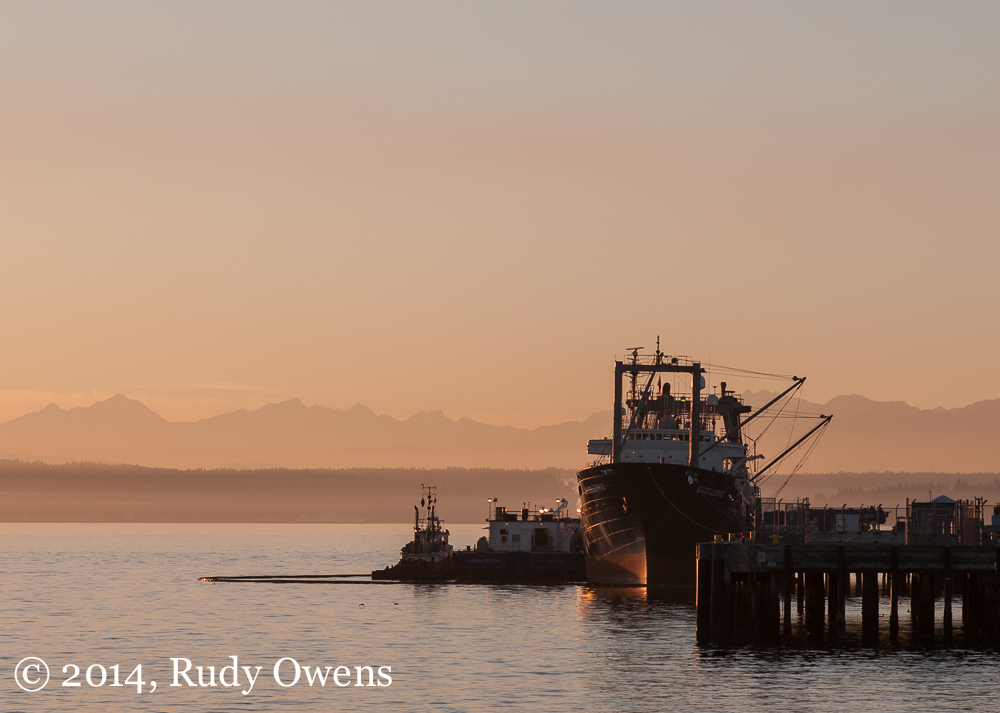
Pier 91 at Elliott Bay, Looking on to the Olympic Mountains

Grain Ship Loading Up
One of many grain ships filling its hull for the global market

Under the spell of Bernd and Hilla Becher

My current expression through still photography, at this moment in time, remains heavily influenced by the highly acclaimed German photographers Bernd and Hilla Becher. The husband-wife duo (Bernd has passed on) influenced perhaps the most acclaimed and financially successful photographers of the past 20 years, through their late-in-life work at the “Dusseldorf School of Photography.” The Bernds’ now famous protégé‎s/students include Thomas Ruff and Andres Gursky. The latter is now on record for selling the world’s most expensive photographic print.

The Bernds were deeply enmeshed in showcasing industrial forms, which they arranged later in books and exhibitions as typologies. (Please read my post about their work and their influence.) They also were telling a story of the economy of the times and the industrial West, just as at was on its downward spiral, before the rise of industrial China and India.

My most recent photographic series on Tacoma and the Duwamish River industrial area of Seattle are in some ways indebted to this thinking, about how the industrial ports of the Pacific Northwest are the lands devoted to the overwhelming power of global trade, the last vestiges of Northwest industrial activity, and the world of high-paid blue collar work that is on the verge of extinction in the United States.

Here is the first of two provocative YouTube videos on the Bechers’ work and thinking, in their own words (you can see part two after part one finishes).