history

Celebrating Finnish Independence Day: Itsenäisyyspäivä

Finland’s Independence Day, itsenäisyyspäivä, is celebrated each year on December 6. It commemorates the day the Finnish Parliament declared independence from Russia in 1917, as Europe was being torn apart by World War I and as Russia was convulsing in its own violent revolution. Finland would soon have its own bloody civil war soon after, in 1918, with the German-backed “whites” defeating the USSR-supported Finnish communist forces, the “reds,” with a decisive and destructive battle in Tampere led by Finnish war hero Carl Gustaf Emil Mannerheim.

For the Finnish people, it marked the first time ever that the country was finally free of foreign domination after more than 700 years of colonization, Christianization, and conquest and rule by Sweden, from the mid-12th century to 1809. It then endured 108 years of Russian domination and rule. It finally became a nation amid the chaos of World War I.

After the Tsar’s rule was toppled, the Parliament of Finland made its Declaration of Finnish Independence on December 6, 1917. The new Nordic nation sent requests to be recognized as a sovereign country to Sweden, Norway, Denmark, Germany, France, and the United Kingdom. The Bosheviks in what became the USSR formally acknowledged Finnish independence on December  31, 1917.

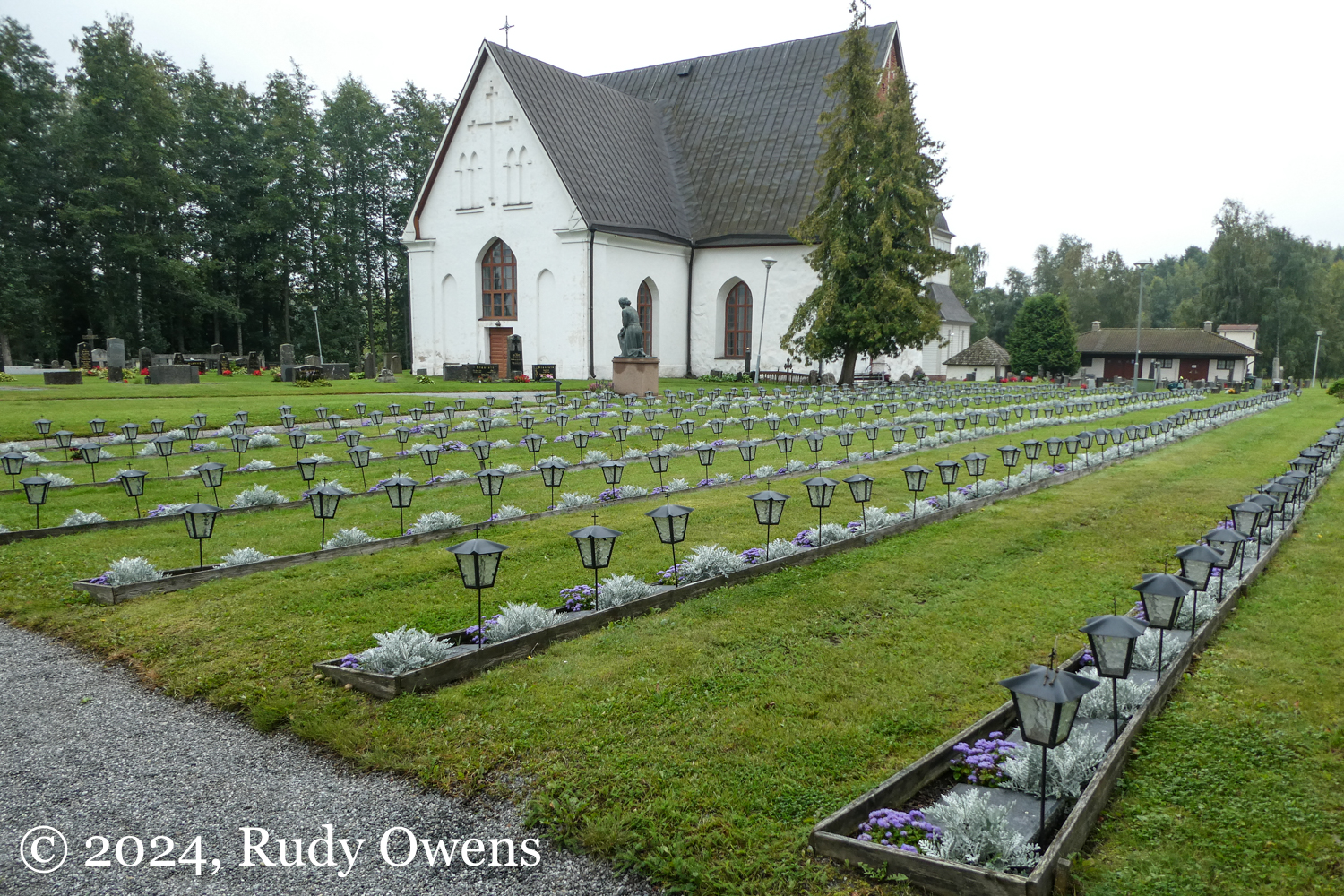
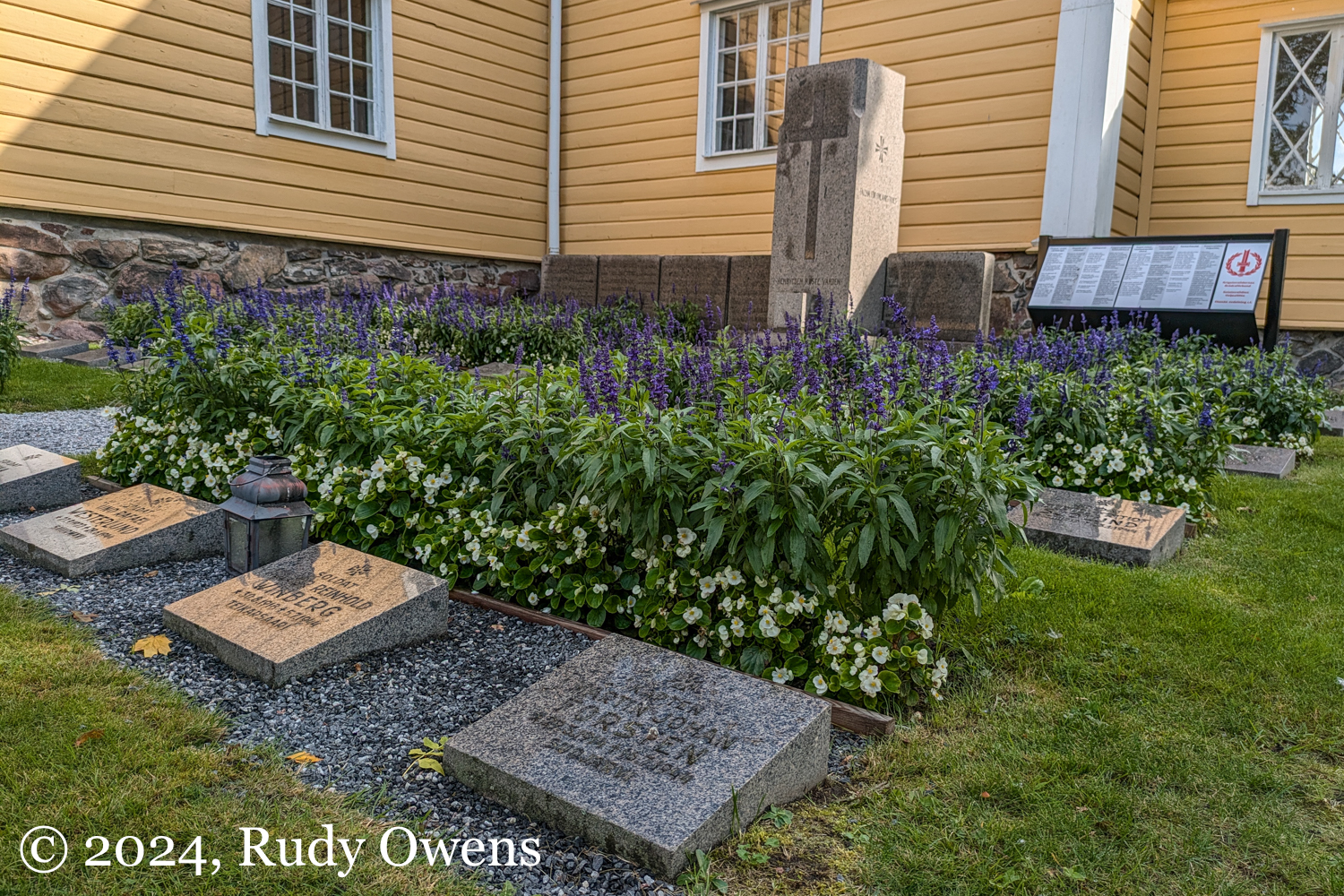
Many Finnish citizens in most communities commemorate their independence with formal and solemn events, often involving war memorials than can be found in every city and every community, no matter how small, throughout the Nordic country, like this event planned for December 6, 2024 in Kuopio, at a memorial, or at churches, like this event the same day in Helsinki.

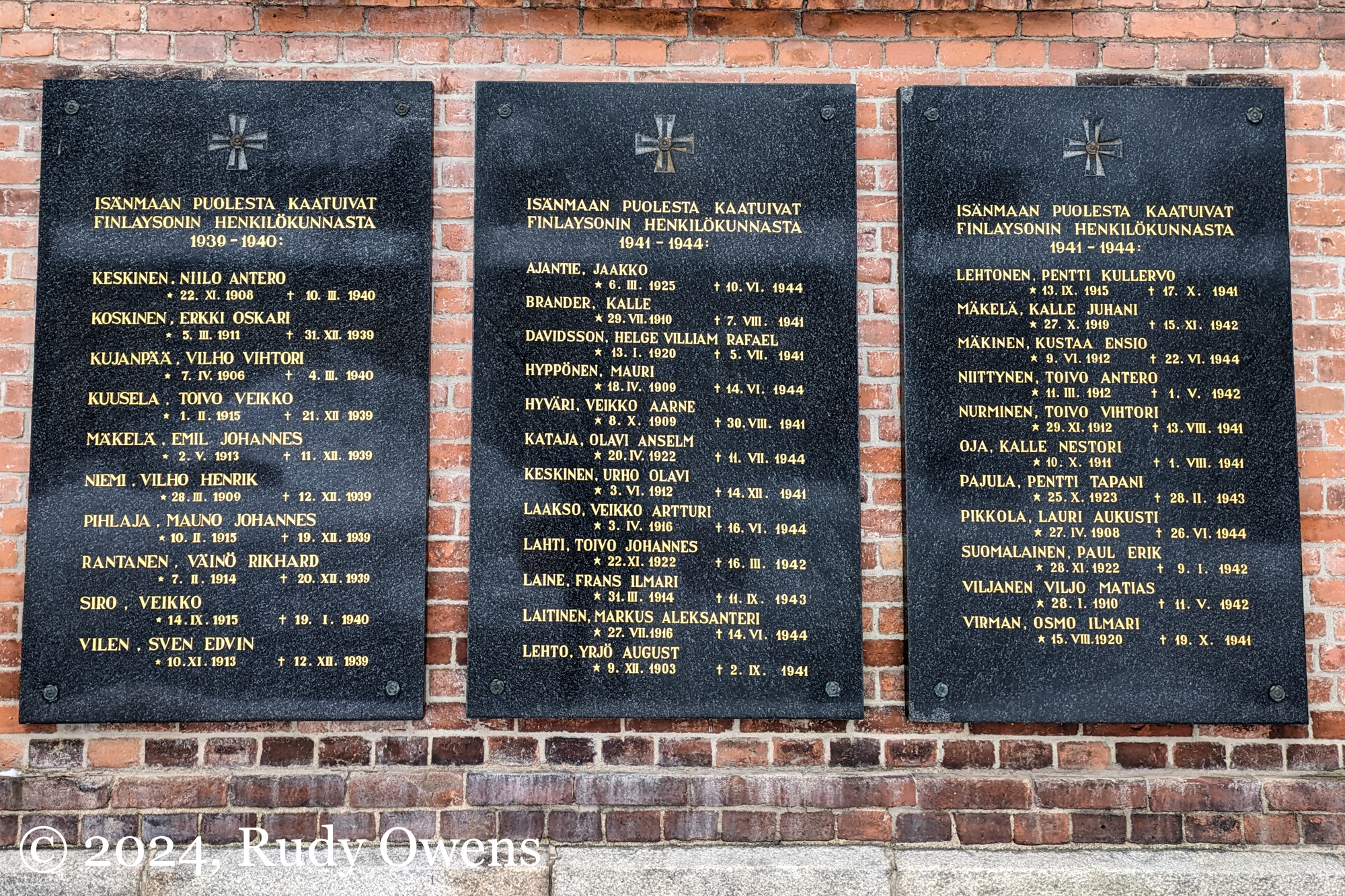
My Finnish relatives, who I only met for the first time in September 2023, told me the day for most Finns has special significance as a remembrance of the war dead, who died in Finland’s three conflicts during World War II: The Winter War, against the USSR (1939-40); the Continuation War (1941-44), against the USSR; the Lapland War against Nazi Germany (former ally, 1944-45). Some of the pictures I’m seeing posted as day awakens in Finland on December 6, 2024, are of people reading the great Finnish war novel, Väinö Linna’s The Unknown Soldier/Tuntematon Sotilas.

It was a brutal time, when Finland, a much smaller nation, faced an adversary with vastly superior resources and weaponry and withstood an unprovoked attack at great cost. Finland ultimately lost more than 10 percent of its land, but was never brutally occupied by the USSR like Estonia, Lithuania, and Latvia, or like other Nordic countries, Denmark and Norway, by Nazi Germany. However, the Nazis fought a scorched earth campaign in late 1944 and early 1945 against Finland when Finland turned on them to reclaim their nation and make peace with the USSR. The Germans left a trail of ruin as they were driven from Lapland, where they once were stationed as allies. The harsh peace signed with the USSR ultimately saw Finland retain its territorial integrity and maintain its independence against heavy odds.

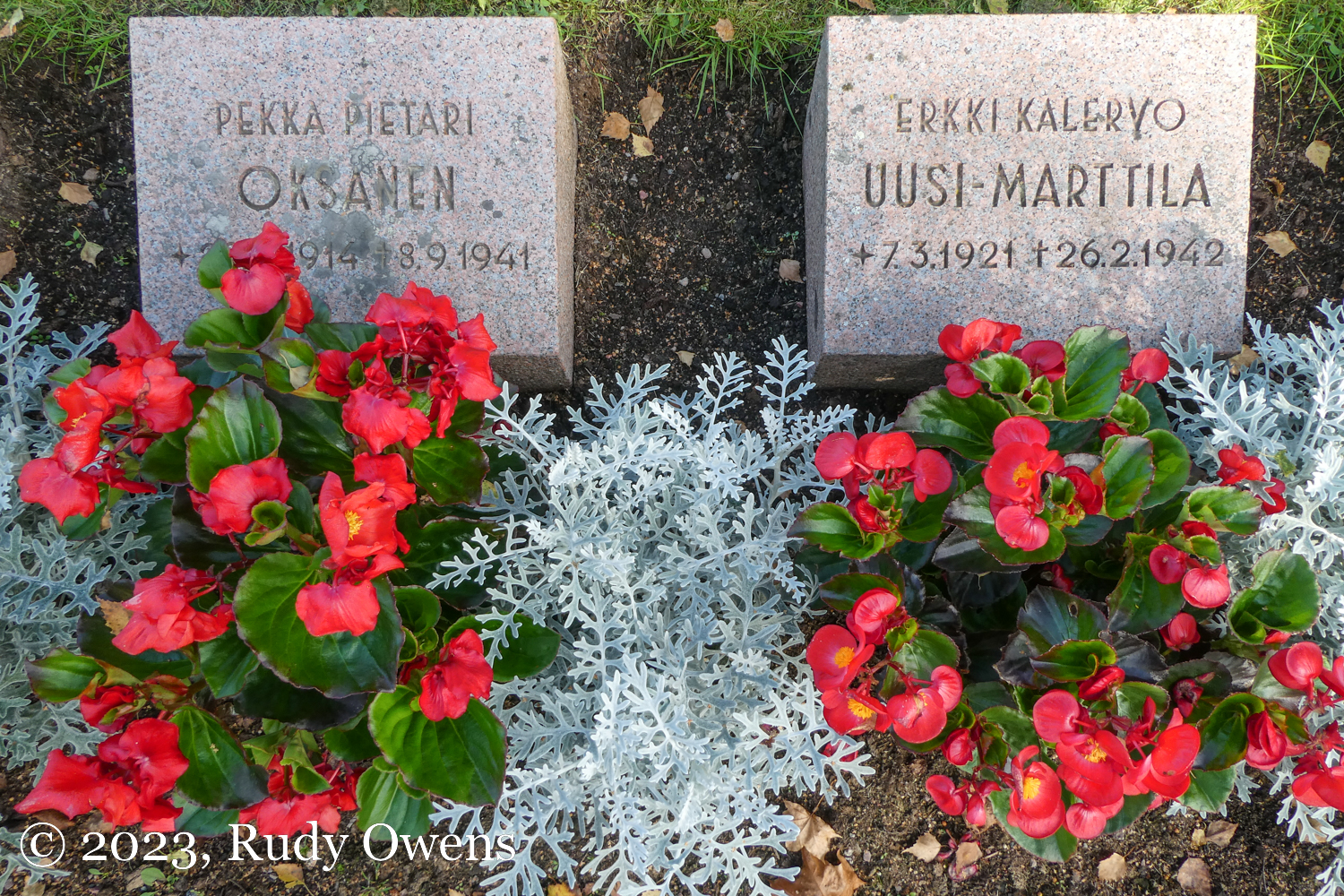
During my three trips to Finland since August 2023, I have been documenting the way the country and its people remember the trauma of these wars, taking photographs of its war memorials and markers for the dead. Nothing has shaped modern Finnish identity more than these conflicts that took 95,000 lives of its soldiers between 1939 and 1945. Finland’s remembrance of these traumatic experiences are found in nearly every Finnish community, no matter the size or location.

Every city and village I visited had memorials. All of them. So I would stop my rental car, get out, and document what I found. Flowers were always fresh. Always. Every memorial I saw everywhere had fresh flowers. Everyone I went to had visitors. The past was always remembered. If you look for Finnish news of itsenäisyyspäivä, inevitably there will a photo at a memorial.

You can see my full photo gallery of the memorials and markers at cemeteries and public spaces on my Flickr photo page dedicated to these places.

Blood is always thicker than water

To those who have never lived without knowledge of their past and their genetic kin, they will never know the visceral desire that dwells deep under the skin to find one’s biological and ethnic ancestry. It is utterly primal, completely natural, and as important as breathing. For adoptees, particularly those born after World War II and through the 1970s, this knowledge was systematically hidden from them by nearly all U.S. states to promote a radically new idea of kinship. This new model of family, composed of strangers, largely denied the essence of what it means to be a human and to ask, “Who am I?”

I spent 24 years without this knowledge, until I found my blood kin. It took years of looking. This story is unnecessarily sad because my biological grandparents never knew of each other’s existence, and in the case of one set of grandparents, my existence. They lived the last part of their full lives mostly ignorant of this missing story in their family narrative. One set of grandparents passed away without any knowledge they had a grandson–knowledge hidden intentionally from them by their son. Yet, I was alive and for some of the years in a neighboring state not far away. I would have liked to have met them. The others were lucky, and we did meet while they were still alive and well, and we enjoyed the time we had together before they both passed away.

As I look at this old photos, both taken near the same time in the 1940s, I squint and a see some of myself in their faces, in their hair, and in their lean, hard-working bodies. They are Midwestern. They lived complicated, rich lives. They are my kin. And we are forever connected through the ties that binds us, and I carry a quarter of each of their genetic material. I am theirs the they are mine. No state-created system will ever change that, even when it tried for decades, and continues that system today. In the end, blood is truly thicker than water. I know this to be true in my bones.

Tourists of Rome, and everyone is loving it

Rome has been on my mind lately. So I dug up some of my old shots from my only trip there in 2006. It was perfect, in every sense. Even the horrible trip coming back to the United States, getting stuck in Paris, getting harassed by French security officials, train stoppages and bus mishaps–it all faded in the dazzling memories Rome left behind. Here are tourists in Rome, quite of few of them in nuns’ habits. They were having a grand time too. (Click on each photograph to see a larger picture in a separate picture page.)


Two sides of a historic coin and wrestling with the past

The debates over the public and state-sanctioned display of the flag of the slave-holding Confederacy point to the United States’ not-so recent past. No country is pure, and the United States’ evolution is marked by great accomplishments, great divisions, and also some historic acts that leave a painful legacy. Our history of conflict in the 1800s stretches the entire century, from the War of 1812, through the Mexican-American War, dozens of conflicts with Native American bands across the continent, overseas expansion and trade wars (the Opium War), and the Spanish-American War.

in 1902, Portland area residents and war veterans erected a statue honoring the nation’s war veterans at the city’s historic Lone Fir Cemetery in Southeast Portland. The cemetery is filled with graves of many white, Christian early settlers from the 1800s, and latter-day residents of all persuasions. I stumbled on the cemetery accidentally at a staging of Macbeth last weekend.

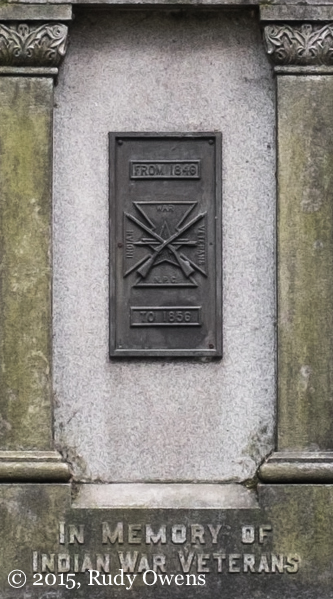
Close up of memorial honoring soldiers who fought for the United States against Native Americans.

Close up of memorial honoring soldiers who fought for the United States against Native Americans.

I looked up and saw this statue of a Civil War soldier, with memorials plaques honoring veterans of Spanish-American War of 1898, the Civil War, the Mexican-American War, and the American Indian Wars from 1846 to 1856, which saw most of Oregon and Washington occupied and appropriated as U.S. territory from many native tribes.

There were conflicts, but many of the original inhabitants were perishing en masse due to diseases like smallpox that accompanied the arrival of new settlers. Even after land was ceded by treaties and tribes were resettled on reservations, hostility was pronounced. Eleven years before this statue was erected, in 1891, the Oregon Legislature was passing resolutions with language that characterized the state’s Native residents as “a wild man.”

State lawmakers signed their names to a measure that stated: “… it would only be a fact of evolution to call him a wild animal on his way to be a man, provided the proper environments were furnished him. While the instincts and perceptions are acute, the ethical part of him is undeveloped, and his exhibitions of a moral nature are whimsical and without motive. Brought into contact with white men. whether of the lowest or of the highest, he is always at a disadvantage which is irritating, and subject to temptations which are dangerous.”

Today, what are we to do with such legacies to this time when these attitudes prevailed, and good people erected monuments to their fellow soldiers who fought for their country, and many doing so believing they were in the right and doing it for the best of intentions?

(Click on each photo to see a larger picture on a separate picture page.)

Monument to the Fallen and Murdered in the East, Warsaw

In Warsaw, ghosts of World War II are all around. In July 2000, I found this one, Monument to the Fallen and Murdered in the East. It honors victims of Soviet atrocities to Polish prisoners who died in captivity in camps in the former U.S. S.R. during that insane war that only ended 70 years ago today. Seems like an appropriate day to honor the memory of ghosts. (Click on the photo to see a larger picture on a separate picture page.)

Slave quarters and slave ledger, Laura Plantation

I visited Louisiana and Mississippi in 2001, partly inspired by the Coen brothers’ great film Oh Brother, Where Art Though. I was also intrigued by the weird tourist subculture built around the glamorization and glorification of the South’s very brutal plantation system, which exploited blacks as slaves and left nearly everyone else out the political system, except very rich, very powerful, and as we later saw in the Civil War, very violent aristocracy. There is a very good book on the economic system that flourished around cotton, North-South trade on the Mississippi River, and slave labor called River of Dark Dreams, by Harvard Professor Walter Johnson. It was in his book where I first learned about a little-known book called 12 Years a Slave, about six months before it burst on the global scene as a movie that won best picture at the 2014 Academy Awards. I figured it was more important to show these pictures of Laura Plantation than fret about their quality (these are now 13-year-old pictures, not well scanned I admit).

Atatürk here, Atatürk there … Atatürk everywhere

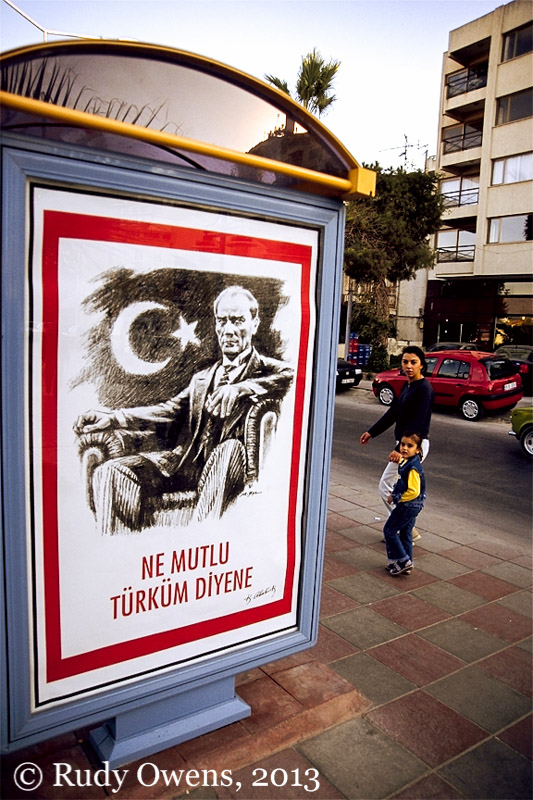
I love Turkey. I traveled widely throughout the country in 2001. Having seen dozens of cities, countless town squares, universities, museums, and public spaces, I was struck by how pervasive the mostly Islamic republic venerates its modern, secular founding father, Mustafa Kemal Atatürk. The cult of Atatürk is alive and well in Turkey, and it remains a bitter legacy to some Armenians and Greeks. Through statues, posters, and mass media, he is more ubiquitous in imagery than Abraham Lincoln is in the United States. See more of my Turkey pictures on my Turkey gallery on my web site.

A picture of modern Turkey's first leader decorates a bus stop in western Turkey (2001).

A picture of modern Turkey’s first leader decorates a bus stop in western Turkey (2001).