Washington State

Season’s Greetings from the Pacific Northwest

I can think of few better ways to enjoy a winter holiday than skate skiing. Hoping you find a way to enjoy yours, and that it brings you closer to nature, friends, and the world around you. (Click on the photo to see a larger picture on a separate picture page.)

In the long shadow of Evel Knievel, daredevils still risk it all

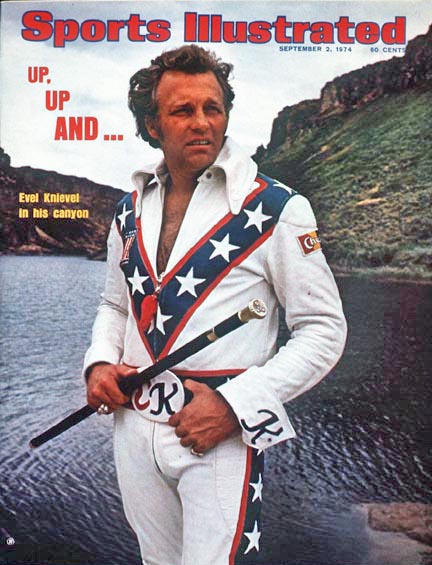
Every modern motorcyle and extreme sports daredevil since the 1960s and  1970s stands in the long shadow of stunt rider Evel Knievel. The Butte, Montana, native and international showman built a legacy of thrilling audiences with death-defying leaps on his motorcyle over long distances. From the grisly televised crash at Caesar’s Palace in December 1967 to jumping 15 buses in Wembley Stadium in London in May 1975, Knievel conquered the public’s imagination. He had spectacular failures and reportedly broke more than 400 bones in his battered body over his long years as a showman extraordinaire and one-of-a-kind daredevil.

The Sports Illustrated cover shows Evel Knievel in his purest form, decked out in his all-American jump suit (great photo).

The Sports Illustrated cover shows Evel Knievel in his purest form, decked out in his all-American jump suit (great photo).

Knievel completely invented himself, his persona, and his brand of entertainment from the ground up, with his imagination knowing no boundaries. His first recorded jump, according to the new documentary on his life called Being Evel, was over two cougars and a box of rattle snakes in Moses Lake, Washington, and he crashed open the box of snakes who got away. He then built up his reputation the hard way, show after show, and also crash after crash. His greatest media stunt, and failure too, was attempting to jump in a specialized vehicle over the Snake River Canyon on Sept. 8, 1974, with him crashing yet again in the canyon floor. But he got back up and kept at it.

As a kid, I likely fell under the Kneivel spell, and saw him many times on TV, on lunch boxes, and on tabloid newspaper covers. He made more than half a dozen appearances on ABC’s Wide World of Sports in the 1970s, when I was growing up. He personified a type of fearless recklessness that excites nearly every young boy, and inspires a few to try such feats later in life. The current climate of Red Bull fueled stunts, jumping from outer space to leaping from cliff faces in wing suits, owes it all to him. Knievel proved you can become a legend if you are willing to put it all on the line and entertain the masses while doing it. Knievel died in 2007 at 69 years of age, a badass to the end, being totally himself.

The photos above were taken at the Omak Stampede in August 2013. I took these shots during practice for a great half-time event at the stampede later that night. Three daredevils, whose names I now cannot find, put on a show with multiple leaps on their dirt bikes and four wheeler. The best rider did a back flip during the show on his bike and totally nailed the landing. They had all of their gear in trailers they hauled by trucks, a bit like Knievel. All three of these guys were accompanied by a trio of totally beautiful women, who stood proudly by their sides. In that way, nothing has changed since Knievel’s day. The daredevil is made of different stuff, and it is the stuff that still appeals to women who like dangerous men. As Knievel may or may not have said, “bones heal, pain is temporary, [and] chicks dig scars… .”

The fury of fire

Following the hottest July ever in human recorded history on planet earth, the American west is having the greatest outbreak of wildfires since the great fires of 1910, which ravaged Montana, Idaho, and Washington state.

Fires are burning widely across my home state of Oregon, Washington, California, British Columbia, and Alaska. Three firefighters were killed on Aug. 19, fighting a blaze in the Methow Valley near Twisp–an area hammered by wildfires in 2014. There is major change taking place. This will involve how we plan for fire, build in fire zones, speculate for fast profits in pretty Western scenery (if you can afford that game), and consider what is safe.

Maybe the lessons will be forgotten. People, particularly wealthy people, will still want to live near the mountains and wild places where fires naturally occur, but with global warming patterns due to climate change, the ecosystem will be transformed more and more by big burns. We as a country cannot afford to purely protect all of the property here, particularly when the sacrifice is lost firefighters’ lives. Will it one day be left just to burn?

I took this picture about a week after fires ravaged the town of Pateros, in central Washington, again at the center of Washington’s complex of fires.

(Click on the picture to see a larger photograph on a separate picture page.)

It’s summer, time to celebrate

These are some of the many dancers who parade through the Fremont neighborhood of Seattle every solstice. The forecast this weekend in Northwest makes me want cheer and welcome the new season. So why not have some summer worshippers show what that means to us in this region. (Photo taken June 2014.)

Click on each the photo to see a larger picture on a separate picture page.

Honoring the fallen at Fort Vancouver

Memorial Day, a day that was first dedicated to the fallen Civil War dead as Decoration Day in 1868, morphed over the decades to honoring all fallen soldiers after World War I. It has been a while since I attended a Memorial Day event (I have done many Veterans Day activities). So I went to beautiful and the historic Fort Vancouver National Historic Site, where hundreds of veterans, their families, and supporters gathered to pay tribute to fallen service personnel on May 25.

I am not a veteran. I do have veterans in my family history. And I know enough about history to know the world is a dangerous place without someone protecting the welfare of folks back home. That would be people like me. I have visited too many battlefields on the planet to not take a long view of what history bitterly teaches us all.

So I think it is important to honor the fallen, and also to honor the individual stories. So I will always honor the ritual, the memories, and emotions. The messaging at such events, by the dignitaries chosen to make meaning of an event, is where issues can arise for me.  So on that note, I will call it good and wish the folks well who were close to those who sacrificed and, as Abraham Lincoln said, gave their full measure of devotion for the country.

Dalles Mountain Ranch

This is the final in my series of photos taken at Columbia Hills State Park, on the Columbia River Gorge, near The Dalles. This historic working ranch was deeded to the state as a vital piece of a park that stretches from the river’s edges to the ridge of the hills overlooking one of the nation’s most dramatic landscapes. Visitors can see historic petroglyphs and pictographs down below, and also drive up the hillside to the ranch, where a trailhead has been created for some outstanding open country hiking. Wildflowers are blooming now. Definitely worth a visit.

Scenes from the Columbia Hills, high on the Gorge


During my visit to Columbia Hills State Park last weekend, I took a hike to the crest of the hills that stand a couple thousand feet above the Columbia River Gorge, from the Washington side. There are miles of open space. Windmill farms lie to the east. To the south, one sees farmland and cattle country in Oregon. Beneath my feet were a dizzying array of blooming flowers, the balsamroot and lupine. I now rate this as one of my favorite perches in the Pacific Northwest.

The Sistine Chapel of Native American art on the Columbia River Gorge

Native Americans, according to archaeology records, lived continuously on the banks of the Columbia River for more than 12,000 years prior to their near demise due to new diseases and the arrival of white settlers in the 1800s. Their culture thrived because of trade among tribes and the stable supply of one of the world’s most nutritious natural food sources: migrating salmon and other fish species in the Columbia River.

The many generations of Native inhabitants also left behind a legacy of artwork, in the form of petroglyphs (rock carvings) and pictographs (paintings). The latter were mostly with white paints, derived from bones, and red paints, derived from blood. The age of these pieces of art are not fully known. They can be found in the region roughly east of Hood River and eastward for the next 40 or so miles. The residents who lived here at the time Lewis and Clark made their journey in the early 1800s on the river were known as the Wishram people.

Sadly, most of the art, the paintings and rock carvings, were flooded when the U.S. Army Corps of Engineers built dams on the Columbia, flooding historic village sites that had been settled since well before the rise of ancient Rome. A number of rock art carvings were salvaged and then reassembled in 2004 for public display at Columbia Hills State Park, in Washington state, near The Dalles, Oregon. The location of the art today was once the site of a thriving Native settlement. Today, the Yakama, Umatilla, and Warm Springs bands hold ceremonies here by their ancestors’ art, which was once on their ancestors’ land.

There is no written record describing the purpose of the art. Current theories suggest the artwork provide guideposts for dream quests, connecting the people to the spirit world. Other pictures also depict elements of folk myth, the most famous painting of all, “Tsagaglalal” or She Who Watches, derived from a story about coyote and clan matriarch who was cast into the rock and stood watch over her people. (The painting is now used as the logo for the Columbia River Interpretive Center.) This is considered one of the finest examples of Native American art in all of North America.

The petroglyphs today are accessible to all for the price of admission to the state park. To see the rock art paintings in an area with limited viewing, you need to call the park in advance and sign up for a guided interpretive tour, led by a park cultural interpreter or a Native American guide. This was one of the highlights of my regional outings in the Pacific Northwest.

I would recommend this trip to anyone, of any age. You find yourself in one of the most scenic areas in North America, standing on land where countless generations stood before you.

You can see some photos of this area and its former Native inhabitants in the collection of Edward Curtis, famed photodocumentarian of Native American people (including staged photos). His work is archived on a superb Smithsonian photo media archive. Look for pictures marked “Wishham” (note spelling differences from above).

Click on each photo to see a larger picture on a separate picture page.

It’s all about the grain, and the global marketplace

Vancouver, Wash., is home to the United Grain Corp.’s export terminal. According to the company, the grain elevator complex is the largest grain elevator on the West Coast. This is a massive facility. The complex dominates the landscape on the banks of the Columbia River north of Portland. Cargo ships will line up on the Columbia River and basically park in the river until there is a berth for at the terminal or across the river at the Port of Portland’s export terminal on the Willamette River. Wheat grown in western Washington is one of the main exports, mainly for global markets.

I took the photos of the anchored cargo vessels from Frenchman’s Bar Park, in Clark County, just north of Vancouver. It is a beautiful spot to see how the global commodities market works–one ship and one train at a time.