Photography

Detroit, my home town

This is the final post I am making, for a while at least, on the city of my birth, Detroit. I wanted to capture the industrial area located in Dearborn and southwest Detroit, around the River Rouge and Zug Island. The neighborhood filmed is called Delray. The murals shown in the video are by Diego Rivera, at the Detroit Institute of the Arts. They capture the world-famous Mexican muralist’s impressions of industrial production and Ford’s River Rouge complex, then the world’s largest factory, in the early 1930s.

UM Law School Quad, the center of power

Architecture serves many purposes. It provides beauty with function. It enlightens and inspires. It expresses our ambitions, desires, and emotions. During my recent visit to Ann Arbor, I toured the University of Michigan Law School Quadrangle, better known as the Quad. I loved the English Gothic style and how the architects purposefully created a space to demonstrate power and purpose. Prestigious? Yes. Expensive? You betcha. And the competition is fierce to get in.

According to the Society of Architectural Historians, “The school recalls the design of the colleges of Oxford and Cambridge and of the Inns of Court in London, but it is adapted to modern academic life.”

Thousands of them a year, bro

Charlie LeDuff, author of Detroit, An American Autopsy, has provided one of the most painful descriptions of nihilistic self-destruction I have ever read. It is a brutally honest dissection of Detroit. While working as a reporter for the Detroit News, he became close to a company of the city’s beleaguered firefighters, who have battled literally thousands of fires intentionally set by criminal arsonists throughout the metro area. LeDuff shared this comment from one of the firefighters who is asked to do the near impossible–save a city the residents are intentionally burning down.

“In this town, arson is off the hook. Thousands of them a year, bro,” the firefighter told LeDuff. “In Detroit, it’s so fucking poor that a fire is cheaper than a movie. A can of gas is three-fifty, and a movie is eight bucks, and there aren’t any movie theaters left in Detroit so fuck it. They burn the empty house next door and they sit on the fucking porch with a forty, and they’re barbecuing and laughing ‘cause it’s fucking entertainment. It’s unbelievable. And the old lady living next door, she don’t have no insurance, and her house goes up in flames and she’s homeless and another fucking block dies.”

In my entire life, during which I have visited dozens of countries, I have not witnessed anything as bizarre as this. I have seen worse than this, and things vastly more evil than this. But the utter pointlessness of this chaos, besides pure anger and loss of meaning, seem overwhelming. And people live with this, next to his, surrounded by this, engulfed by this. For those of you out there who may snicker and even enjoy this, take heed. LeDuff and many other chroniclers of the downfall of the American middle-class in cities like Detroit have a message for you. Detroit is not the past. Detroit is the future, coming to a place near you, and quicker than you think.

Most of these crime scenes are in what used to be called the Delray neighborhood, near Dearborn and Jefferson, by Zug Island. Hard to imagine that people still make the best of it here. It is home to someone. I often wonder what Canadians just across the Detroit River may have thought seeing flames, if they could see the smoke amid the heavy industry that surrounds this former Hungarian-American enclave. This is now called a “ghost town” within a city.

God has left Detroit

In April, I spent a couple of eye-opening days in my home town, Detroit. I was born here. My grandparents lived here for decades. My biological family (I am adopted) grew up here on my birth mother’s side. I only lived here a year, before my adoptive parents left in 1966, a year before the deadly race riots of 1967, one of several that have spanned more than 120 years.

Photographers who parachute into Detroit, like me, are rightfully accused of being disaster voyeurs. Photographing Detroit is now its own photo genre many dub “ruin porn.” Taking pictures of a dying place, where real people are struggling just to survive, is by definition schadenfreude.

I guess I have a saving grace. I am a native son. I really was born in a hospital here. My family, on my birth mother’s side, has true Detroit roots, and for that reason I feel a strong attachment.

I wrote a short essay about my trip in April, and I find myself feeling deeply unsettled now about how the last eight years of our Great Recession have been handled and the wars that preceded it. Going to Detroit you cannot ignore the massive impact of trade policies like NAFTA and the globalization of manufacturing in the years before and after its signing, when the United States began to export its manufacturing jobs overseas.

Jeez, here we are the wealthiest country on earth, and yet we let our great industrial center literally collapse before us, all while venturing overseas to preserve our strategic interests. We all watched and let the patient wither in agony, at times laughing at the patient’s demise. Today the lethal court clown of a city titillates us with reality TV that delights in the destruction of Detroit and the goofy exploits of its charismatic preachers, reality star cops, and wacky urban survivalists.

I love road trips, particularly in Oregon

Road trips always have their own flavor. I love unexpected discoveries and having an open mind to welcome the new, the different, and the unplanned. This trip took me from Portland, to Sisters (biking up to McKenzie Pass), to Fort Rock, to Eugene, and back home. I learned about the oldest shoes ever found in the world, at Fort Rock. I also fell in love with the beauty of Eugene. I lived there for nearly two years in the mid-’90s and still thinks it’s a lovely place. Hope you all take a road trip soon, everyone. (Click on each photo to see a larger photo on a separate picture page.)

Fort Rock State Natural Area up close and from afar


This is the second in my series of images published on the Fort Rock State Natural Area. My first set of photos were taken  near the entrance to the old volcanic caldera. A reply I received from a person who is an advocate for the Fort Rock Valley Historical Society wanted to be sure I noted that the Fort Rock Homestead Village is a citizen led effort and uses donated buildings, all of which are authentic to the area. Duly noted. A museum is open to the visiting public, and it is worth a story stop too. My only regret is not having done enough research in advance and learned more about the amazing footwear found near the crater–the world’s oldest known pair of shoes, or should I say sandals. Here are a few more angles of the area, as well as the village.

Click on each photo to see a larger picture on a separate picture page.

Fort Rock State Natural Area, a sacred place

This is the first of a couple of posts I will do on Fort Rock State Natural Area (formerly park), in the high desert of south central Oregon. I wanted to show its features today from the perspective given by my GoPro, which has a unique and very wide angle perspective (and distortion).

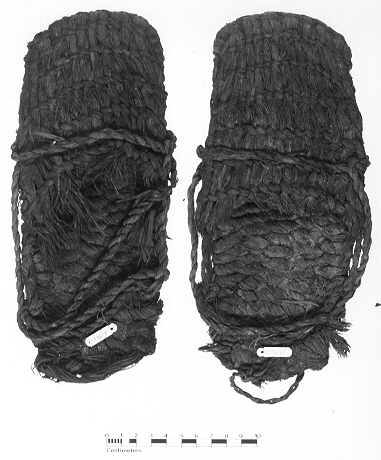
These sandals were found a mile from Fort Rock State Natural Area and are approximately 10,000 years old (photo courtesy of the University of Oregon). These sandals were found in 1938 by archaeologist Luther Cressman.

These sandals were found a mile from Fort Rock State Natural Area and are approximately 10,000 years old (photo courtesy of the University of Oregon). These sandals were found in 1938 by archaeologist Luther Cressman.

Fort Rock is a gem. It stands prominently on the floor of what was once a lake bed. The formation is an extinct volcano that blew about 1.8 million years ago. Archaeological evidence dates Native American habitation here for at least 10,000 years. A research expedition in 1938 unearthed dozens of sage bark sandals under a layer of volcanic ash about a mile from here that are carbon dated as 10,000 years old. So clearly the continent’s first peoples have been coming here for many millenia.

I felt a touch of the divine and sacred here. How can one not. Its circular formation, its prominence on a desolate landscape, its energy when one stands on the rim of the crater–all create a feeling of otherworldliness. I saw deer and jackrabbits, so clearly food could be hunted here. It is well worth a visit. The area is about 70 miles southeast of upscale retirement city Bend, and there is no entrance fee. The state has also erected a recreated historic pioneer village near the entrance.

Click on each photo to see a larger picture on a separate picture page.

Downtown Portland, a profile in Northwest-style gentrification

Portland is no stranger to gentrification. I’ll use that term to describe the redevelopment of urban properties that “revitalize” areas from being low-value for tax collectors to high-value and geared to serve people with high-income levels. That is my own definition. One piece of downtown that has transformed over the last two decades is around Burnside Street and the blocks of SW and NW 10th through SW and NW 14th. One of the anchor businesses here is Powell’s Books, a great institution. Whole Foods moved in more than a decade ago, and there continues to be a lively debate if the company follows the prevailing winds, or moves the local real-estate market up in price once it chooses a site. (For the record, I have shopped and eaten here many times.)

The landmark building in this section of downtown is the old Henry Weinhard’s Brewery. This is a classic late 19th century brick factory style structure that once was home to the former local beer company of the same name that is now folded within the larger MillerCoors brewing empire. The old factory is now mixed-used retail and condos, following the redevelopment completed in 2002. The building retains a facade of a brewery, but it doesn’t brew beers. Scores of other fine microbreweries do that around town. On any give night, there is a lot of foot traffic, and people usually pack the Henry’s Tavern located inside the old factory. When I first moved to Portland in 1983, I remember this part of town as being a popular area to many homeless residents, warehouses, and retail businesses that came and went.

Click on each photo to see a larger picture on a separate picture page.

You know you are in Portland when …

Portland reportedly has the highest number of breweries than any city in the country, at nearly 60, plus an uncountable number of microbrewing enthusiasts. I have my own favorites in the realm of microbrews. At the West Coast’s largest bookstore, Powell’s, one can find more than a few resources to help a person try this centuries-old tradition at home. Prost!

(Click on the photo to see a larger picture on a separate picture page.)