I will be taking a road trip in a week. The destination is probably where most people in my country last would want to be traveling. But I always seems to find unexpected treasures when I pick a new place, and have a purpose, and find wonderful, beautiful things in places overlooked or shunned. Hoping your journey leads to new discoveries for you.
Oregon
Letting go of pressure
Letting go. One of the hardest things to do. Stress. Worries. Troubles at work, with the family, with a loved one. Sometimes, letting go of pressure is all most of us need.
Click on the image to watch the video in WordPress, or to see a larger version, you can see the video directly on YouTube.
It’s a big old goofy world in carnie land
I visited the Oaks Amusement Park this weekend, in southeast Portland, along the Willamette River. This 110-year-old facility is a classic, old-style small amusement park, not a corporate-themed fantasy land that milks consumers for all they got. It is among the oldest in the country. Old-school amusement parks are part of an older, carnival world that dates back to the Midways and Pikes of the 1893 and 1904 World’s Fairs in Chicago and St. Louis. In fact, Oaks Park is part of that tradition, opening as part of the 1905 Portland World’s Fair.
There is something utterly low-brow about businesses like these. No one who attends the opera would be found anywhere near here. The rides are not forcing us to buy Disney products or watch a Universal Pictures film. Most are just about flinging our bodies in different directions, so we can momentarily feel a sense of safely packaged fear and excitement, with a slight twinge of panic these old contraptions might break down and fling us to oblivion.
What I saw at Oaks Park also was about the most diverse crowed I have seen in one place in Portland since arriving. Parents and their kids, and also grandparents, were letting it rip, laughing, and having a good time. The carnie atmosphere prevailed on the main strip, complete with gun-skills galleries, basketball tosses, junk food, and stuffed toys. I thought about the people who worked here and what they thought about their daily grind, and the people who spend their hard-earned money just to escape from life for an hour or two without going broke.
Surprisingly, amusement parks are almost always portrayed as sinister places in film, from West World to Jurassic Park, to even older films like the noir classic Third Man with Orson Welles and Joseph Cotten. This American Life did a pretty good episode on amusement parks also. It is worth a listen too. So amid that joy, and it was joy, you always feel that sense of trepidation, like maybe, just maybe, the rides might not work. And maybe, that is why people keep coming back, year after year.
Hot, dry and scenic Wasco County, Oregon
I took a short trip in July to the Deschutes River, in north central Oregon. It’s a region defined by a great giver, beautiful rolling hills, ranches and farmland and remnants of Oregon’s more agricultural past. All of these photos were taken in Wasco County. Here is my tip. Never go biking in the late afternoon sun. Choose the morning.
Sauvie Island river surf
North of Portland, you will find Sauvie Island, a stretch of land that is both a fish and wildlife area and superb farmland. About 30 mammals can be found here, not to mention dozens of different bird species. Today I spied osprey to egrets. It is also a layover spot for migratory birds on their passages north and south.
One of the nicest sections of this popular getaway from Portland are the beaches that line the Columbia River. No doubt Native Americans fished and hunted here for thousands of years. Today, you will find residents from the Portland area trying to stay cool.
The sandy stretches are superb. You can see the freighter traffic pass by, to the ports of Portland and Vancouver, where there are large grain silos and shipping docks. When the big ships pass by, they of course leave some powerful wakes that create micro surf on the beach. It is a pretty fun thing to do on a hot day, and everyone I saw was having a great time.
(Click on each photo to see a larger picture on a separate picture page.)
A story for every stone
My explorations of Portland’s historic Lone Fir Cemetery found lots of fascinating headstones. Each represents a life, a full story, a story that intersects with hundreds of other stories. And how do we remember these former residents, who are now but forgotten. Cemeteries remain a good place to contemplate one’s life and what one does with one’s life. Because ultimately we all return to the earth, and our life is but a speck in the passage in time in an infinite universe. (Click on each photograph to see a larger picture on a separate picture page.)
Two sides of a historic coin and wrestling with the past
The debates over the public and state-sanctioned display of the flag of the slave-holding Confederacy point to the United States’ not-so recent past. No country is pure, and the United States’ evolution is marked by great accomplishments, great divisions, and also some historic acts that leave a painful legacy. Our history of conflict in the 1800s stretches the entire century, from the War of 1812, through the Mexican-American War, dozens of conflicts with Native American bands across the continent, overseas expansion and trade wars (the Opium War), and the Spanish-American War.
in 1902, Portland area residents and war veterans erected a statue honoring the nation’s war veterans at the city’s historic Lone Fir Cemetery in Southeast Portland. The cemetery is filled with graves of many white, Christian early settlers from the 1800s, and latter-day residents of all persuasions. I stumbled on the cemetery accidentally at a staging of Macbeth last weekend.
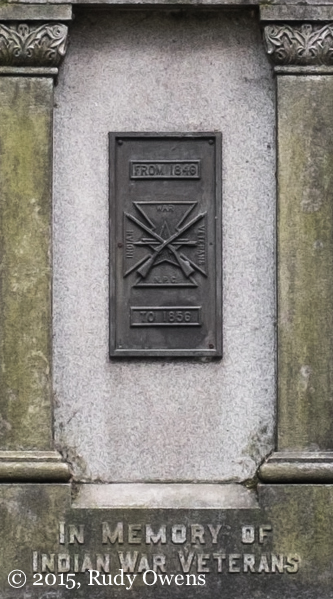
I looked up and saw this statue of a Civil War soldier, with memorials plaques honoring veterans of Spanish-American War of 1898, the Civil War, the Mexican-American War, and the American Indian Wars from 1846 to 1856, which saw most of Oregon and Washington occupied and appropriated as U.S. territory from many native tribes.
There were conflicts, but many of the original inhabitants were perishing en masse due to diseases like smallpox that accompanied the arrival of new settlers. Even after land was ceded by treaties and tribes were resettled on reservations, hostility was pronounced. Eleven years before this statue was erected, in 1891, the Oregon Legislature was passing resolutions with language that characterized the state’s Native residents as “a wild man.”
State lawmakers signed their names to a measure that stated: “… it would only be a fact of evolution to call him a wild animal on his way to be a man, provided the proper environments were furnished him. While the instincts and perceptions are acute, the ethical part of him is undeveloped, and his exhibitions of a moral nature are whimsical and without motive. Brought into contact with white men. whether of the lowest or of the highest, he is always at a disadvantage which is irritating, and subject to temptations which are dangerous.”
Today, what are we to do with such legacies to this time when these attitudes prevailed, and good people erected monuments to their fellow soldiers who fought for their country, and many doing so believing they were in the right and doing it for the best of intentions?
(Click on each photo to see a larger picture on a separate picture page.)
The big toys come out during summertime
Everywhere I walk and go it seems, some water or road project is going on, digging up streets, laying new sewer lines, and creating some inconvenience for all of us. Hey folks, that is called the price of living in a modern world. Be thankful you have these things. According to Food and Water Watch, 2.5 billion people, 1 billion of them kids, live without basic sanitation like a sewer system. And if you think your roads are bad, try them overseas, where they create literally lethal situations daily. So, you may just try and chill out if you have to wait. You can even smile at those flaggers. They are your price for a modern, comfortable life. It is worth our investment.
How Portland Looks from the Burnside Bridge
Burnside Bridge gives one a great view of the Willamette River and downtown Portland. It’s also near the areas where the city’s large homeless community congregates. One normally has to keep one’s wits about oneself here at night. Usually some crime noir is happening here, in a not so pleasant way. I came here on summer solstice to capture a few random views. I love the view of the grain elevator the Steel Bridge to the north and the freeway jumble where I-84 and I-5 collide.
Swan Island and downtown Portland
One of my favorite views of Portland is from the overlook along North Willamette Boulevard, looking at the Swan Island shipyards to downtown Portland. It is always worthwhile checking what ships are getting work here. This shipyard keeps our economy ticking, and to date we have not found a way to outsource the jobs and industry to Indonesia or Brazil, but I know people are working hard to do that. I want this shipyard to stay.