Landscapes

The fury of fire

Following the hottest July ever in human recorded history on planet earth, the American west is having the greatest outbreak of wildfires since the great fires of 1910, which ravaged Montana, Idaho, and Washington state.

Fires are burning widely across my home state of Oregon, Washington, California, British Columbia, and Alaska. Three firefighters were killed on Aug. 19, fighting a blaze in the Methow Valley near Twisp–an area hammered by wildfires in 2014. There is major change taking place. This will involve how we plan for fire, build in fire zones, speculate for fast profits in pretty Western scenery (if you can afford that game), and consider what is safe.

Maybe the lessons will be forgotten. People, particularly wealthy people, will still want to live near the mountains and wild places where fires naturally occur, but with global warming patterns due to climate change, the ecosystem will be transformed more and more by big burns. We as a country cannot afford to purely protect all of the property here, particularly when the sacrifice is lost firefighters’ lives. Will it one day be left just to burn?

I took this picture about a week after fires ravaged the town of Pateros, in central Washington, again at the center of Washington’s complex of fires.

(Click on the picture to see a larger photograph on a separate picture page.)

Has it been 20 years already, Machu Picchu?

Yes, Machu Picchu, with a llama munching on grass, is a complete photographic cliché. I do not care. I snapped this photograph in the very very early morning hours at this great Inca hill city in late August 1995. I hiked the Machu Picchu Trail to get here, passing six ruins. It was a highlight of my life, mainly because of the incredible mountain topography, the historic footprint of the now-gone Inca culture, and the fulfillment of a dream of mine to mix my passions for mountains, long-distance trekking, and archaeology-history. The negative for this photo was damaged by the developer, as I made a big mistake entrusting my film to a shop in Santiago. But with a little Adobe magic, it turned out OK.

When I arrived at Machu Picchu, it was smoked out from fires on the Amazon basin, where farmers and cattle owners were burning land. I had camped out at Intipunku (Sun Gate), which looks down on the ruins from a nearby pass. That was not, ahem, entirely allowable, but I practiced low-impact camping and had zero impact. And I know my footprint was radically less than the organized tours, some of whom were leaving trash at camp sites. I am now glad the trail is more regulated. There simply is no other way with such a globally popular destination.

(Click on the photo to see a larger picture on a separate picture page.)

Washington Park Cemetery, the forgotten burial place

In the completely overlooked and unknown north St. Louis County community of Berkeley, Missouri, lies an overgrown, forgotten, and largely abandoned cemetery. Washington Park Cemetery was founded in the 1920s as a burial place for the St. Louis area’s black residents. It lies just off Natural Bridge Road, about 1.5 miles from Lambert International Airport.

Today, few if anyone knows about this place. It has been the subject of news stories throughout the years, mainly involving land use controversies that led to cemetery land and graves being removed to make way for an interstate and more recently in 1993 for the MetroLink light rail, which connects the urban center with the airport. Literally thousands of former bodies were removed to make way for major public infrastructure.

I knew about this battered resting place ever since I was a kid. I could see the graves literally right next to Interstate 70, and read stories in the 1990s about the light rail and airport expansion disputes. When I stayed in a hotel literally just across from this cemetery in July, I instantly knew what the place was, even though I found no signs. All I found were grave markers, names of African-American residents who were interned and the weeds, trees, and brush that were taking over the place. It reminded me of Jewish cemeteries I found in Poland, now abandoned since the tragedy of the Shoah in the 1940s.

Here are a few shots that I took wandering around on my last night before flying back to Portland. It was hot, humid, and eery. In the distance in one shot is the Renaissance Hotel, a luxury airport accommodation that looms over the cemetery. I doubt a single guest at that place ever wanders in the back to see the history that is now slowly being taken over by the Missouri bush.

(Click on each photograph to see a larger picture on a separate picture page.)

Hot, dry and scenic Wasco County, Oregon

I took a short trip in July to the Deschutes River, in north central Oregon. It’s a region defined by a great giver, beautiful rolling hills, ranches and farmland and remnants of Oregon’s more agricultural past. All of these photos were taken in Wasco County. Here is my tip. Never go biking in the late afternoon sun. Choose the morning.

Sauvie Island river surf

North of Portland, you will find Sauvie Island, a stretch of land that is both a fish and wildlife area and superb farmland. About 30 mammals can be found here, not to mention dozens of different bird species. Today I spied osprey to egrets. It is also a layover spot for migratory birds on their passages north and south.

One of the nicest sections of this popular getaway from Portland are the beaches that line the Columbia River. No doubt Native Americans fished and hunted here for thousands of years. Today, you will find residents from the Portland area trying to stay cool.

The sandy stretches are superb. You can see the freighter traffic pass by, to the ports of Portland and Vancouver, where there are large grain silos and shipping docks. When the big ships pass by, they of course leave some powerful wakes that create micro surf on the beach. It is a pretty fun thing to do on a hot day, and everyone I saw was having a great time.

(Click on each photo to see a larger picture on a separate picture page.)


Swan Island and downtown Portland

One of my favorite views of Portland is from the overlook along North Willamette Boulevard, looking at the Swan Island shipyards to downtown Portland. It is always worthwhile checking what ships are getting work here. This shipyard keeps our economy ticking, and to date we have not found a way to outsource the jobs and industry to Indonesia or Brazil, but I know people are working hard to do that. I want this shipyard to stay.

Thousands of them a year, bro

Charlie LeDuff, author of Detroit, An American Autopsy, has provided one of the most painful descriptions of nihilistic self-destruction I have ever read. It is a brutally honest dissection of Detroit. While working as a reporter for the Detroit News, he became close to a company of the city’s beleaguered firefighters, who have battled literally thousands of fires intentionally set by criminal arsonists throughout the metro area. LeDuff shared this comment from one of the firefighters who is asked to do the near impossible–save a city the residents are intentionally burning down.

“In this town, arson is off the hook. Thousands of them a year, bro,” the firefighter told LeDuff. “In Detroit, it’s so fucking poor that a fire is cheaper than a movie. A can of gas is three-fifty, and a movie is eight bucks, and there aren’t any movie theaters left in Detroit so fuck it. They burn the empty house next door and they sit on the fucking porch with a forty, and they’re barbecuing and laughing ‘cause it’s fucking entertainment. It’s unbelievable. And the old lady living next door, she don’t have no insurance, and her house goes up in flames and she’s homeless and another fucking block dies.”

In my entire life, during which I have visited dozens of countries, I have not witnessed anything as bizarre as this. I have seen worse than this, and things vastly more evil than this. But the utter pointlessness of this chaos, besides pure anger and loss of meaning, seem overwhelming. And people live with this, next to his, surrounded by this, engulfed by this. For those of you out there who may snicker and even enjoy this, take heed. LeDuff and many other chroniclers of the downfall of the American middle-class in cities like Detroit have a message for you. Detroit is not the past. Detroit is the future, coming to a place near you, and quicker than you think.

Most of these crime scenes are in what used to be called the Delray neighborhood, near Dearborn and Jefferson, by Zug Island. Hard to imagine that people still make the best of it here. It is home to someone. I often wonder what Canadians just across the Detroit River may have thought seeing flames, if they could see the smoke amid the heavy industry that surrounds this former Hungarian-American enclave. This is now called a “ghost town” within a city.

God has left Detroit

In April, I spent a couple of eye-opening days in my home town, Detroit. I was born here. My grandparents lived here for decades. My biological family (I am adopted) grew up here on my birth mother’s side. I only lived here a year, before my adoptive parents left in 1966, a year before the deadly race riots of 1967, one of several that have spanned more than 120 years.

Photographers who parachute into Detroit, like me, are rightfully accused of being disaster voyeurs. Photographing Detroit is now its own photo genre many dub “ruin porn.” Taking pictures of a dying place, where real people are struggling just to survive, is by definition schadenfreude.

I guess I have a saving grace. I am a native son. I really was born in a hospital here. My family, on my birth mother’s side, has true Detroit roots, and for that reason I feel a strong attachment.

I wrote a short essay about my trip in April, and I find myself feeling deeply unsettled now about how the last eight years of our Great Recession have been handled and the wars that preceded it. Going to Detroit you cannot ignore the massive impact of trade policies like NAFTA and the globalization of manufacturing in the years before and after its signing, when the United States began to export its manufacturing jobs overseas.

Jeez, here we are the wealthiest country on earth, and yet we let our great industrial center literally collapse before us, all while venturing overseas to preserve our strategic interests. We all watched and let the patient wither in agony, at times laughing at the patient’s demise. Today the lethal court clown of a city titillates us with reality TV that delights in the destruction of Detroit and the goofy exploits of its charismatic preachers, reality star cops, and wacky urban survivalists.

Fort Rock State Natural Area up close and from afar


This is the second in my series of images published on the Fort Rock State Natural Area. My first set of photos were taken  near the entrance to the old volcanic caldera. A reply I received from a person who is an advocate for the Fort Rock Valley Historical Society wanted to be sure I noted that the Fort Rock Homestead Village is a citizen led effort and uses donated buildings, all of which are authentic to the area. Duly noted. A museum is open to the visiting public, and it is worth a story stop too. My only regret is not having done enough research in advance and learned more about the amazing footwear found near the crater–the world’s oldest known pair of shoes, or should I say sandals. Here are a few more angles of the area, as well as the village.

Click on each photo to see a larger picture on a separate picture page.

Fort Rock State Natural Area, a sacred place

This is the first of a couple of posts I will do on Fort Rock State Natural Area (formerly park), in the high desert of south central Oregon. I wanted to show its features today from the perspective given by my GoPro, which has a unique and very wide angle perspective (and distortion).

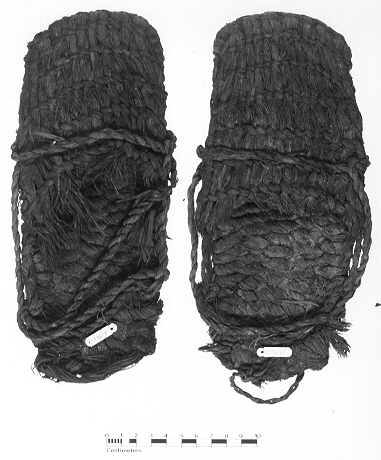
These sandals were found a mile from Fort Rock State Natural Area and are approximately 10,000 years old (photo courtesy of the University of Oregon). These sandals were found in 1938 by archaeologist Luther Cressman.

These sandals were found a mile from Fort Rock State Natural Area and are approximately 10,000 years old (photo courtesy of the University of Oregon). These sandals were found in 1938 by archaeologist Luther Cressman.

Fort Rock is a gem. It stands prominently on the floor of what was once a lake bed. The formation is an extinct volcano that blew about 1.8 million years ago. Archaeological evidence dates Native American habitation here for at least 10,000 years. A research expedition in 1938 unearthed dozens of sage bark sandals under a layer of volcanic ash about a mile from here that are carbon dated as 10,000 years old. So clearly the continent’s first peoples have been coming here for many millenia.

I felt a touch of the divine and sacred here. How can one not. Its circular formation, its prominence on a desolate landscape, its energy when one stands on the rim of the crater–all create a feeling of otherworldliness. I saw deer and jackrabbits, so clearly food could be hunted here. It is well worth a visit. The area is about 70 miles southeast of upscale retirement city Bend, and there is no entrance fee. The state has also erected a recreated historic pioneer village near the entrance.

Click on each photo to see a larger picture on a separate picture page.