Nazis

Portland, Oregon rally against the Trump administration, April 19, 2025

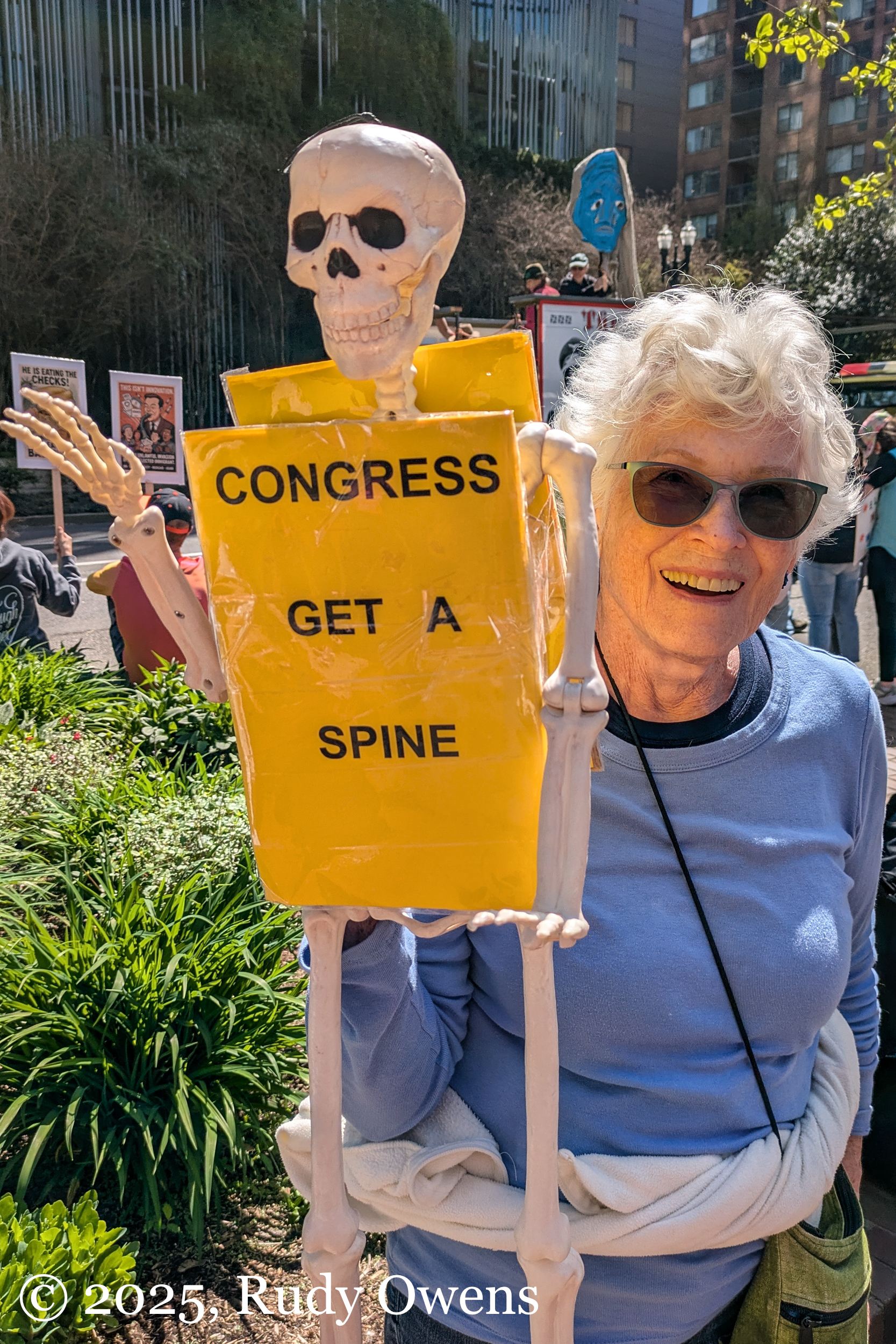
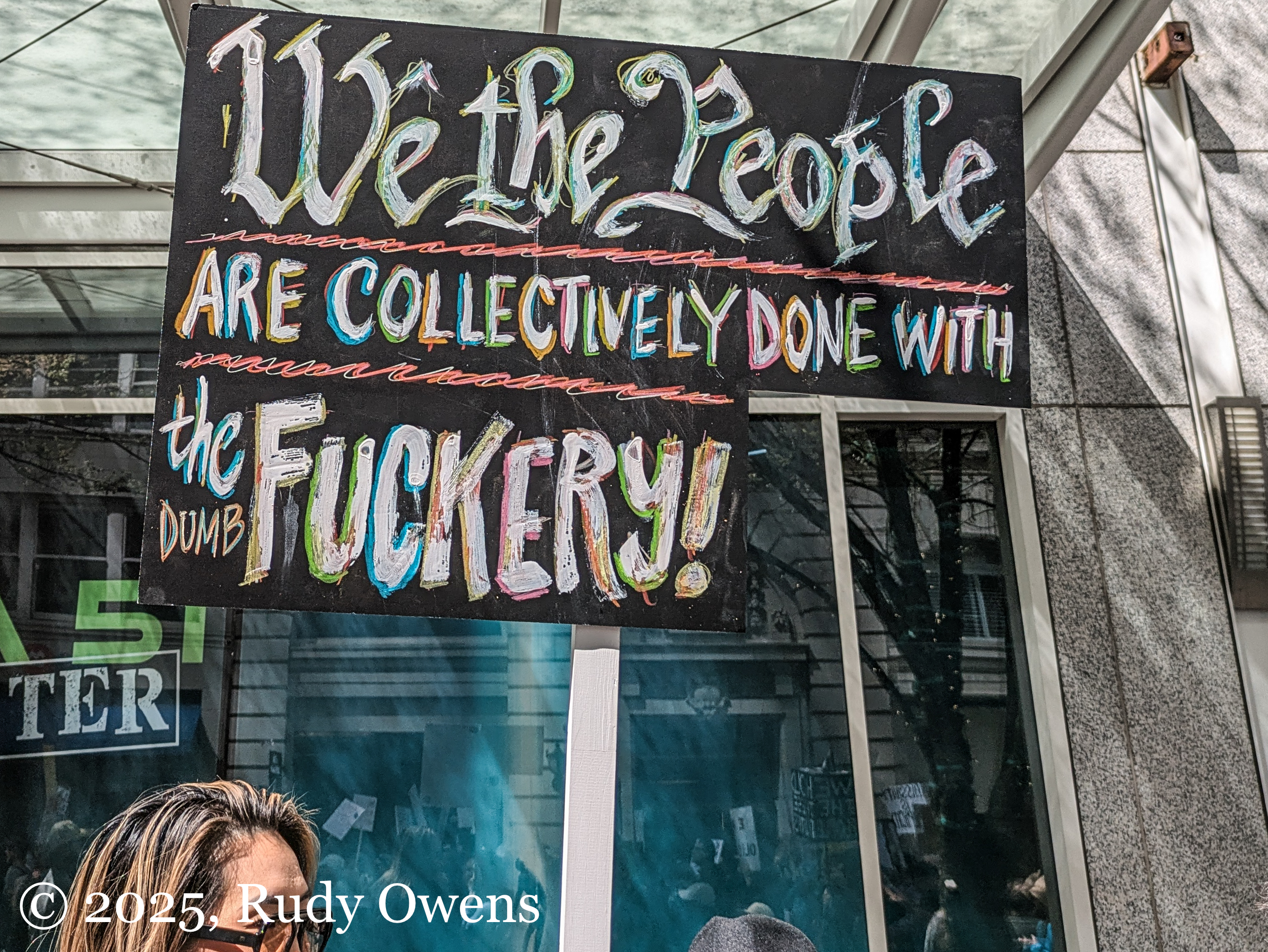
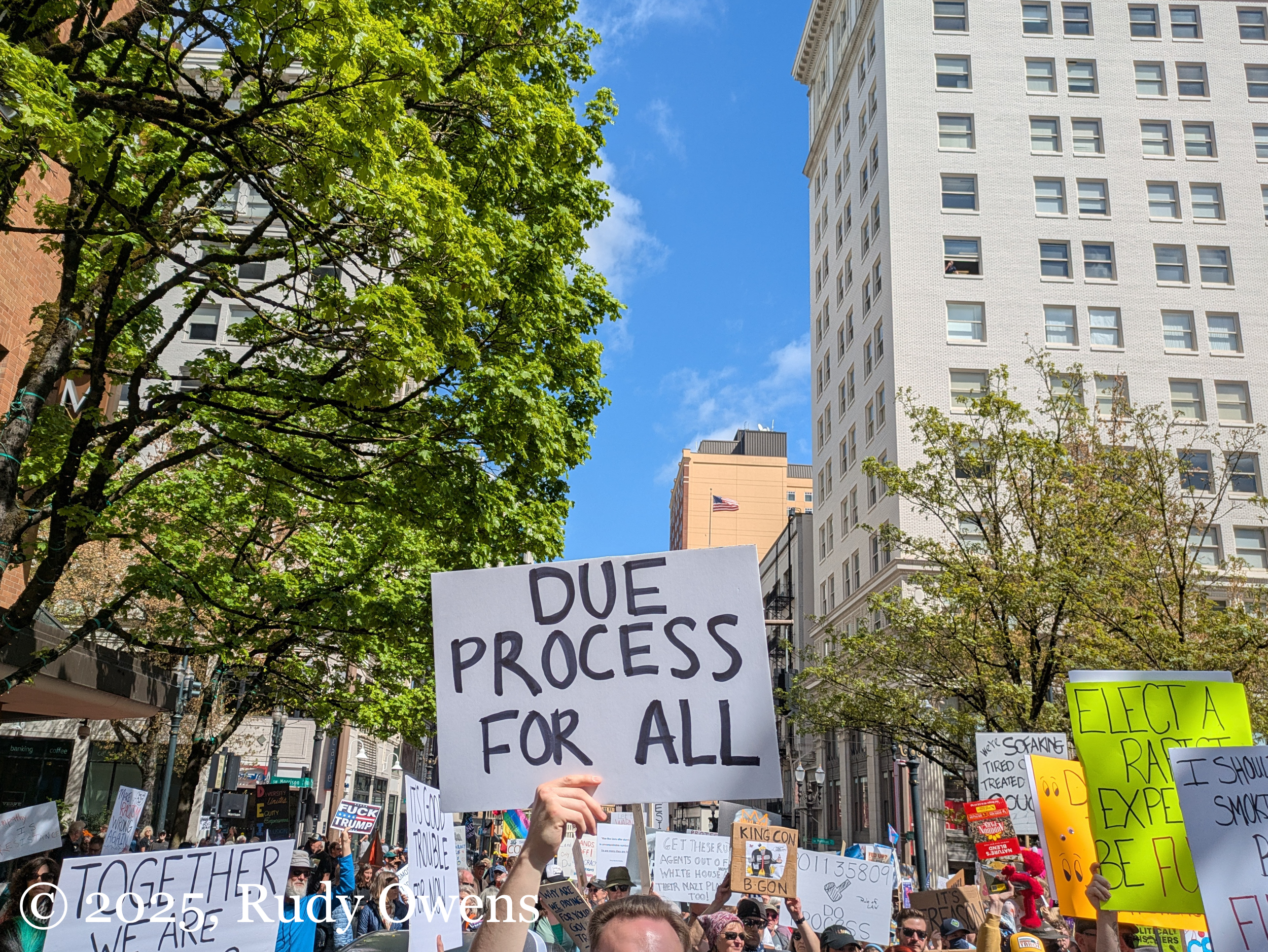
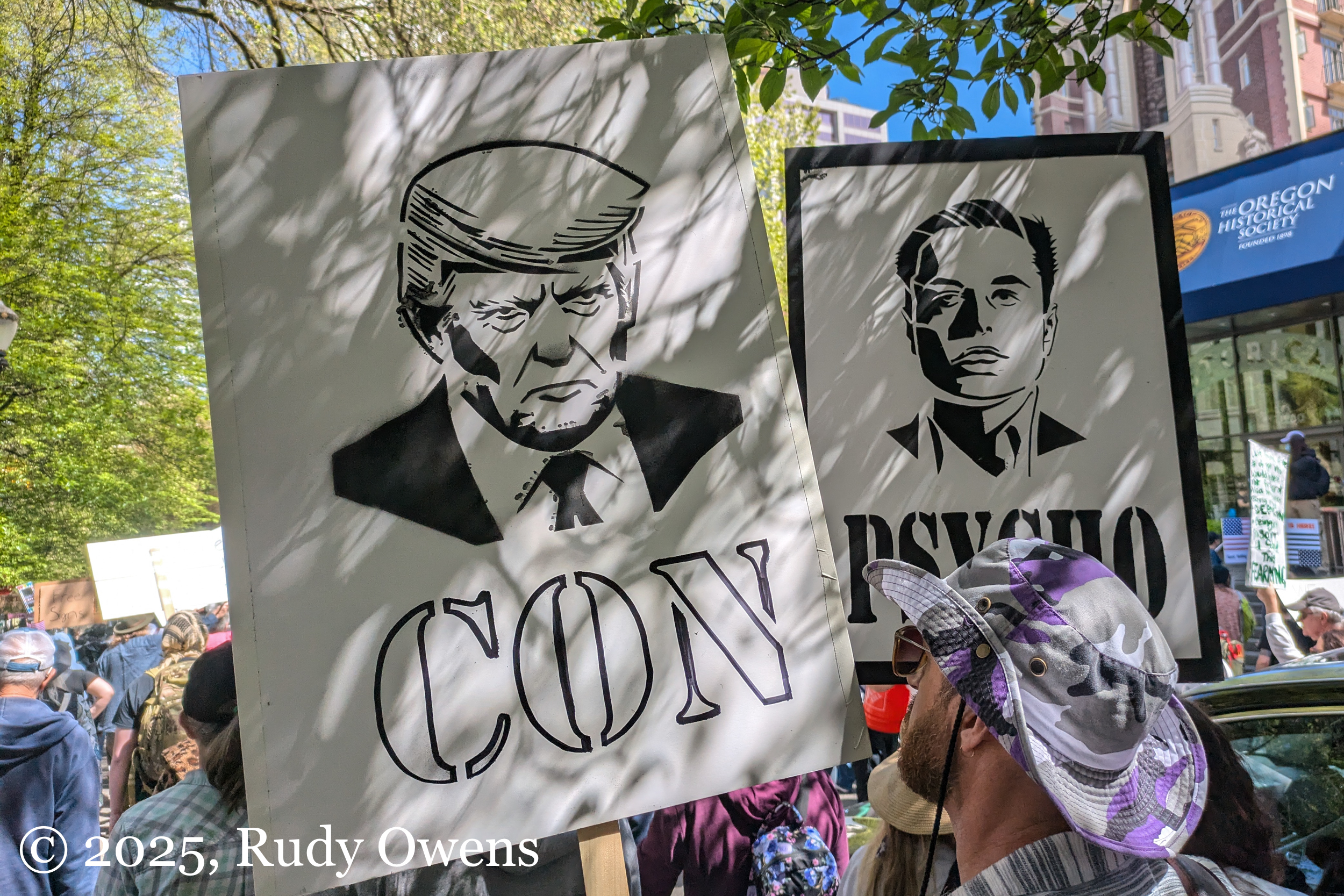
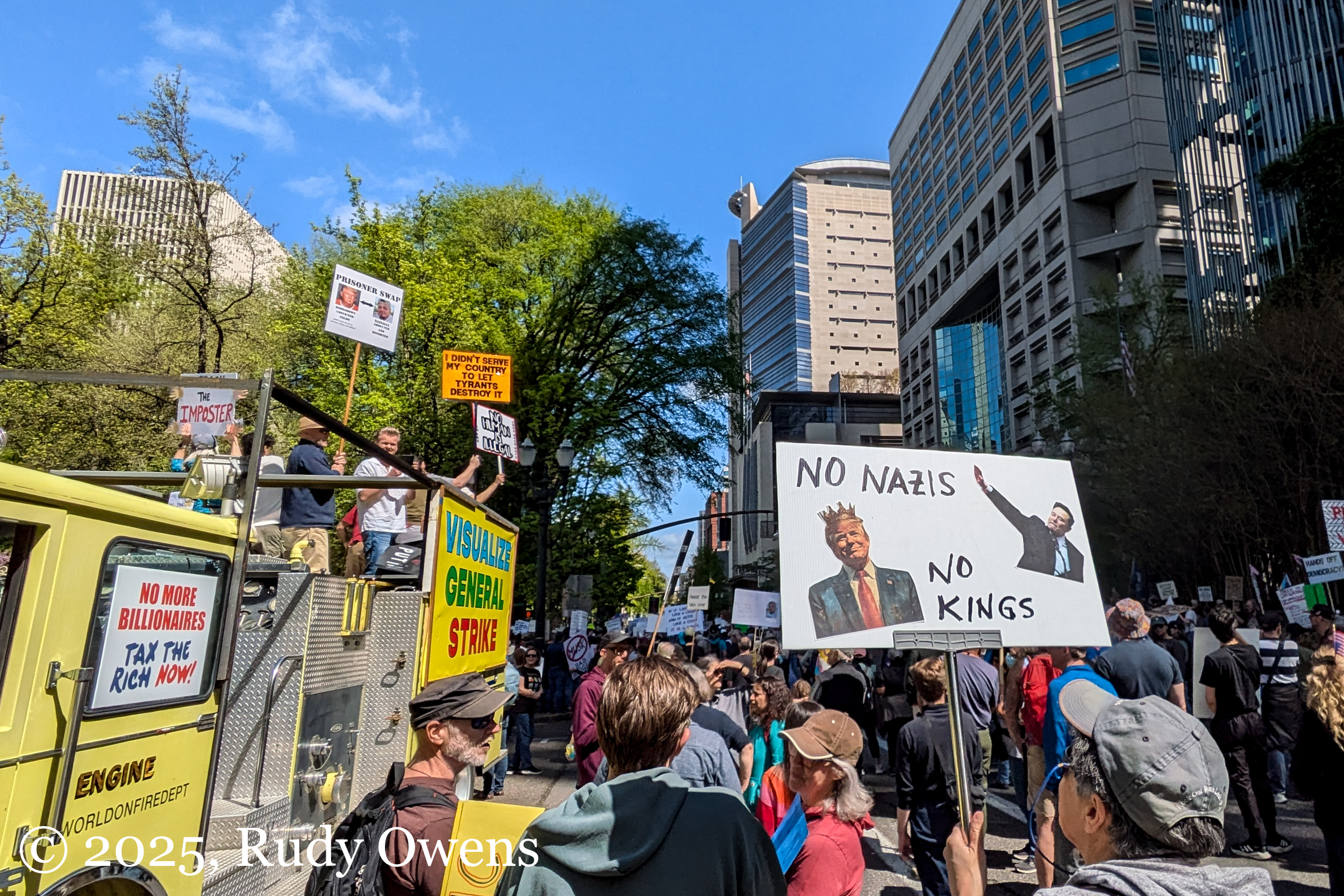
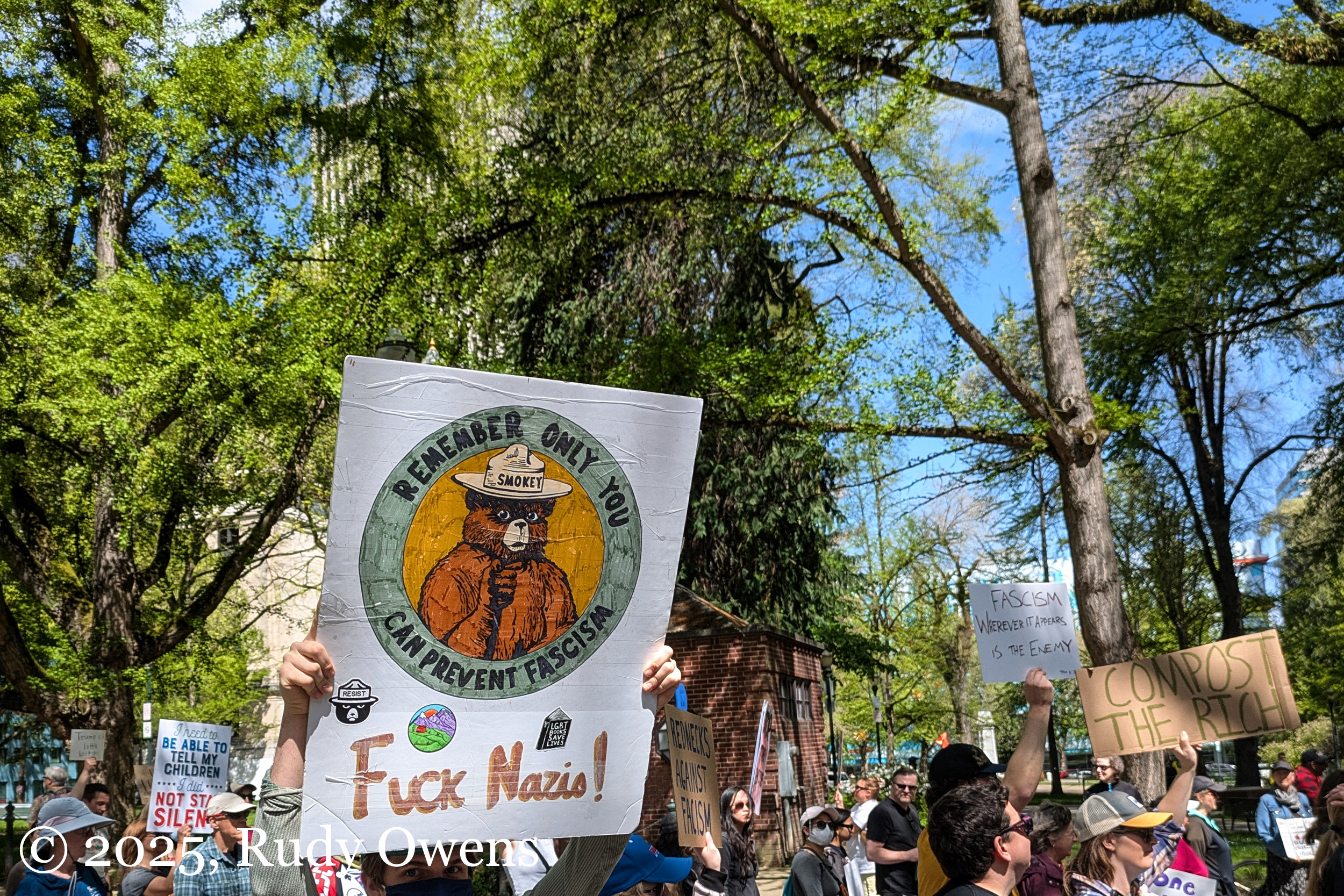
Protesters against the administration of President Donald Trump numbered at least 3,000 and shared a diverse range of creative protest signs, defending American democracy.

On the weekend marking the 250th anniversary of the first shots fired in the American Revolution against a tyrannical monarch and the British Empire, at least 3,000 people gathered in downtown Portland, Oregon to protest the administration of President Donald Trump.

The April 19, 2025 events kicked off at Pioneer Square, a gathering place for many public events in the city, and then the march took over the streets for over an hour. Protesters represented all ages and carried a wide array of colorful, creative, and biting signs criticizing Trump, Elon Musk, and the administration for its many actions. I saw about a dozen Portland police officers following on bikes, but mostly there was no visible law enforcement presence based on my observations.

There was no need for any police given the entirely peaceful nature of the civil action by thousands of people exercising their protected speech, as allowed by the First Amendment to the U.S. Constitution.

The day was a fitting one too.

Nationally some have dubbed collective national protests on April 19, 2025, as “No Kings Day, Part II.” The reasons for unrest today have a striking similarity to what happened two and a half centuries ago, as British forces gathered in Massachusetts to confront increasingly rebellious colonial residents.

The issues that led to the first conflict of the American Revolution—the right to self-determination, liberty, democracy, the rule of law, a life free from the power of kings—helped to forge a nation 13 years later, in 1788.

That year, the newly christened United States of America was created through the adoption of a founding charter, the Constitution. While revolutionary, it was also terribly marred and flawed by enshrining slavery, our country’s greatest sin. It would still take over two centuries to guarantee the document’s original promise for all persons.

This framework for a nation, set forth in the Constitution, called for a system of checks and balances by three branches of government: the executive, legislative, and judicial branches. On April 19, 2025, in Portland, people gathered with deep and profound concern that this sacred charter had been irrevocably broken by a man who has proclaimed himself to be a king.

At these protests in Portland, the residents who gathered to assemble recalled our original bold vision for a country with their calls for accountability, the rule of law, and the safeguarding of our democratic freedoms. Their demands reminded us all of our daring experiment to forge a more perfect union, stretching from 1775 to 1788, and grounded in our Constitution: “We the People of the United States, in Order to form a more perfect Union, establish Justice, insure domestic Tranquility, provide for the common defense, promote the general Welfare, and secure the Blessings of Liberty to ourselves and our Posterity, do ordain and establish this Constitution for the United States of America.”

Lastly, I observed few persons from a group being targeted for enforcement and deportation action by this administration: Latinos. There was a lot of chatter online by some of the organizers (I can’t confirm who the organizers are based on published posts), who said it would be safe for all people. However, many Latinos are fearful in Oregon, given the cancellations this month of upcoming Latino cultural events statewide. I believe they do not want to be seen, photographed, or filmed at these events. There were very few African Americans too. The lack of diversity at this event is telling and needs to be discussed.

Remembering Rwanda on a sad anniversary

Today, April 6, 2019, marks the 25th anniversary of the start of the Rwandan genocide. During the 100 days that followed its start, the ruling ethnic Hutu government organized the mass murder of more than 800,000 mostly ethnic minority ethnic Tutsis and moderate Hutus in the tiny central Africa nation. The world stood by and largely did nothing.

The war and genocide ended only when a rebel Tutsi army called the Rwandan Patriotic Front (aka Rwandan Patriotic Army) defeated the government in a fight to the death that ended the mass murdering. Millions of Rwandan refugees then fled the country, leading to destabilization and civil war in neighboring Zaire (now the Democratic Republic of Congo) and the collapse of its dictatorship. Years of bloody war in eastern DRC and beyond followed and continue to this day.

I went to Rwanda three years after the genocide and then left after about three weeks. I succumbed to malaria and realized I could not accomplish my larger goal to report on the ongoing genocide trials. Violent reprisal attacks by Hutu extremists were taking place and the body count was rising. I decided to leave.

After I left, I did two more projects documenting genocide: in Europe, focusing on Nazi crimes, and in Turkey, focusing on Ottoman Empire crimes. After I completed my documentary project on the Armenian genocide, I was interviewed by a descendant of Armenians who fled the Ottoman Empire and survived the Armenian genocide in modern-day Lebanon. My Lebanese-Armenian friend, who did a story about my travels in Turkey to former Armenian communities, asked me why I did my project. This was my reply. I reflected on what I had learned between the time I was in Kigali, Rwanda, and the time I visited former Armenian communities that no longer exist in the fall of 2001:

My primary objective has been to use my camera as a tool to infiltrate the realm of evil. What ways do people express evil, this thing that seems to define the human condition? How do people express it? Why do they do it, and why do other people allow evil to triumph? What do they accomplish, ultimately, through evil?

That’s the nut I’m trying to crack by examining the genocides of the 20th century. If nothing else, this knowledge helps me live my life better. It’s now much easier for me to understand human history and human behavior because the very worst form of human activity, genocide, strips reality to its essentials. In other words, all that is not essential is not really relevant. Some concentration and death camp survivors see the world in these terms. For example, Robert Jay Lifton wrote about the Nazi doctors, and he interviewed an Auschwitz survivor, a dentist forced to pull gold from the teeth of dead prisoners. Lifton described his meeting with the dentist this way: “He looked about the comfortable room in his house with its beautiful view of Haifa, sighed deeply, and said, ‘This world is not this world.’ What I think he meant was that, after Auschwitz, the ordinary rhythms and appearances of life, however innocuous and pleasant, were from the truth of human existence. Underneath those rhythms and appearances lay darkness and menace.”

I left the memories of my genocide documentary projects behind me, though I still have essays on display on my website. I normally don’t think about these photos, but on anniversaries like today’s, I must reflect and, I hope, remember.

72nd Anniversary of the Liberation of Auschwitz-Birkenau and Donald Trump

Today, January 27, 2017, is the 72nd anniversary of the Red Army’s liberation of the Auschwitz Concentration Camp/Birkenau Death Camp. (There was a third camp too, the slave factory called Monowitz.) The facilities are a short train ride from the historic and beautiful Medieval city of Krakow, in southwest Poland.

I visited the camp three days in a row during my tour of Europe in 2000, when I toured five countries and documented the legacy of the Nazis crimes against humanity that claimed at least 11 million lives in the camps. The majority of the victims, here at Auschwitz/Birkenau, were Jews, but the camps also practiced genocide on Gypsies and Soviet POWs, throughout the Germans vast camp and prison system. The majority of the nearly 1.1 million murdered at Birkenau, the main killing center, were Jews from Europe.

Today, the United States also marks its first week under the United States’ first openly totalitarian strongman who embraces the tactics, ideology, and the support of fascists. A certified Nazi, in the words of Howard Dean, Steve Bannon, is a senior policy advisor with direct access to the Oval Office and President Donald Trump.

In one week the world has seen Trump take radical actions that mark the clear tilt to fascism, which in Nazi Germany found its gruesome manifestation in death camps like Auschwitz. Trump did the following:

  • Confirm a wall with Mexico will be built,
  • Defend torture–yes torture–to a global audience,
  • Promote Orwellian ideology now called “alternative facts,”
  • Muzzle government agencies,
  • Sign orders to try to begin removing basic and health insurance access for nearly 30 million Americans,
  • Attack the scientific process by demanding all U.S. EPA scientific research receive political approval,
  • Sign orders that promote policies with pipelines and immigration that enrich his personal wealth,
  • Threaten to defund American cities where he faces political opposition on immigration matters,
  • Lash out at all critics who reported his inauguration was vastly less attended than President Barack Obama’s, and
  • Continue to promote proven lies of alleged voter fraud, when in fact he lost the popular vote by nearly 3 million votes.

fierce-urgency-of-nowDuring my trip in 2000, I asked myself a question, repeatedly: what would I do if confronted by a man like Hitler, a regime like Nazi Germany. I always assumed I would see it coming and be able to respond in time. I think that time has arrived. I think the response for now is to fight this, here on this blog, and with my feet and mouth at events, and tactically empower our somewhat feeble minority party in Congress to try and slow down the GOP’s and Trump’s plans to dismantle the Affordable Care Act and our modern welfare state. The “fierce urgency of now,” as Dr. Martin Luther King Jr. called it, is truly NOW! I admit, I am scared, and it can be a positive emotion because it forces urgent action.