Greenland

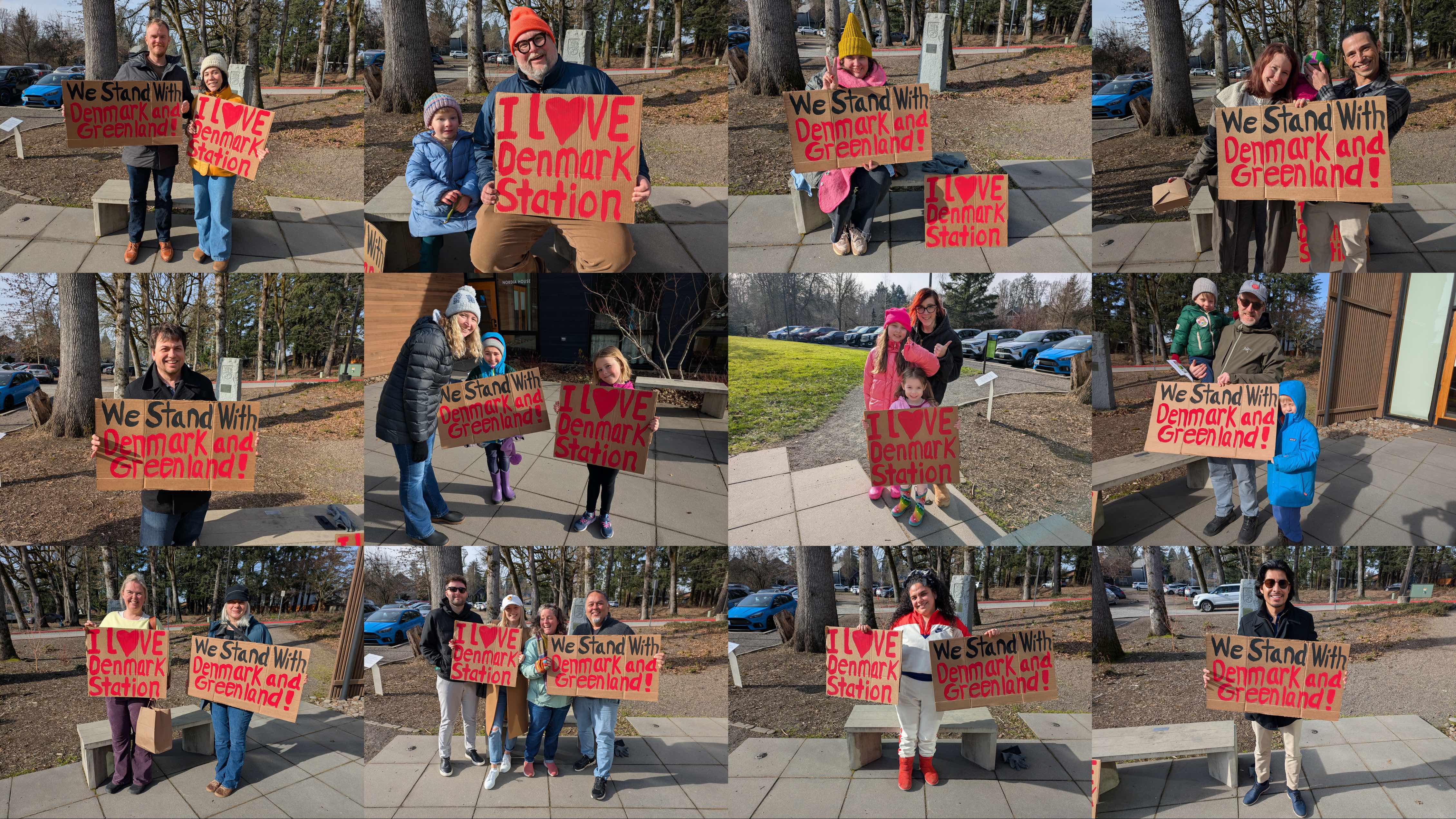
With love from Portland to Greenland and Denmark

In response to the ongoing threats being made by the leader of the United States to Greenland and Denmark, I want to say to my personal friends in both lands, and all the people that call those places home, we in the United States, the people of the United States, are your friends. We send love.

To show this, I took these photos this morning (January 25, 2026) in Portland, Oregon, at Nordia House, a cultural center celebrating the ties between Nordic nations and peoples and the United States.

Everyone who I met shared warm words for all the people in Greenland and Denmark. We the people will never sever our friendship. We the people are not spoken for by the increasingly dangerous man who is leading my country to a dark place.

To that darkness, I shine light. That light is the love you see here from the people, some who have relatives in Denmark and others who will be visiting.

To see all of my portraits as individual photos, visit the my “Love Portraits” page dedicated to the people of Greenland and Denmark.

Greenlanders: Nobody’s Fools

This is my friend, Lars, who I had the great pleasure of meeting in 1998 in Sisimiut, Greenland. He took me seal hunting with his family, at a fjord just north of the coastal city. I did this trip with his brother and father.

This past week, from March 23 to 28, 2025, the world again saw Greenland and Greenlanders at the center of a global security debate if the United States could assert control of Greenland, beyond longstanding and existing security arrangements that have seen U.S. military on the island continuously since World War II.

After the snow settled, one outcome was clear: Greenlanders are nobody’s fools.

The mostly ethnical Inuit population have called the more than 830,000-square-mile arctic island, the world’s largest, their home for nearly 5,000 years. Today, Greenlanders number about 57,000 residents, of which nearly 90 percent claim ethnic Inuit identity.

They are smart, resilient, and fiercely grounded in their identity as descendants for nearly five millennia of their homeland, what they call Kalaallit Nunaat in their Greenlandic language.

They are not pawns, patsies, or stupid.

I can say this based on my own experience, having befriended many residents there during my visits in 1998, 1999, and 2000. During my trips now more than a quarter century ago, I had lively discussions with Greenlanders who shared divergent views of becoming independent or staying aligned under semiautonomous status with Denmark.

What is clear is that Greenlanders made abundantly clear to the world they are opposed to coming under greater military and political control of the United States, as announced by the Trump administration.

(See my full story on the significance of Trump administration’s plan to take full control of Greenland on my website.)

Some of my fondest memories of summer

(Click on each photo to see a larger picture on a separate picture page.)

This “midsommar,” or midsummer as Americans might call it, marks the 20th year since I first flew to Greenland to explore, pursue some old passions of Viking exploration and colonization of the arctic, and do some serious backcountry travel.

I succeeded on all fronts. I ended up visiting Greenland three summers in a row, in 1998, 1999, and 2000.

I made some amazing treks (Sisimiut to Kangerlussuaq, Igaliku to Qaqortoq, Brattalid/Qassiarsuk, to Narsaq) during each trip.

I made friends with local Greenlanders, who invited me into their homes and took me seal hunting and fishing.

I befriended several Danes, including two doctors, who made sure to extend hospitality to me when I visited their country.

I also participated in a celebration of the 1,000th anniversary of Leif Ericson’s arrival in southwest Greenland.

I thought about Greenland (Kalaallit Nunaat in Greenlandic) this week as we entered that magical time of 24 hours of daylight in the arctic. In 1998, I hiked all night on June 21, 1998, north of the Arctic Circle, where the sun never set and the mosquitos never slept!

Here are a few photos highlighting the magic of that place, its people, its culture, and beauty. I hope they bring you some joy as in the northern hemisphere celebrates the arrival of summer.

Traditional Greenland kayak and kayak methods


In Greenland. the current generation of Greenlanders have rediscovered the historic kayak building, paddling, and handling techniques. The kayak, or qajaq, enabled Greenlanders to populate the entire western coastline and southeast coastline and survive, mainly by giving the hunters the ability to hunt sea mammals. These boats were all built by hand by people with no modern tools, and all from materials available from animals, bones, and driftwood. Greenlanders, like this man, practice their techniques, including flips with and without their traditional paddles. I took this in Qassaiarsuk in 2000, when there were more than a dozen paddlers showing off their finely honed skins on traditionally built kayaks. See more of my pictures of Greenland on my Greenland gallery. (Click on the photograph to see a larger picture on a separate picture page.)

Greenlandic Elder, Qassiarsuk


I photographed the 1,000-year anniversary of Leif Ericsson’s exploration to the New World in Greenland in 2000. The attendees included the Queen of Denmark and the President of Iceland, along with all of the prominent Greenlandic leaders, artists, and respected elders. I shot this picture of a Greenlandic elder at the celebration ceremonies that took place in the old Greenland VIking settlement of Brattahlid, today known as Qassiarsuk. That was a very memorable experience. I loved it. You can see more of my Greenland portraits on my Greenlanders gallery. (Click on the photograph to see a larger picture on a separate picture page.)

You never forget the first time you step foot in Greenland


Yesterday I discovered some nice photos taken of east Greenland, in fjords near the air hub of Kulusuk. This is the sparsely inhabited region of Greenland, a home rule territory still within the Kingdom of Denmark. I landed in Kulusuk in June 1998. I will never forget this flight, from Reykjavik, Iceland. I flew on the very tough Bombardier Dash-8 prop plane, and my captain was a wonderful Greenlander who I then hired to charter a boat trip up a fjord near Nuuk, the capital, to find Viking archaeological ruins. The air when I stepped off for the refueling stop was crisp. Those arctic low hanging fog clouds shrouded the mountains. My fellow passengers were all delighted to be back home. I was in heaven. This trip changed my life.

You can see more of my photos shot in 1998, 1999, and 2000 on my Greenland picture gallery. (Click on photograph to open a larger picture on a separate picture page.)

Danish colonial legacy in Greenland


A statue of Hans Egede stands over the harbor in Nuuk, capital of Greenland. Greenland was long a colony of the Kingdom of Denmark, and among the most prominent and I would say beneficent colonial settlers was  Egede, a Lutheran missionary who in the early 1700s established the then colonial town of Godthåb, which was later renamed Nuuk. This photo dates from 1998, and I wonder how much has changed on this hillside since. I imagine a fair bit. I ended up visiting Nuuk several times over three years. It was among the most interesting northern cities that I have explored.

Inuit identity in the circumpolar north

In 2007, I attended the Inuit Circumpolar Conference in Barrow, which brought together the different Inuit groups, spanning the circumpolar north from Russia, to Alaska, to Canada, to Nunavut, to Greenland. The Inuit are distinct culturally, linguistically, and historically. Having traveled widely in Greenland and Alaska, this was abundantly clear in many of the ways these cultures express their identity and relation to the sea. Here are two perspectives on how closely linked Inuit culture is to its traditional hunting lifestyle, in this case hunting, killing, eating, and utilizing whales. You can also find other photos I have taken of Greenland and Alaska on my web site (www.rudyowens.com).

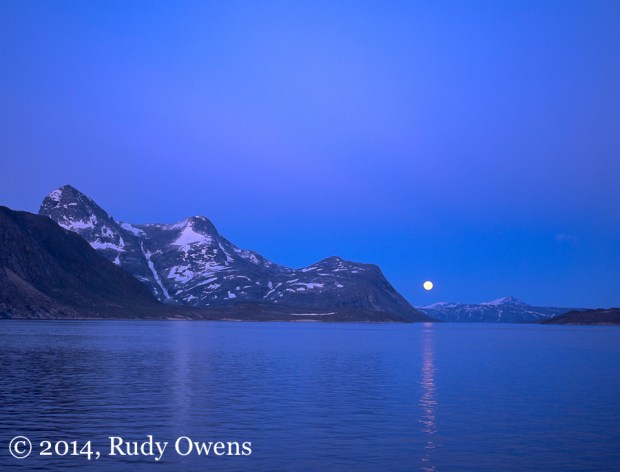
Moonrise over Nuuk harbor

Full moon rising on a summer night near Nuuk, capital of Greenland (1998)

Full moon rising on a summer night near Nuuk, capital of Greenland (1998)

On my second night in Greenland, on the first of my three trips, I sat in a state of utter bliss. I watched a full moon rise over the rocky, mountainous coast of west Greenland outside the capital, Nuuk. It was around 10:30 p.m. I don’t think I have seen other natural events as serene or calm as this. More of my Greenland photos can be found on my Greenland gallery, on my web site.