My faith in humanity

On days when chaotic people around me seem overwhelming, in that place called life and the real world, I always seek the solace in what I know to be universally true. And that is the goodness in others.

I ignore the emotional tornadoes who suck energy from others, and I bring back memories of people I have met everywhere in the world. Today, on a day when the whirlwind people were a bit too much, I got a jolt of the “rest of humanity” through some friendly old smiles. Here are a few of their faces, taken from my travels in Bali and Java, in Indonesia, in February 2009.

(Click on each photo to see a larger picture on a separate picture page.)

Memorial to the masterminds of the Armenian genocide

Fourteen years ago I traveled in Turkey and worked on a documentary project photographing the legacy of Armenia’s culture in modern-day Turkey and historic locations associated with Armenians’ long history in Anatolia. I also photographed locations linked to the genocide of Armenian citizens of the Ottoman Empire, between 1915 and 1922. About 1.5 million civilians were slaughtered in the first documented case of genocide in the 20th century. This fact is still disputed today by the Republic of Turkey, and I outright discount that argument because of the overwhelming evidence, from documents, first-person accounts, and mountains of evidence.

The Talaat Pasha Memorial in Instanbul proved to be the hardest place for me to find and photograph. There was no guidebook showing me the way, and no map called it out. Even its name was in dispute. I called it the Talaat Pasha memorial, and that is what some Turks I met called it when I finally tracked it down in the Caglayan neighborhood of Istanbul. It was gated, not well-marked, and overgrown with weeds. It was not the safest place to go, and photographing the monuments in the square likely would have caused me problems. So, I made a fast job of it, snapped some photos, and left quickly.

Currently web sites are now publishing pictures of the site, more than a decade later.  Here are photos by a Turkish photographer from 2011. Web sites I found, including the Wikipedia entry (whose facts may not be fully accurate), also show contemporary photos of the location. I have found the plaza square to be dubbed the Monument of Liberty Cemetery and Hürriyet Şehitleri Abidesi, or “Freedom Martyrs Monument.” There is apparent agreement of online sources that the site was originally built before World War I to honor reformers, who died or were killed.

It is perhaps famous or infamous today becuase it has the graves of the remains of two of the three leaders of the Ottoman Empire, Enver Pasha and Talaat Pasha, who organized the genocide against civilian Armenians. (You can read my detailed story here about the genocide and my trip to Turkey; note the file is large, so please allow time for it to download.)

Current photographs of those memorials honoring these leaders is even published by the official Government of Turkey web site. That site clearly shows the memorials of these two leaders and notes, almost ironically, the massive Palace of Justice of Istanbul that has been built behind the memorial plaza: “Hailed as the biggest courthouse in Europe by the government, it overlooks the park and the Monument. It almost seems like the justice system is entrusted to the watch of the Committee whose members used to pledge alliance to it with a rifle and Quran. Whether this has any connection with justice let alone liberty is of course another question.”

Symbolism and language matter, as do monuments. Enver Pasha’s remains were returned here in 1996, and Talaat Pasha’s remains in 1943, during World War II. When Enver Pasha’s remains were feted in a ceremony in 1998, one news account noted that thousands attended, including President Suleyman Demirel, ministers, deputies, and Turkey’s top generals, and the former war minister. Enver Pasha was proclaimed a martyr. “Enver Pasha, with his faults and merits, is an important symbol of our recent history,” Demirel said. “We have no doubt that history will reach the proper judgments through evaluating past events.”

The photo evidence published online today and the Government of Turkey’s web site that shows a spruced up memorial  clearly signal that the current government of Turkey shows no interest in backing away from its denial that the last leaders of the former Ottoman Empire were masterminds of a massive human rights violation, which still causes controversy today.

(Click on each photograph to see a larger picture on a separate picture page.)

A story for every stone

My explorations of Portland’s historic Lone Fir Cemetery found lots of fascinating headstones. Each represents a life, a full story, a story that intersects with hundreds of other stories. And how do we remember these former residents, who are now but forgotten. Cemeteries remain a good place to contemplate one’s life and what one does with one’s life. Because ultimately we all return to the earth, and our life is but a speck in the passage in time in an infinite universe. (Click on each photograph to see a larger picture on a separate picture page.)

Two sides of a historic coin and wrestling with the past

The debates over the public and state-sanctioned display of the flag of the slave-holding Confederacy point to the United States’ not-so recent past. No country is pure, and the United States’ evolution is marked by great accomplishments, great divisions, and also some historic acts that leave a painful legacy. Our history of conflict in the 1800s stretches the entire century, from the War of 1812, through the Mexican-American War, dozens of conflicts with Native American bands across the continent, overseas expansion and trade wars (the Opium War), and the Spanish-American War.

in 1902, Portland area residents and war veterans erected a statue honoring the nation’s war veterans at the city’s historic Lone Fir Cemetery in Southeast Portland. The cemetery is filled with graves of many white, Christian early settlers from the 1800s, and latter-day residents of all persuasions. I stumbled on the cemetery accidentally at a staging of Macbeth last weekend.

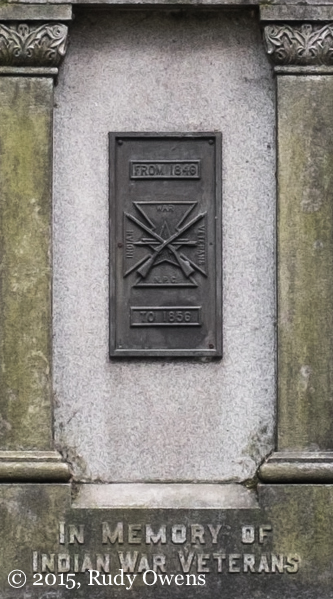
Close up of memorial honoring soldiers who fought for the United States against Native Americans.

Close up of memorial honoring soldiers who fought for the United States against Native Americans.

I looked up and saw this statue of a Civil War soldier, with memorials plaques honoring veterans of Spanish-American War of 1898, the Civil War, the Mexican-American War, and the American Indian Wars from 1846 to 1856, which saw most of Oregon and Washington occupied and appropriated as U.S. territory from many native tribes.

There were conflicts, but many of the original inhabitants were perishing en masse due to diseases like smallpox that accompanied the arrival of new settlers. Even after land was ceded by treaties and tribes were resettled on reservations, hostility was pronounced. Eleven years before this statue was erected, in 1891, the Oregon Legislature was passing resolutions with language that characterized the state’s Native residents as “a wild man.”

State lawmakers signed their names to a measure that stated: “… it would only be a fact of evolution to call him a wild animal on his way to be a man, provided the proper environments were furnished him. While the instincts and perceptions are acute, the ethical part of him is undeveloped, and his exhibitions of a moral nature are whimsical and without motive. Brought into contact with white men. whether of the lowest or of the highest, he is always at a disadvantage which is irritating, and subject to temptations which are dangerous.”

Today, what are we to do with such legacies to this time when these attitudes prevailed, and good people erected monuments to their fellow soldiers who fought for their country, and many doing so believing they were in the right and doing it for the best of intentions?

(Click on each photo to see a larger picture on a separate picture page.)

The big toys come out during summertime

Everywhere I walk and go it seems, some water or road project is going on, digging up streets, laying new sewer lines, and creating some inconvenience for all of us. Hey folks, that is called the price of living in a modern world. Be thankful you have these things. According to Food and Water Watch, 2.5 billion people, 1 billion of them kids, live without basic sanitation like a sewer system. And if you think your roads are bad, try them overseas, where they create literally lethal situations daily. So,  you may just try and chill out if you have to wait. You can even smile at those flaggers. They are your price for a modern, comfortable life. It is worth our investment.

How Portland Looks from the Burnside Bridge

Burnside Bridge gives one a great view of the Willamette River and downtown Portland. It’s also near the areas where the city’s large homeless community congregates. One normally has to keep one’s wits about oneself here at night. Usually some crime noir is happening here, in a not so pleasant way. I came here on summer solstice to capture a few random views. I love the view of the grain elevator the Steel Bridge to the north and the freeway jumble where I-84 and I-5 collide.

Testimony to my love of running

I can never seem to get rid of my running shoes after their intended purpose ends, usually around month six. But they still work fine for walking and other sports. And so my stack of shoes is alive and well by my door. I actually just dropped off four pairs at Goodwill too. (Click on the photo to see a larger picture on a separate picture page.)

Swan Island and downtown Portland

One of my favorite views of Portland is from the overlook along North Willamette Boulevard, looking at the Swan Island shipyards to downtown Portland. It is always worthwhile checking what ships are getting work here. This shipyard keeps our economy ticking, and to date we have not found a way to outsource the jobs and industry to Indonesia or Brazil, but I know people are working hard to do that. I want this shipyard to stay.

The Resurrection River, Alaska

One of my favorite day trips from Anchorage was traveling to Hope, Alaska, and then heading up the Resurrection Trail on the Kenai Peninsula. Lots of bears in here, but almost no salmon. I think the salmon runs had been decimated by placer mining on the Resurrection River, and fish and game officials were trying to restore the runs as I was leaving the state in 2010. Ran and biked many times along this beauty, including a 50 mile ultra. Always great in June.