North St. Louis, a gentrification-free zone

(Click on each photo to see a larger picture on separate picture page.)

I recently visited St. Louis, to see my family. I normally use my visits to tour historic sections of the once proud and fourth-largest U.S. city in the late 1800s. But those are the long-gone glory days.

Today, the city is struggling to define itself in the post-NAFTA, post-industrial reality of the “new economy” that has led to the greatest level of income inequality the nation has seen since before the Great Depression.

The pain and fragments of this change are visible everywhere in the city, mainly in the form of shuttered factories and feral and abandoned houses that almost give Detroit a run its money as the epicenter of U.S. urban decay. They are most pronounced on the city’s north side, historically the racially demarcated home to the city’s poorer African-American residents for more than eight decades. That is the story I went out to photograph this trip, in June 2016.

Love can be in short supply in north St. Louis.

Love can be in short supply in north St. Louis.

St. Louis experienced what many Midwest, industrial cities confronted during and after World War II. The U.S Interstate System promoted out-migration to the surrounding county. White flight rapidly accelerated population losses following the 1950s. (See a superb illustration of that white flight here: http://mappingdecline.lib.uiowa.edu/map/.) The population dropped from 880,000 residents at the start of the 1950s to a mere 315,000 souls in 2015, according to the most recent U.S. Census Bureau estimate.

Industry, including automobile manufacturing and other sectors, began a long slide to obsolescence. St. Louis and the surrounding region were once major players in automobile manufacturing and home to several “Big Three” plants: one Ford, two Chrysler, and one General Motors. The city’s world-famous Corvette plant closed its doors in 1981 after a 37-year run. At its peak it had a payroll of more than 13,000 employees. Since then, Ford shuttered its plant in nearby Hazlewood in 2006, and Chrysler closed two plants between 2008 and 2009 (north and south plants), costing the region about $15 billion, according to one study. (GM still has an assembly plant 40 miles from St. Louis in Wentzville.)

I wanted to see first hand how things look on the city’s infamous north side, or “home” as it is known to its residents. It had been years since I did such a trip. I was startled by the lack of businesses except gas stations, beauty shops, food and restaurant establishments, and garages.

I met a sixty-something man on a street just off Vandeventer Avenue and North Market Street. He told me he had worked for Chrysler until being laid off in 2009, when the Fenton plant was shuttered for good, before the factory was razed to the ground. A grandfather, he called himself T-Bone, and had just purchased his two-story brick home for $24,000. He hoped to acquire two adjacent lots through a process that allows property owners adjacent to vacated lots to acquire those lots at no cost after three years of maintenance. He told me he wanted to become more engaged in local politics to help restore his section of the city. He lived two houses down to a boarded up, abandoned home, one of several on his block.
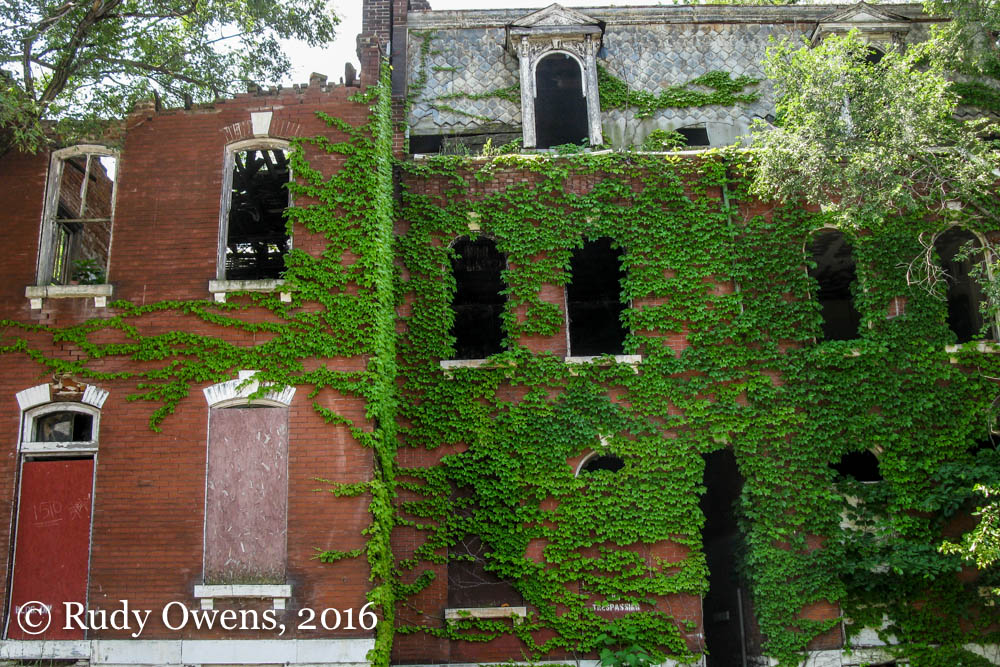
Beautiful old brick homes have long gone feral in the economically challenged neighborhoods of north St. Louis.

Beautiful old brick homes have long gone feral in the economically challenged neighborhoods of north St. Louis.

Today, more than one in four St. Louis residents live in poverty. The U.S. census puts the median household income in the Gateway City at $35,000, well below the U.S. average of $53,000. Racially, the city is as divided as ever with blacks and whites evenly divided, and now Hispanics and Latinos numbering (officially) under 5 percent.

All of these numbers mean that the city, and its poorest residents, are struggling. That struggle can be seen on just about every block north of Delmar Avenue, all the way to the city’s borders with adjacent and also struggling municipalities like Jennings. Anyone visiting the city should soak its charms—the Gateway Arch, the amazing churches, the historic downtown, and especially charming and historic Lafayette Square.

Then they should take a drive for an hour or two and see what life in the new urban, post-industrial America looks like. Gentrification is not a problem that is displacing residents in the city’s north side. No urban, yuppie, or tattoo-covered and scrappy millennial pioneers from the affluent suburbs are rushing to create art centers or startups in old factories sites. This is the place people leave if they can.

This is not Portland, Seattle, or Boston. This is a much tougher, more violent, and grittier place. It is also in many ways a more friendly place too, where people will still say hello if you have street cred and give them respect. This is St. Louis, and the recovery, if it comes, is still a long ways off. Without long-parted industry, that future is still not certain.

Industrial architectural icons of St. Louis

St. Louis has more than its magnificent Gateway Arch to showcase the city’s rich industrial and economic past. During my recent visit, I caught a few of the city’s most iconic structures: the old Falstaff Beer plant in North St. Louis, the Union Electric Company energy plant in the city’s industrial riverfront, and the massive grain silo facility in central St. Louis, now owned by the Ray-Carroll County Grain Growers Inc. cooperative.

Click on each photo to see a larger picture on a separate picture page.

A field of strawberry dreams

Memorial Day for me now has become my strawberry picking day. Two years in a row makes a tradition. I drove to Sauvie Island, just north of Portland on the Columbia River. It has several U-pick farms. This year I picked my berries at Sauvie Island Farms.

Half of the people around me were speaking a language other than English. I heard Hindi, Cantonese, Mandarin, and Japanese. Family fruit picking clearly is popular with Portland’s East and South Asian families. Strawberries signal the end of spring and beginning of summer, and they taste so darn good.

Looking at all the little kids being pulled by their well-off moms and dads made me think of all the kids who are not that much older working in the fields with their families in our land of plenty, for up to 10 hours a day. Sometimes, it is fate of birth that separates one world from another. I am glad I never had to and do not have to do this for a living. It is incredibly hard work bending over, sorting through fruit, gently picking it one by one. Something to think about as you pick out your fruit at your local store. Someone always had to pick it.

(Click on each photo to see a larger picture on a separate picture page.)

Paying my respect to the Flatirons

Three years ago I rolled into Boulder, Colorado, during a whirlwind cross-country drive from St. Louis to Seattle. I was stunned by how congested and sprawling the Denver metro area had become. However, I found the Flatirons lived up to their reputation. These are the heaps of mountainous granite that jut out of the front range of the Rocky Mountains above the city of Boulder, all accessible from a lovely city park call Chautauqua. The place was packed with locals, out-of-town visitors like me, and climbers. I even saw a hang-glider packing his gear up the hills.

So, if you go to Boulder, carve out half a day. Take a hike. Enjoy the scenery. Get some altitude and say hello to the many nature lovers on the trails. Happy Memorial Day weekend, all.

(Click on the image to see a larger picture on a separate picture page.)

St. John’s Bridge, Icon of the Northwest

(Click on each photograph to see a larger picture on a separate picture page.)

St. John’s Bridge in Portland is one of the most recognized icons in the region. It was built using local dollars at the height of the Depression, taking two years to build. The steel suspension bridge connects the Northwest and Northeast quadrants of the city. Its towering Gothic inspired towers create a feeling of awe. When it opened, apparently elephants walked across it (if one is to believe the information posted in the park below).

It is showing real signs of decay too, with its concrete foundations crumbling in plain view. Cathedral Park at its base on the northeast side of the Willamette River is an ever popular destination for residents. Everyone always seems to marvel at the design.

The base of the bridge was once home to the region’s Native Americans, who lived on the river banks, harvesting the river’s bounty. Most of the region’s Native residents perished during the 1800s due to the apocalyptic impact of communicable disease and malaria introduced with the arrival of European and American travellers and settlers.

St. Louis, once a great city

Before the Arch was built, St. Louis aspired to greatness through the early 1900s. It then began its long spiral downward. This once prosperous industrial city has seen most of its manufacturing leave and the population contract since the 1960s. Suburbanization, car-centered urban planning, racism, and very painful economic restructuring completely changed this community. The city’s leadership and the corporate owners of the St. Louis Cardinals still managed to build a new baseball stadium for the beloved Redbirds downtown. I still love this city, despite having completely opposite feelings growing up there.

You can track the demographic changes in St. Louis, St. Louis County, and the surrounding bi-state area on this very informative interactive map. You can also read how eminent domain and the freeway system destroyed neighborhoods and fragmented the city. The Arch, that great structure I love so dearly, was part of this process that leveled entire blocks.

Click on each photo to see a larger picture on a separate picture page.

Sunset and morning light in Encinitas

A week ago I was watching the sun go down and catching up with a great friend from college. I think the ocean is a good antidote to whatever heavy may be weighing on your soul and in your mind, if just for a few hours. I felt months of weariness wash away in these waves. (Click on each photo to see a larger picture on a separate picture page.)

Life really is great when you are in the ocean, and in the moment

This photo, taken at South Ponto Beach in San Diego County, came courtesy of mediocre and now very old camera. Who cares. the picture does the talking. Yeah, life can be real, real, real good! Click on the picture to open a larger photo on a separate picture page.

The San Diego Mission: oldest and site of a great armed revolt

(Click on each photo to see a larger picture on a separate picture page.)

San Diego de Alcalá, the first of the 21 colonial Spanish California missions, was founded in 1769, when the state fell under the orbit of the Kingdom of Spain. At the time, the Spanish Empire still included much of South America and a wide swath of land on the North American continent. The mission today is located in San Diego, a sprawling southern California metropolis, and it attracts visitors from the world over. It is worth a visit.

I have visited about a half-dozen of the missions in the Golden State. I like them because of their architecture and testament to history, when the continent was not yet fully conquered by European powers and the growing American nation.

The mission was supposed to serve the Catholic Church and convert native peoples from their local faiths to the new religion hailing from Europe. The mission gives a weak showing of its Native American past, with a display of the Kumeyaay peoples traditional homes and culture in the main plaza–it is as if someone realized recently that the people converted actually had meaningful stories and narratives to the larger mission story. The Kumeyaay peoples had lived on the lands for more than 10,000 years before the Spanish arrived. The Franciscan friars who first ran the mission came to settle the area, grow crops, and convert the non-Christian indigenous people. It was, after all, a mission with very clear religious purpose.

An illustration of the killing of Father Jayme

An illustration of the killing of Father Jayme

According to the mission’s own records, nearly 800 indigenous residents attacked the mission on Nov. 4, 1775, less than a year before the U.S. revolutionaries were declaring a new nation on the East Coast and fighting another empire–that of Great Britain. The native attackers reportedly burned the mission down and massacred a number of residents and Father Jayme. He became, according to the Catholic tradition, “California’s first Catholic martyr.” Whether a person killed by native residents fighting against a foreign colonial empire is truly a martyr is not for me to decide. I do not think the native residents saw members of the mission as benign, nor perceived the Catholic Church as friendly. Indigenous peoples in the Americas did not spark armed uprisings without good reason. Public health threats from disease, reported rapes by soldiers, and threats to local religious traditions all fueled the attack.

The mission was rebuilt, more as a fortress. After Mexico became independent and after the Union army occupied it during the Civil War, it fell into disrepair. It was not until 1931 when the mission was rebuilt, according to how it likely looked during its early heyday. Today it is still home to an active Catholic parish.