Arctic

Danish colonial legacy in Greenland


A statue of Hans Egede stands over the harbor in Nuuk, capital of Greenland. Greenland was long a colony of the Kingdom of Denmark, and among the most prominent and I would say beneficent colonial settlers was  Egede, a Lutheran missionary who in the early 1700s established the then colonial town of Godthåb, which was later renamed Nuuk. This photo dates from 1998, and I wonder how much has changed on this hillside since. I imagine a fair bit. I ended up visiting Nuuk several times over three years. It was among the most interesting northern cities that I have explored.

Inuit identity in the circumpolar north

In 2007, I attended the Inuit Circumpolar Conference in Barrow, which brought together the different Inuit groups, spanning the circumpolar north from Russia, to Alaska, to Canada, to Nunavut, to Greenland. The Inuit are distinct culturally, linguistically, and historically. Having traveled widely in Greenland and Alaska, this was abundantly clear in many of the ways these cultures express their identity and relation to the sea. Here are two perspectives on how closely linked Inuit culture is to its traditional hunting lifestyle, in this case hunting, killing, eating, and utilizing whales. You can also find other photos I have taken of Greenland and Alaska on my web site (www.rudyowens.com).

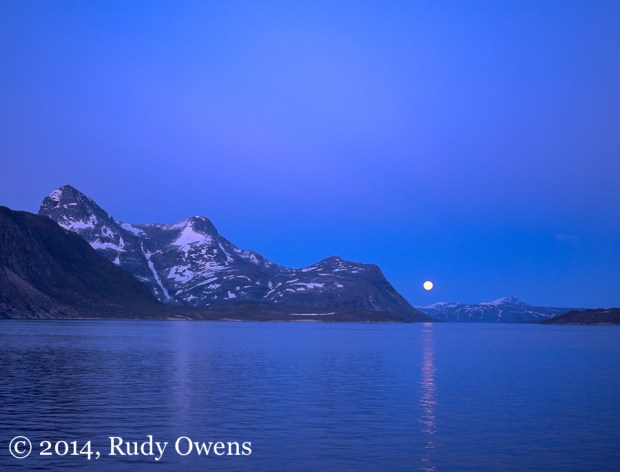
Moonrise over Nuuk harbor

Full moon rising on a summer night near Nuuk, capital of Greenland (1998)

Full moon rising on a summer night near Nuuk, capital of Greenland (1998)

On my second night in Greenland, on the first of my three trips, I sat in a state of utter bliss. I watched a full moon rise over the rocky, mountainous coast of west Greenland outside the capital, Nuuk. It was around 10:30 p.m. I don’t think I have seen other natural events as serene or calm as this. More of my Greenland photos can be found on my Greenland gallery, on my web site.