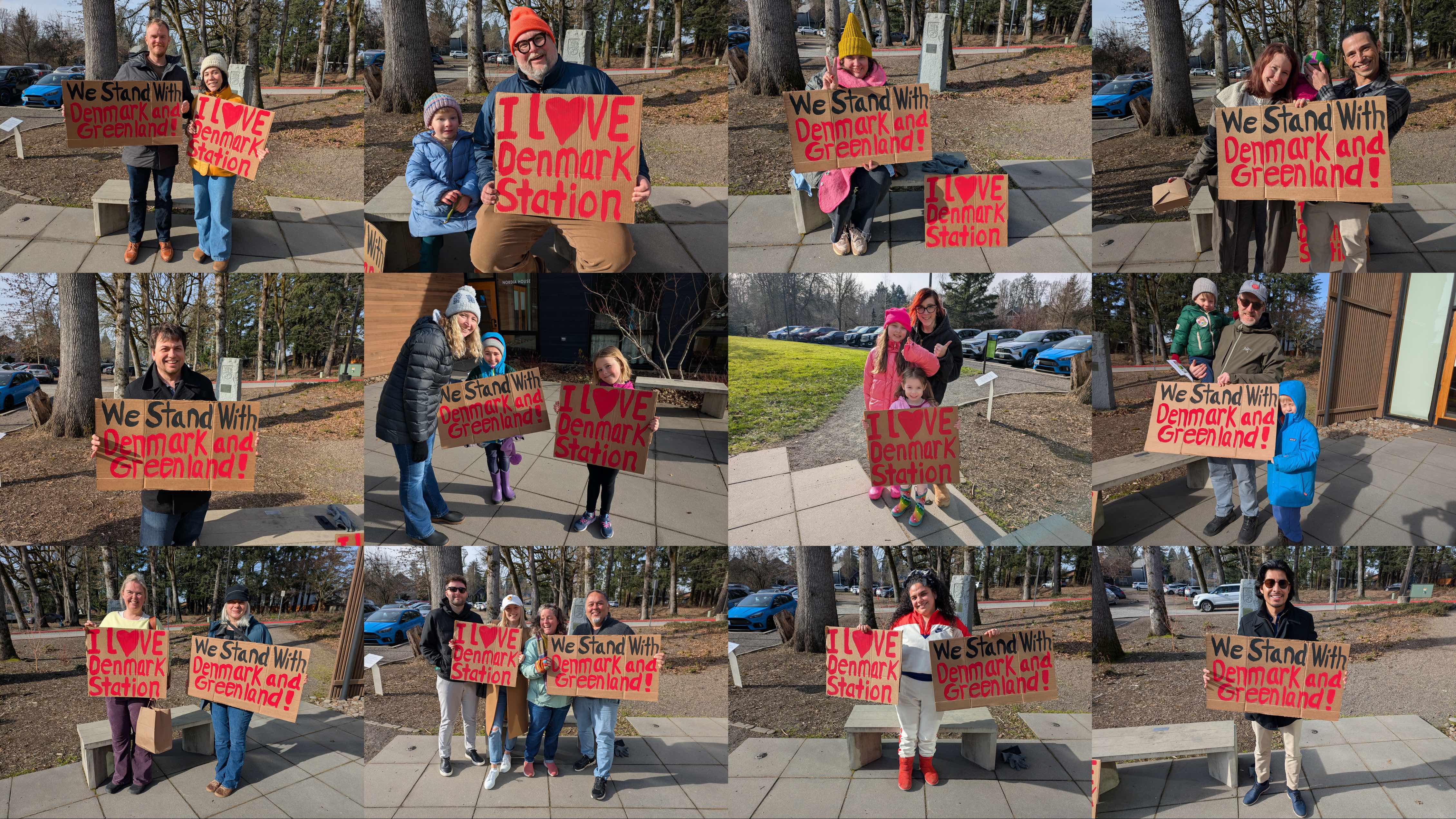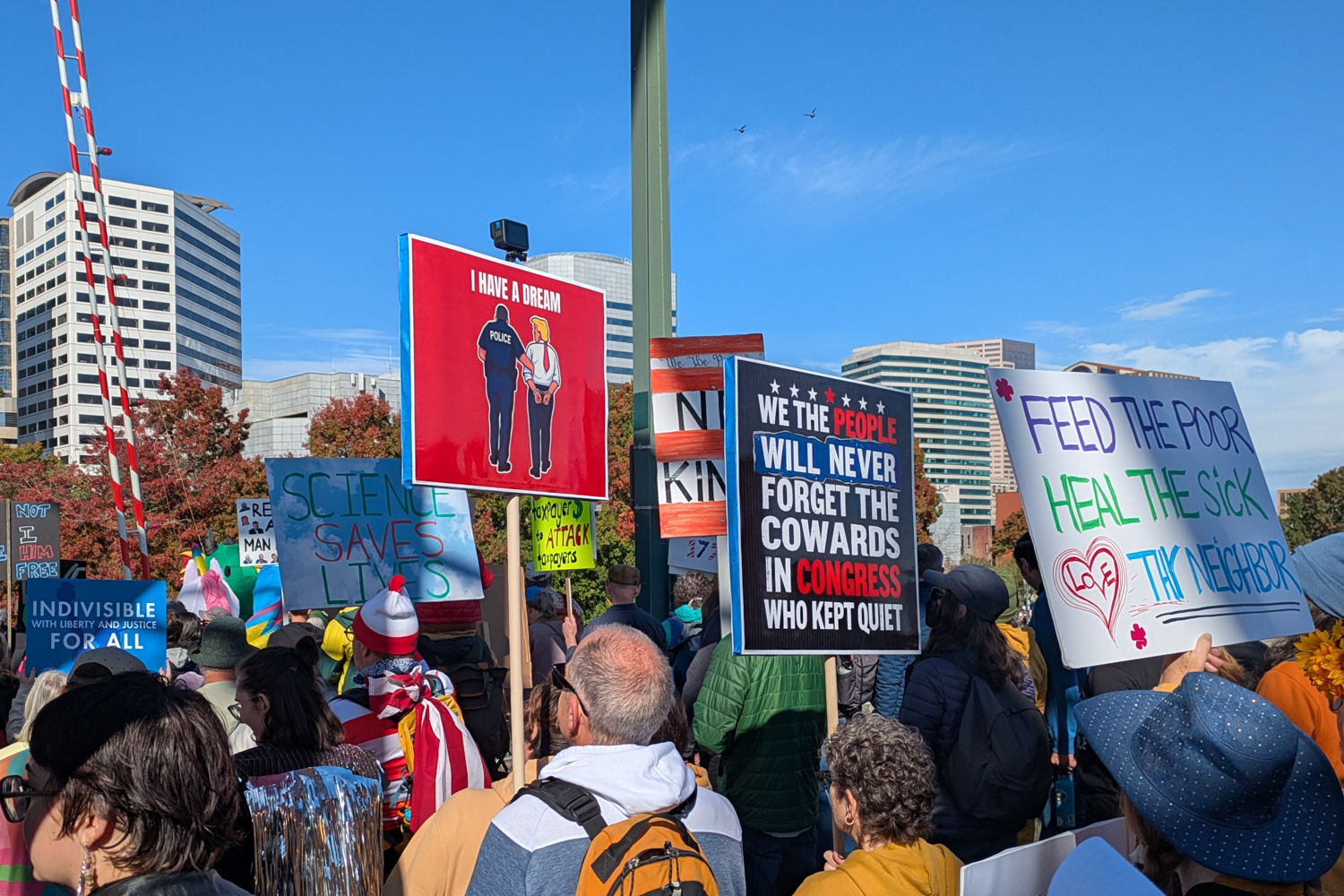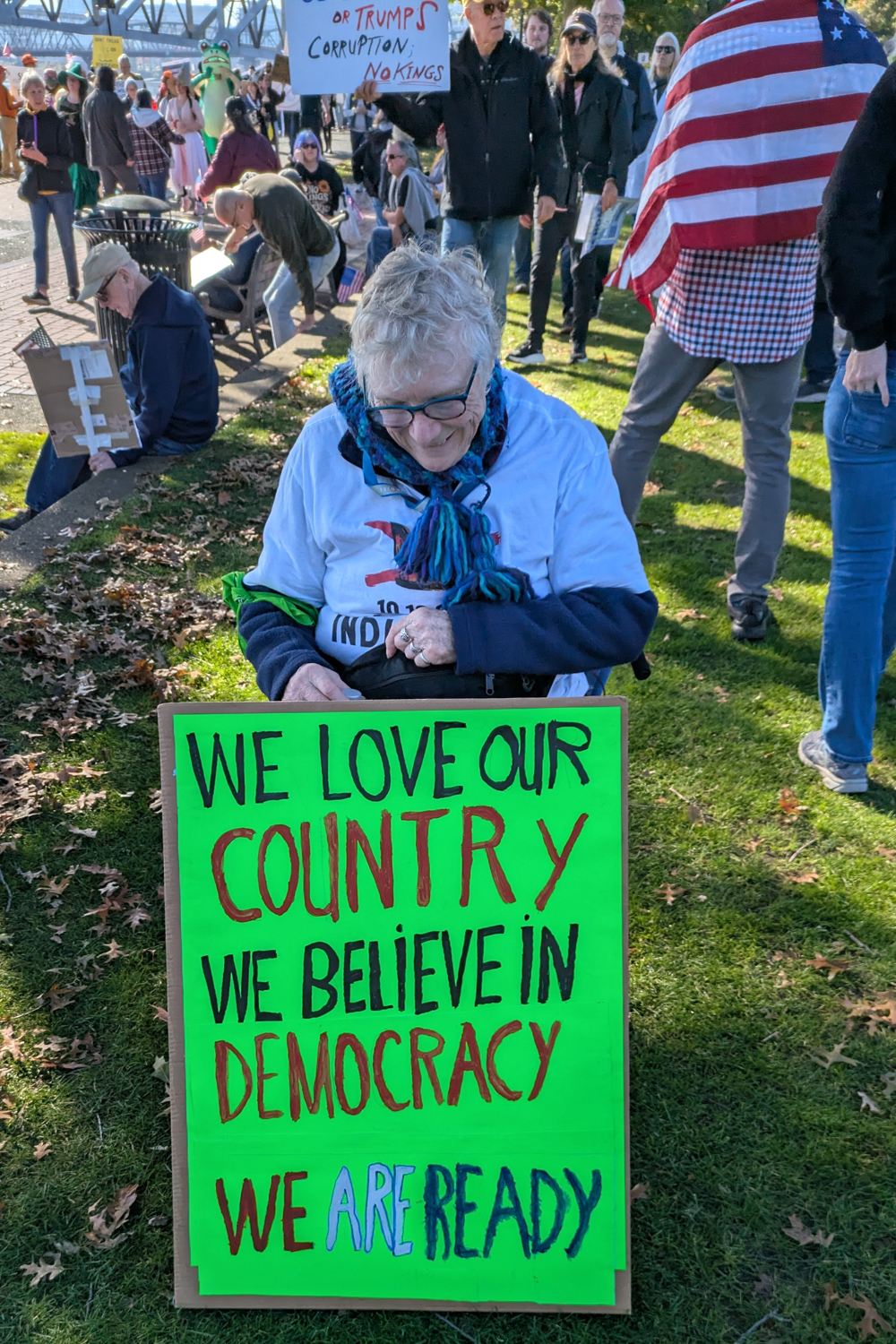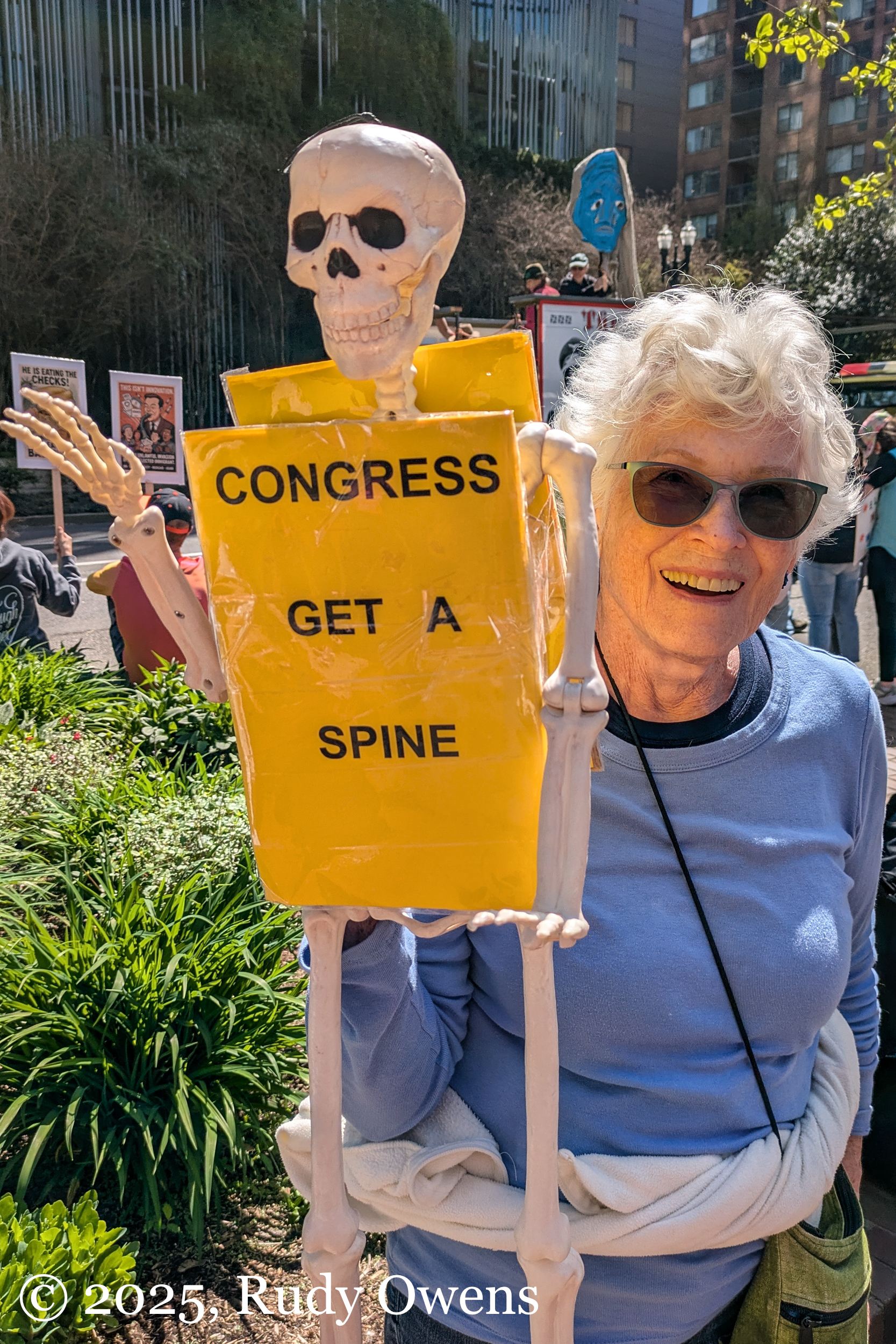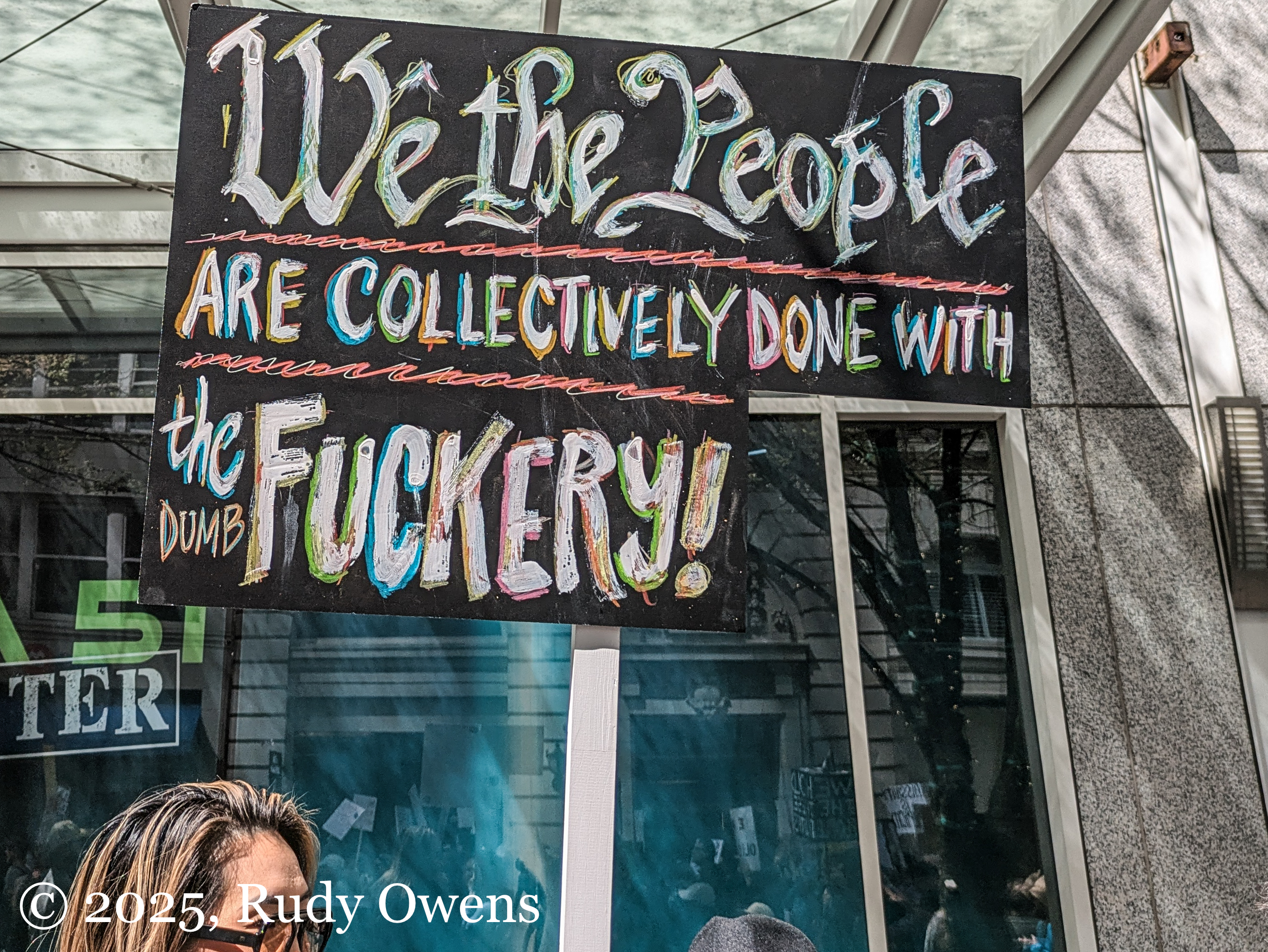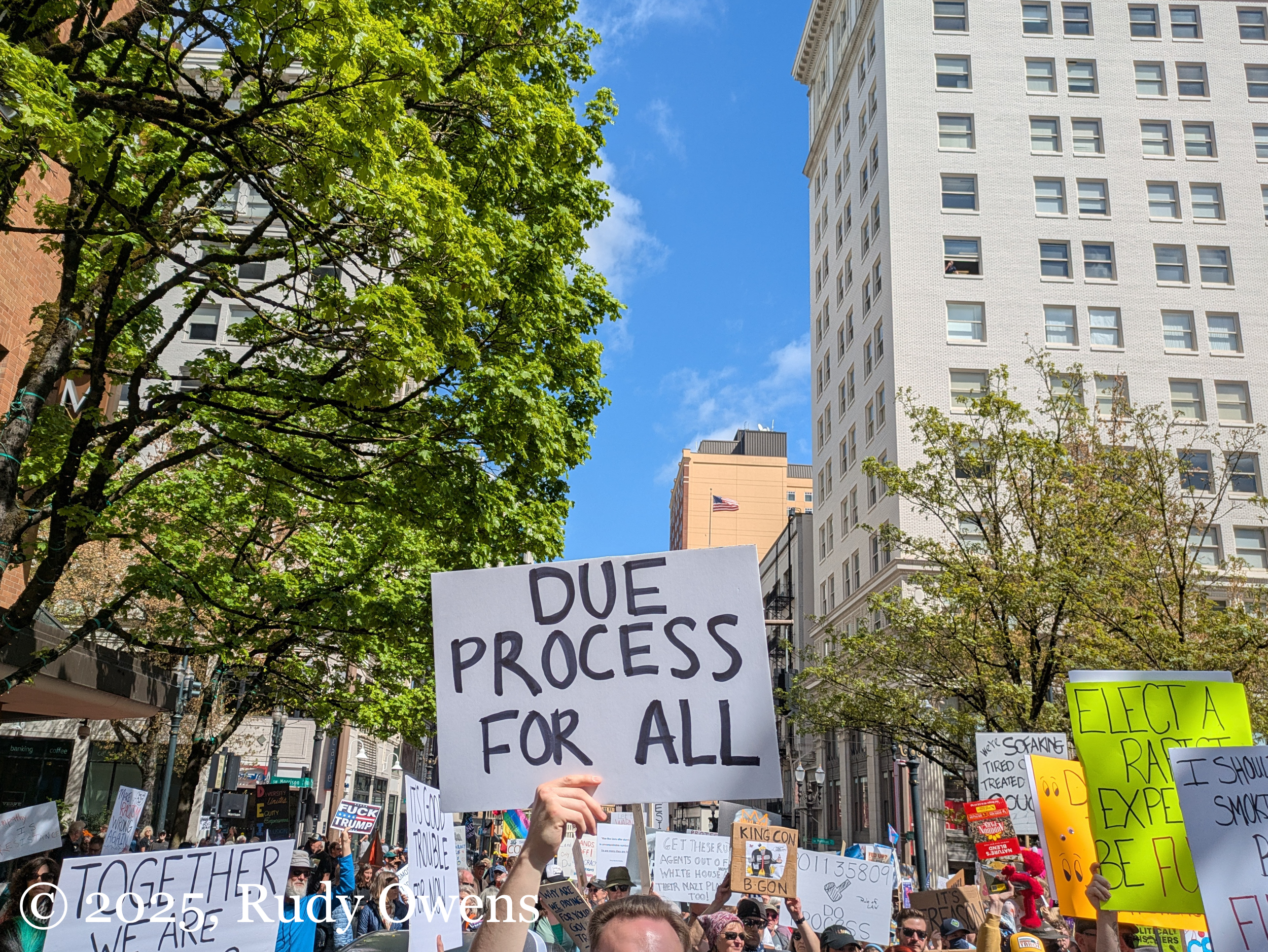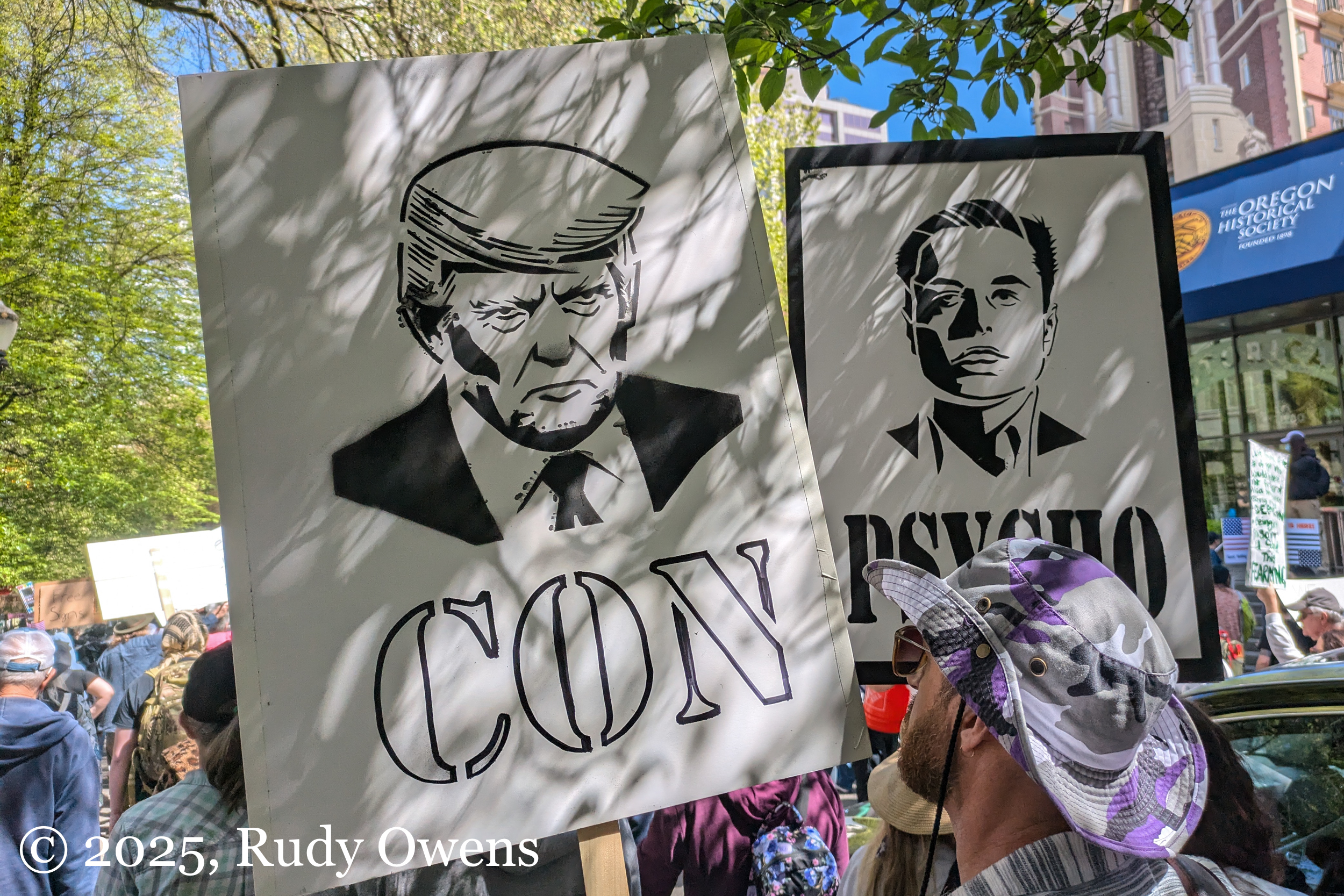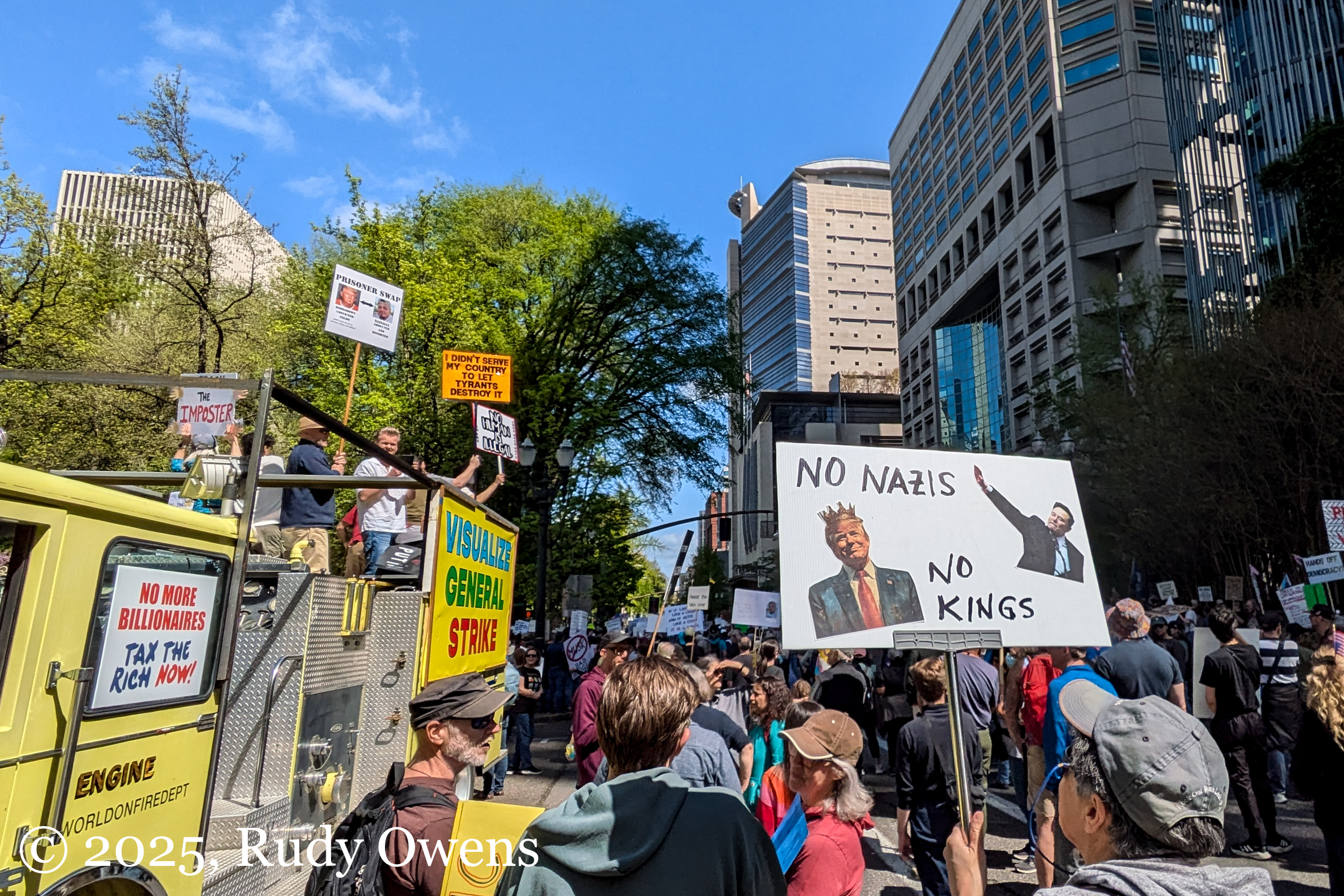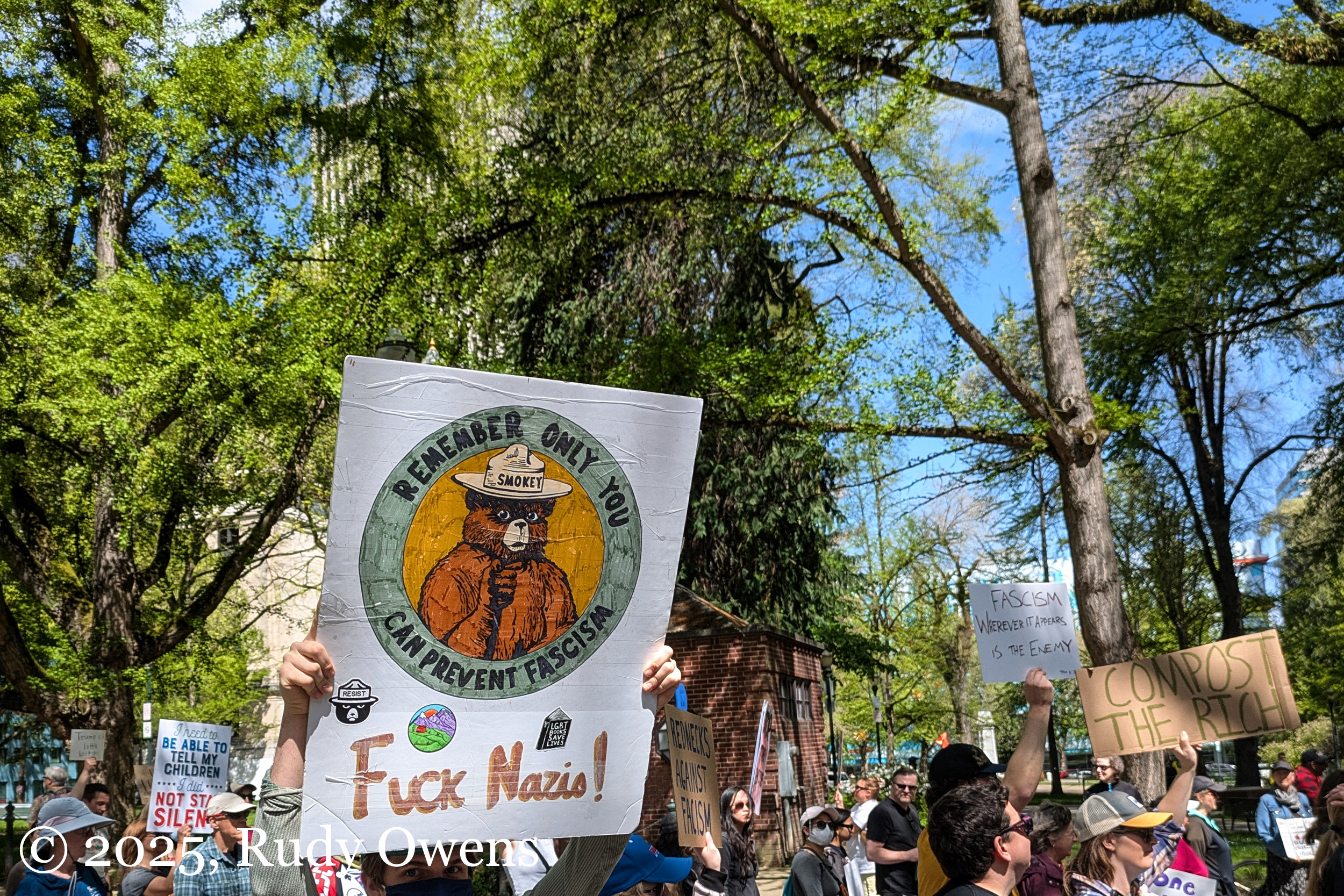
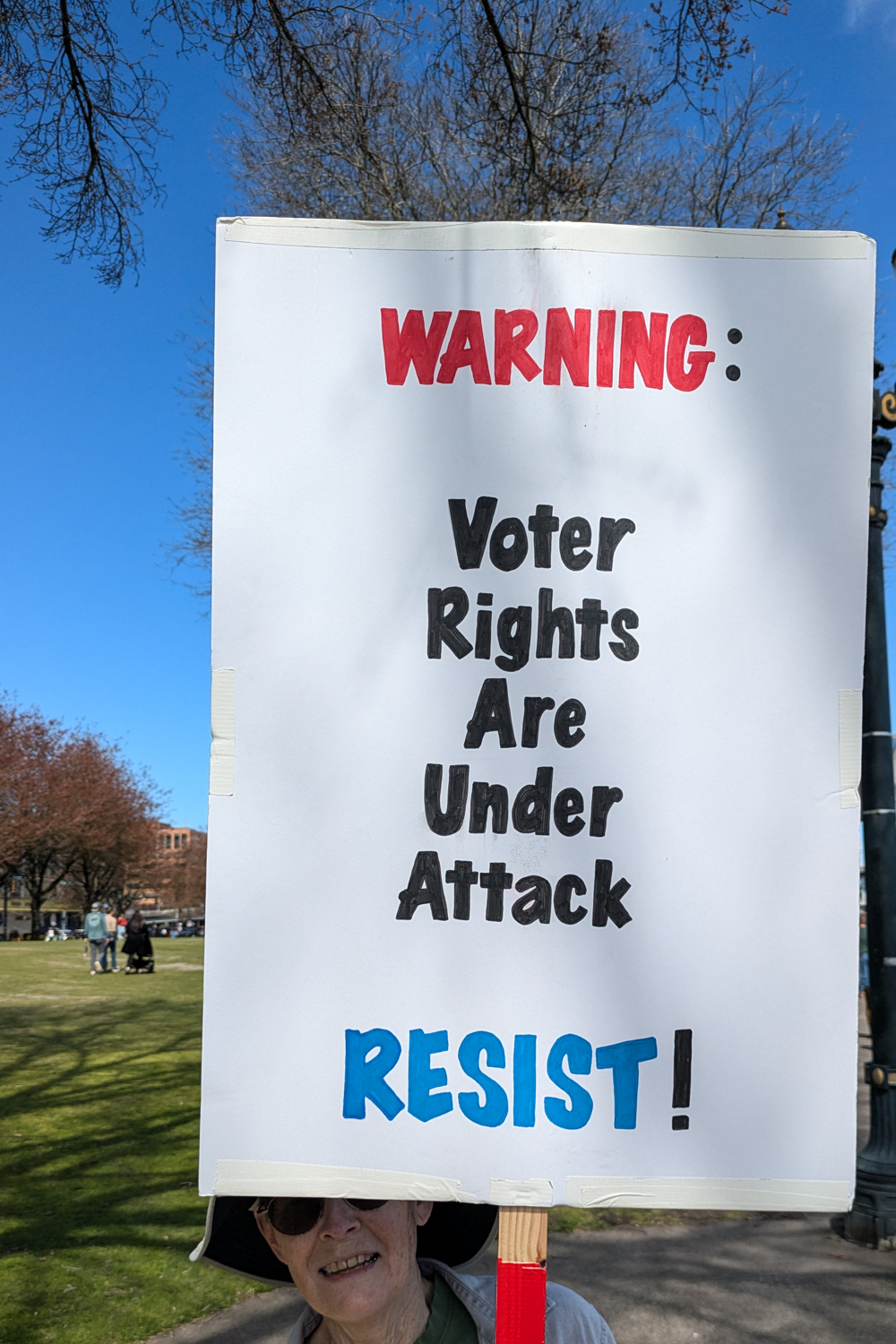
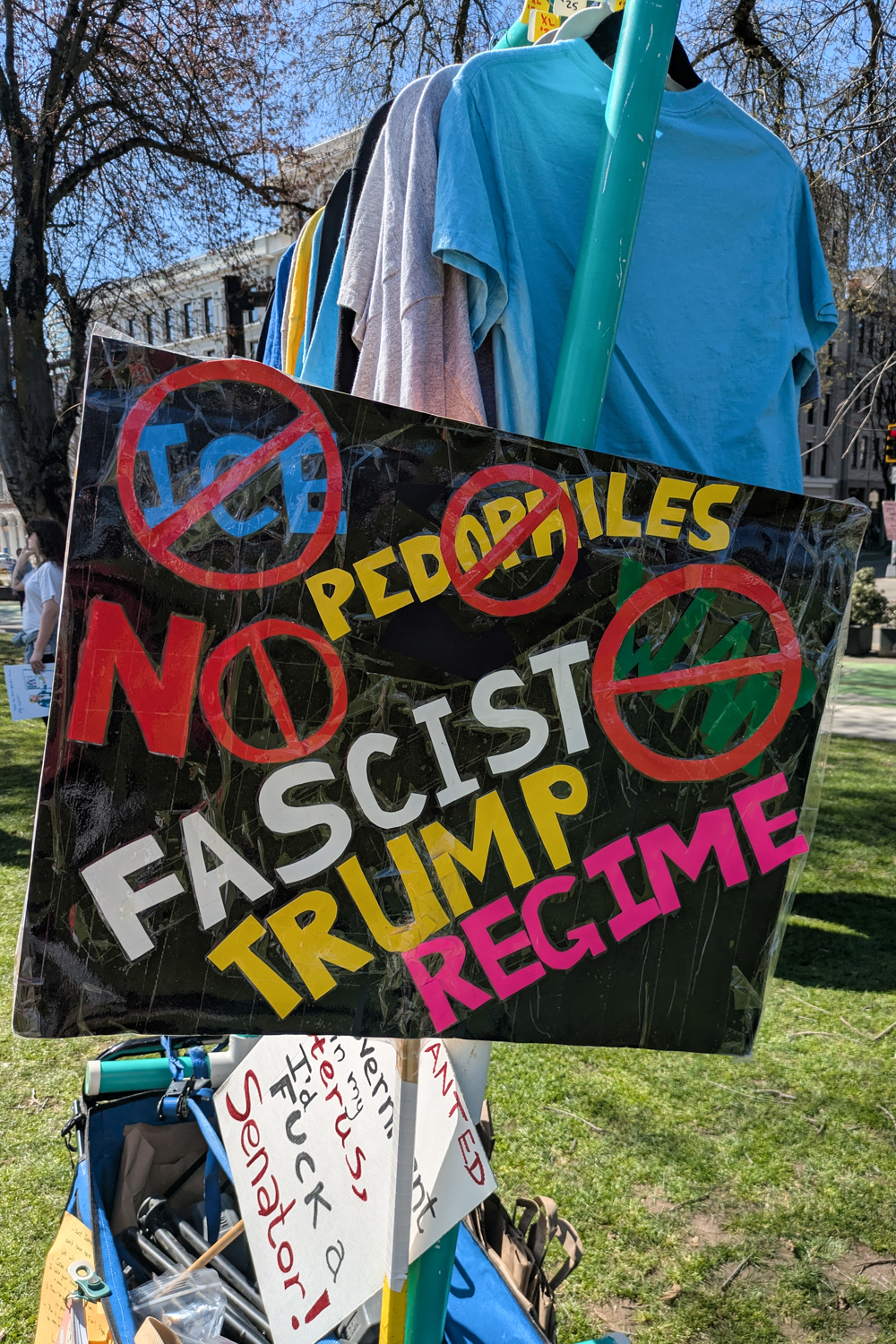
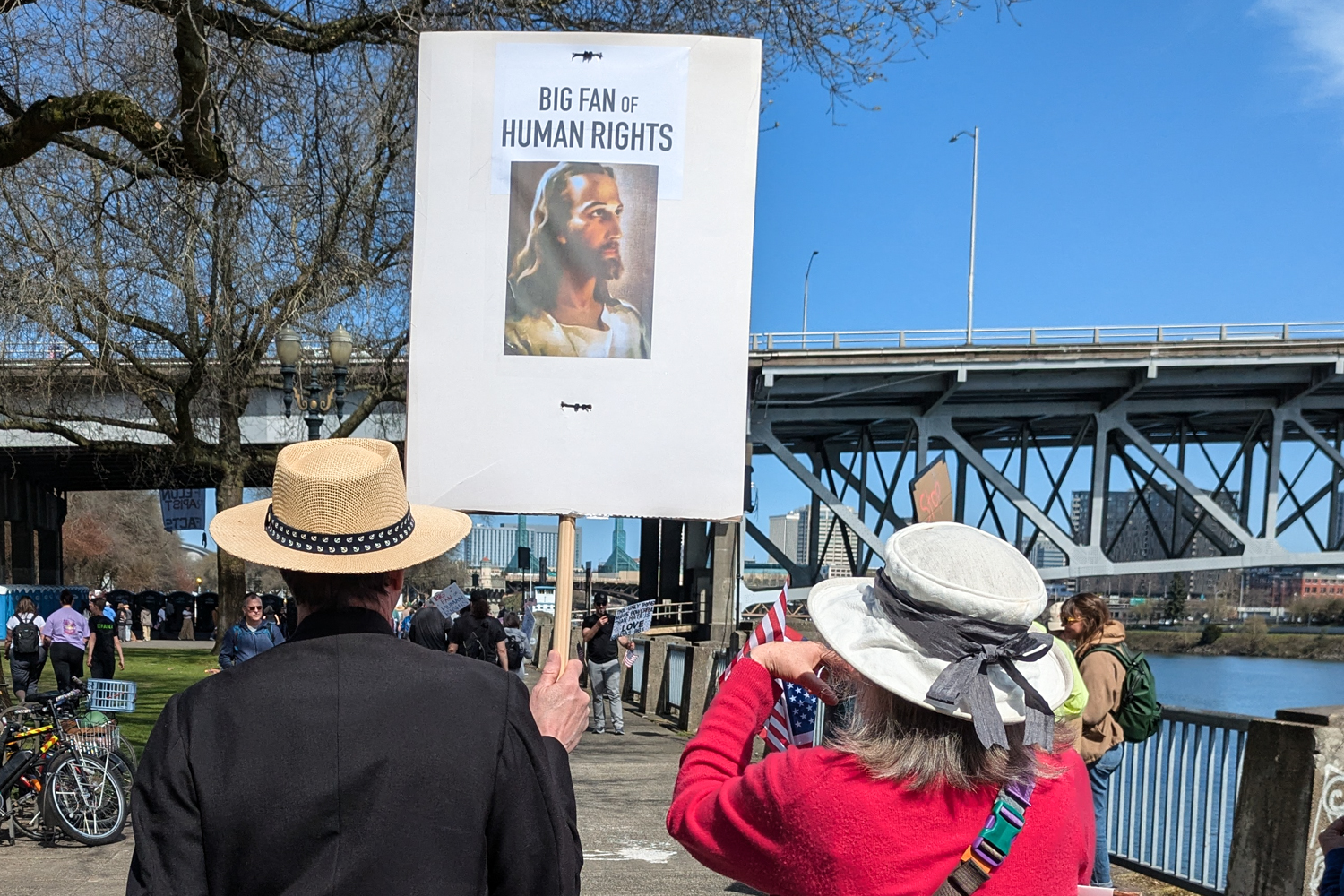
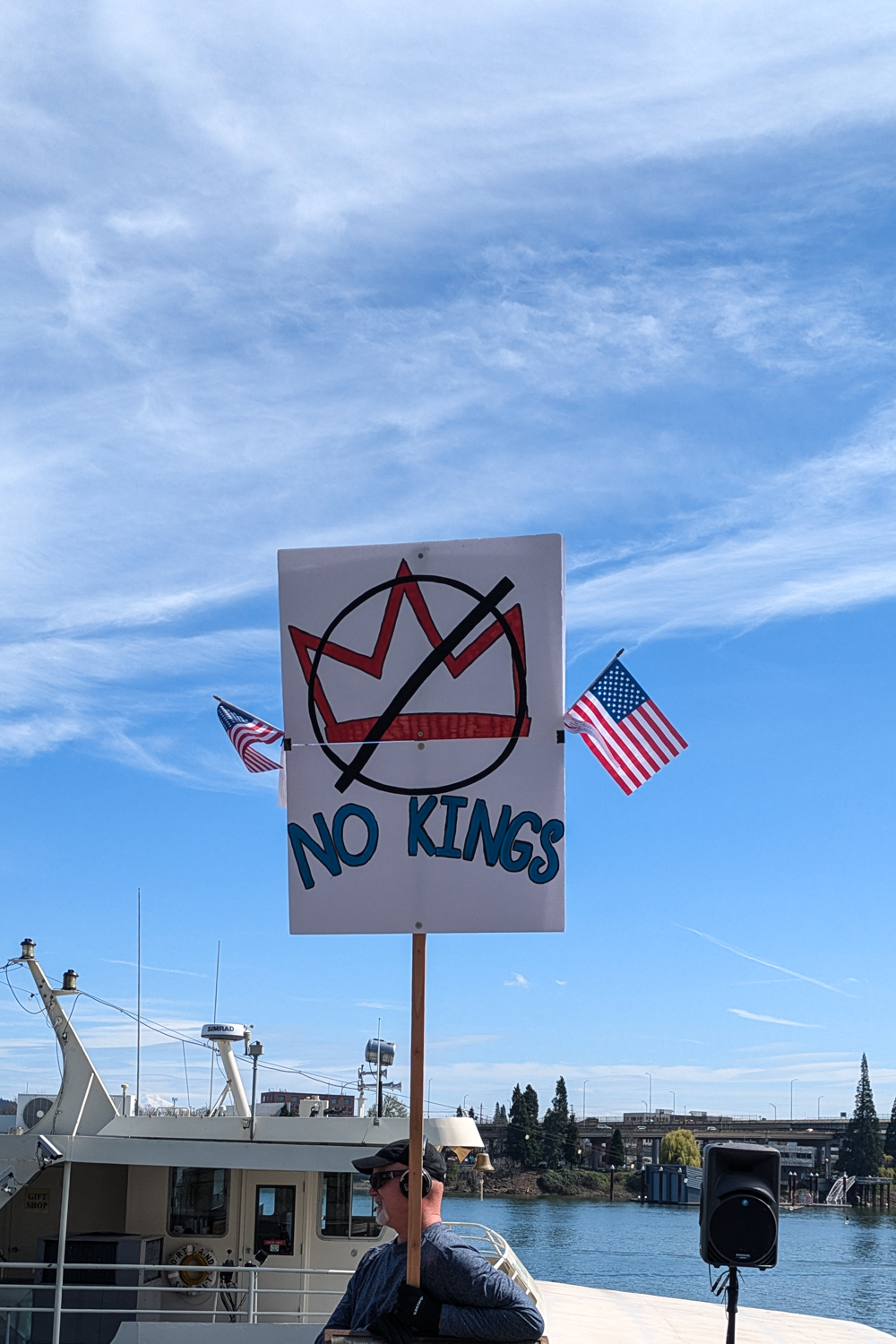
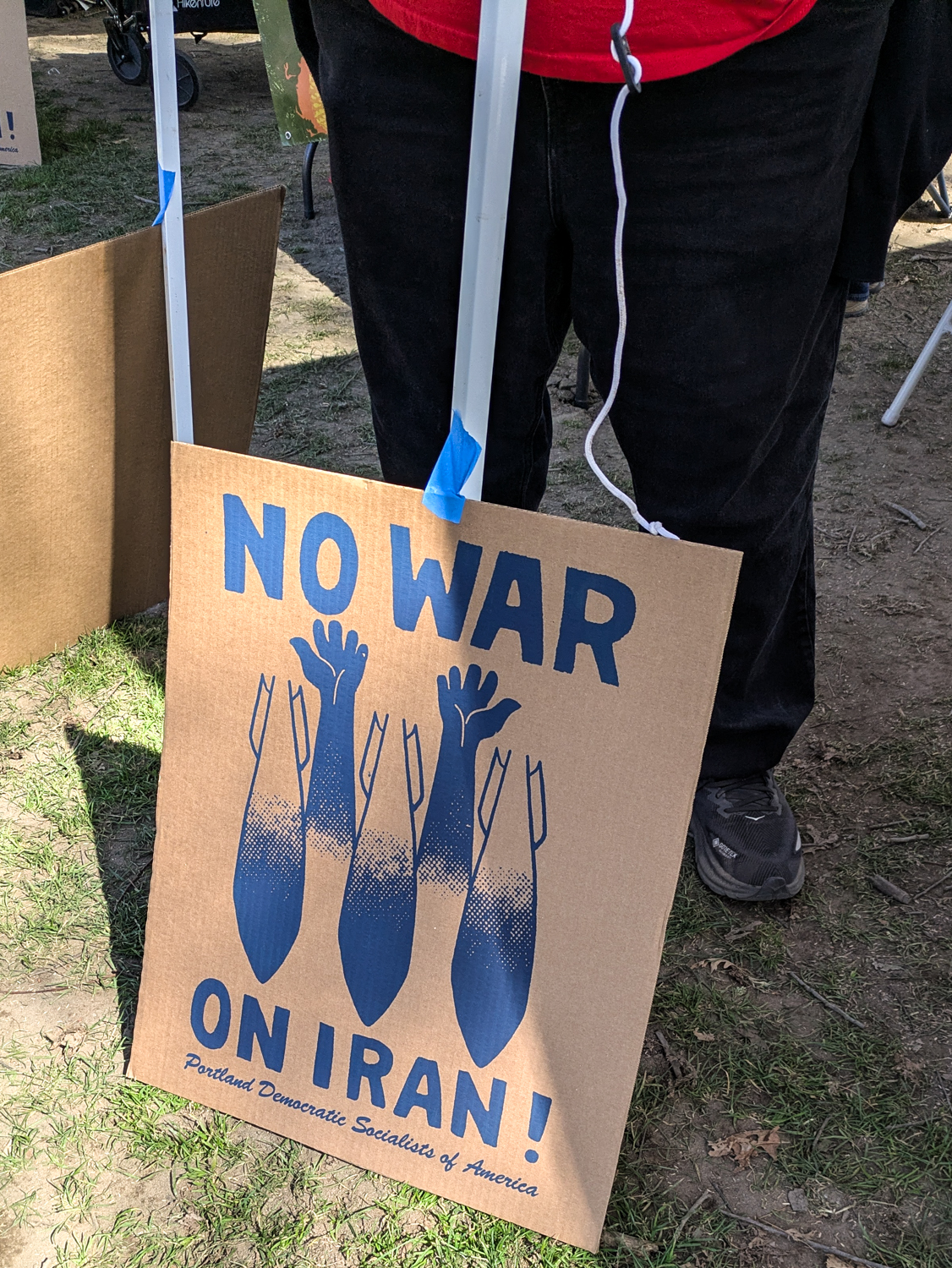
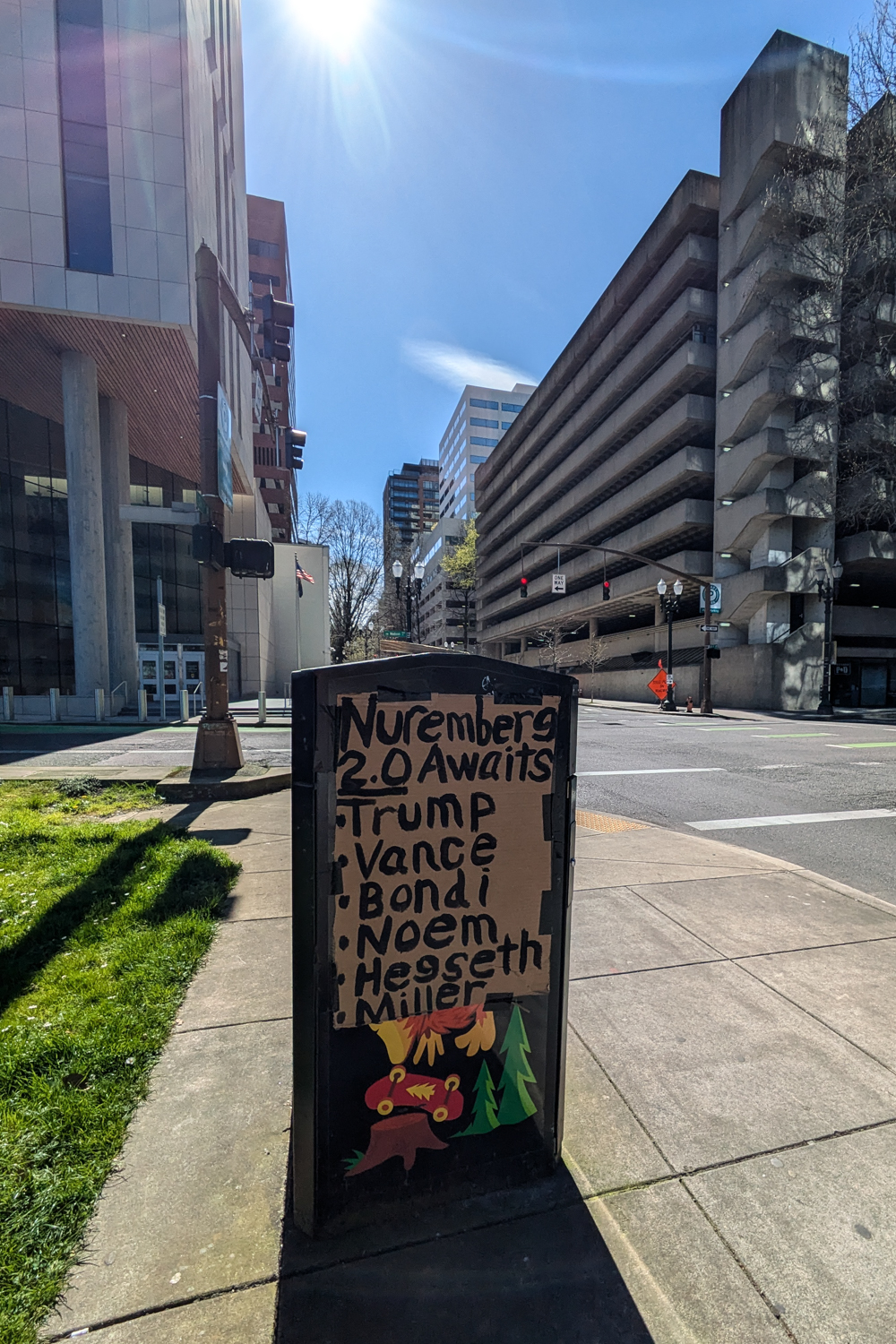
That’s right: October 18, 2025, “No Kings Day,” will go down in American history as a defining day for our troubled, imperiled democracy.
The protests were mobilized around one theme: that in the United States we have no kings. And they took place to challenge the authority of a sitting president and his administration that have falsely called peaceful American cities, like my hometown of Portland, Oregon, “war zones.”
Current estimates peg the number of protesters at 7 million, at least, in more than 2,600 locations, spread throughout every state.
VISIT MY POST ON MY WEBSITE TO SEE MORE PHOTOS AND READ MORE.
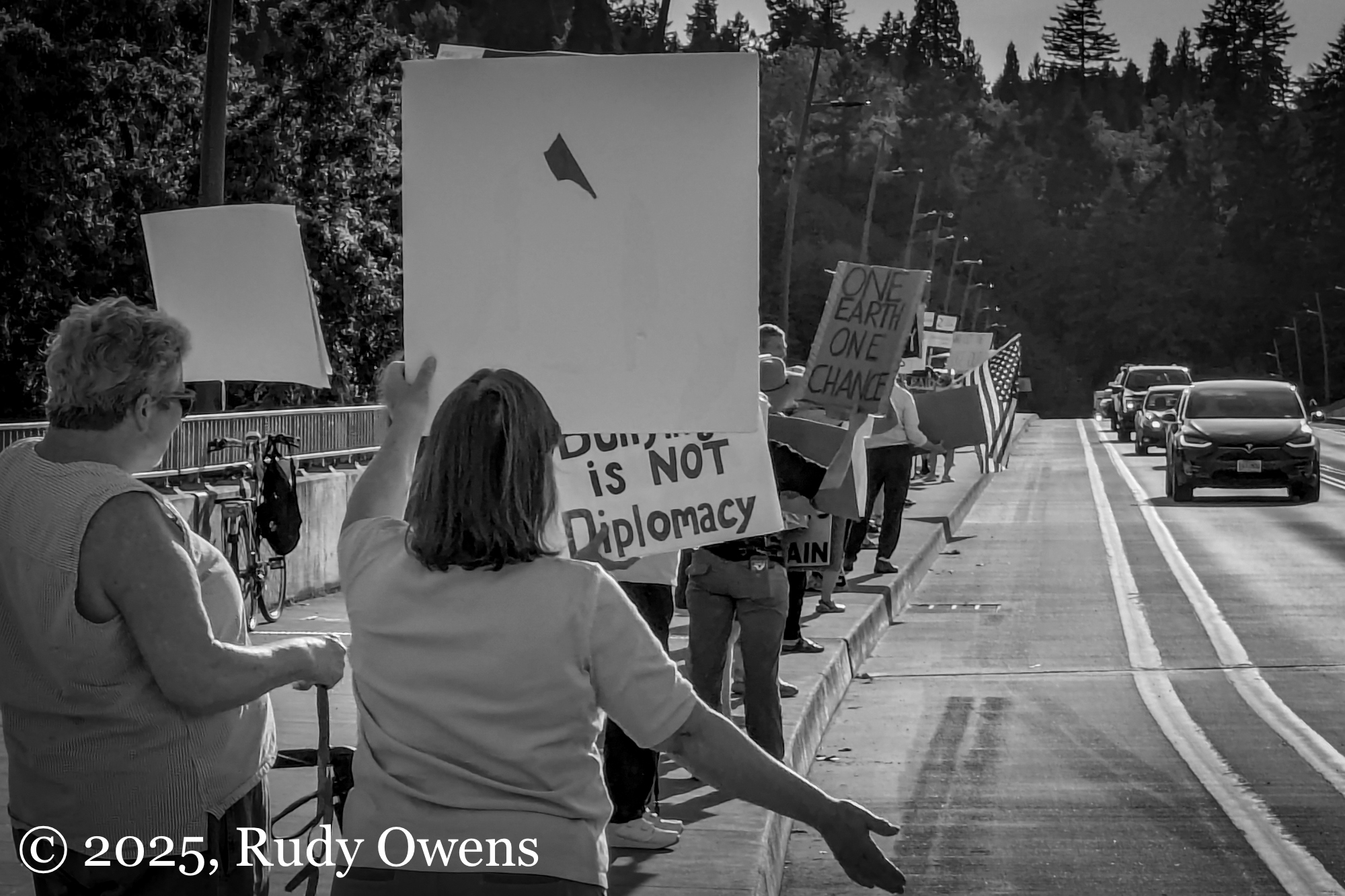
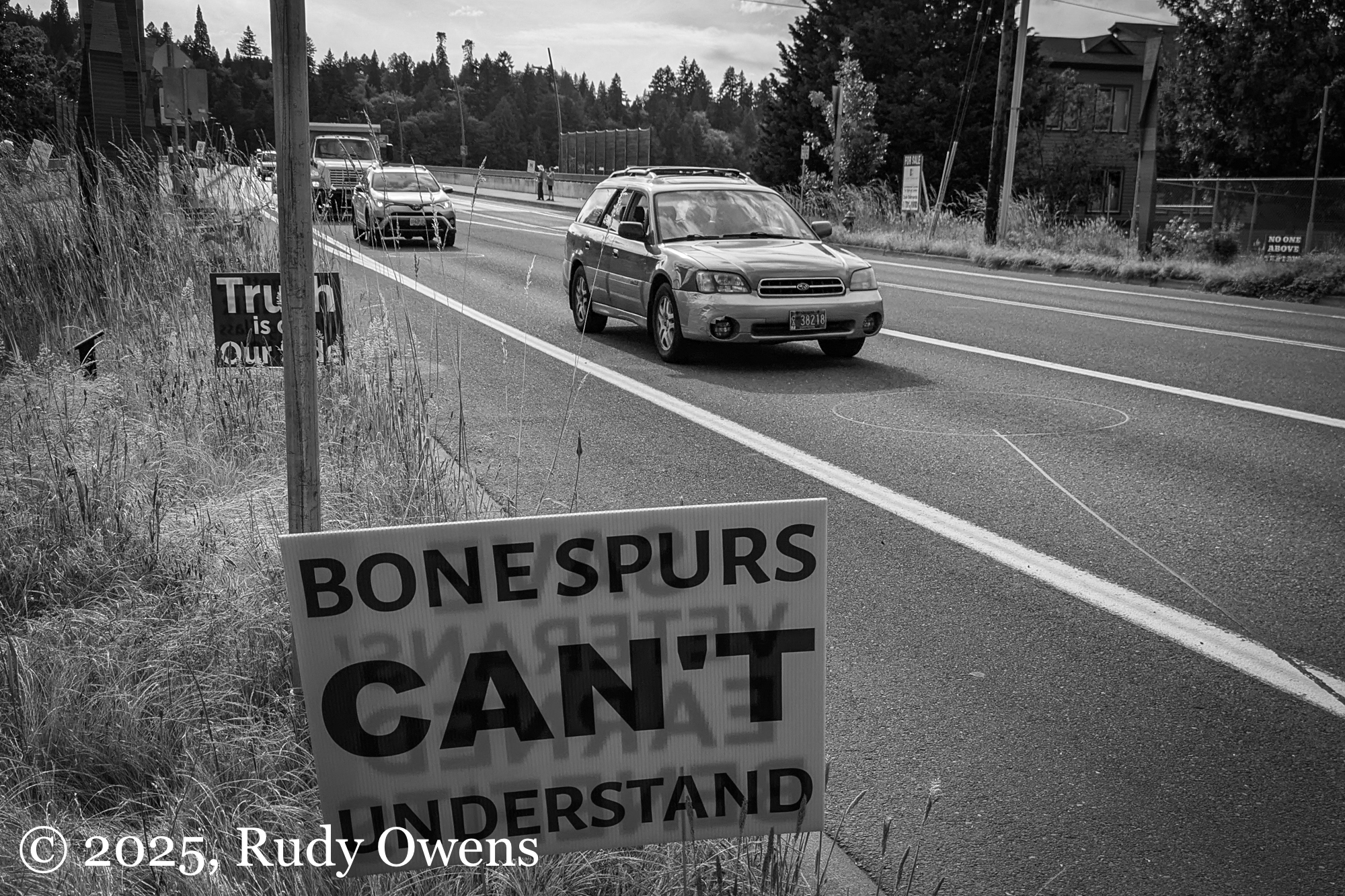
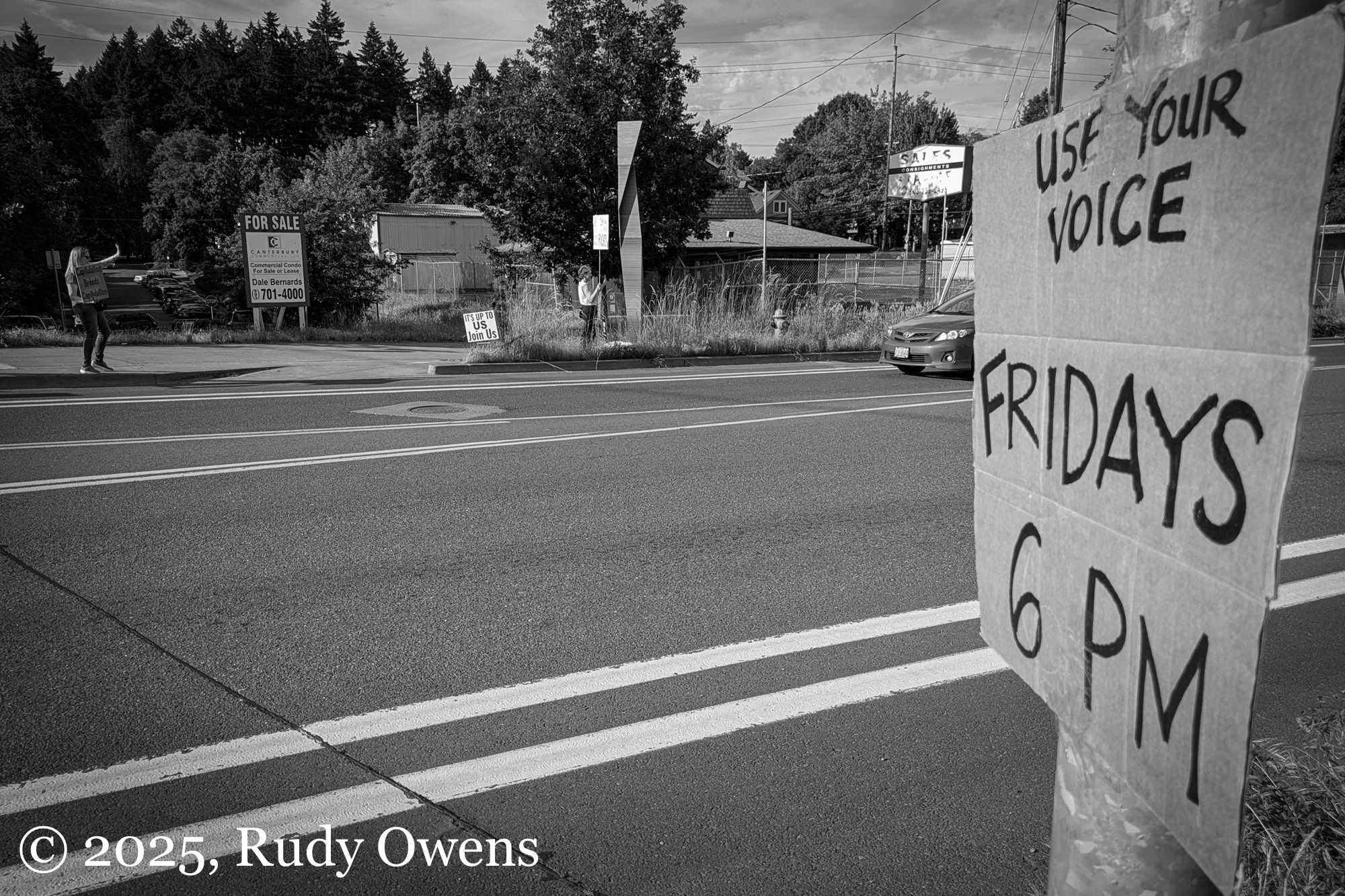
Every Friday since early April I have been joining a group of mostly older (like me) Portland residents at peaceful protests on Portland’s Sellwood Bridge during the Friday night, after-work rush hour.
The local organizers live in southeast Portland, like me, not far from Sellwood Bridge. The bridge is found on the south side of Portland, straddling the Willamette River. It’s a busy corridor for traffic heading from mostly Democratic and left-of-center leaning Multnomah County to a more evenly split jurisdiction politically, Clackamas County, which lies the south.
The organizers call their weekly civic event “Friday protests on the Sellwood Bridge.” It is an apt name. Their mission is simple too: “Our goal is to encourage our community to stay engaged and to use our voices and First Amendment rights to protest any erosion of our Constitutional freedoms or functioning government.”
The last event took place on Friday, May 30, 2025. My photos, all intentionally hiding most of the faces of the participants, were taken at the protest under sunny, warm skies.
That night, from about 5:30-7 p.m., over 75 folks assembled on the Sellwood Bridge to defend our country, exercise protected speech, and engage hundreds and hundreds of rush-hour commuters. We come with our own signs—painted, drawn, or marked out with Sharpies. Participants can also use the many more professional signs and repurposed but evergreen cardboard signs brought by the organizers.
On the last Friday of May 2025, the horn energy was righteous under the early summer sun.
Supporters in the passing rush hour cars, and also cyclists, outnumbered the few angry white male bird flippers by about a ratio of 25-1. That was encouraging.
Like previous weeks, I saw the outrage and solidarity in people’s faces. They showed with their expressions they were all in on the resistance themes. I observed how they leaned into their horns, giving protesters a thumbs ups, pumping their fists, and even yelling in support.
For the commuters, they see people engaged. They see protest happening. They see the signs focusing on: cuts to Medicaid, violations of due process, cuts to our federal health system, illegal firings of tens of thousands of federal workers, threats to the environment and education, the gutting of our federal bureaucracy, the illegal disappearance of lawful residents to gulags out of the United States, and more.
The drivers recognize that their frustration and outrage at the ongoing coup to the U.S. Constitution is not a personal assault, but one shared by their neighbors and our country. And man, were they laying in on the horns on May 30, 2025.
The Sellwood Bridge Protest logo
The importance of showing up, week after week
The protests each Friday on the Sellwood Bridge are all organic, with almost no coordination, outside of weekly email reminders.
A few people started the civil actions in February 2025, and they have grown. The entire purpose is to keep showing up, to keep calling out the violations of law by the current president, and to demand a restoration of law and the end of corruption and lawbreaking by the current administration of President Donald Trump, a convicted felon.
What’s important about the events each week is the consistency of civil disobedience and the act of protest.
Renown historian of 20th century tyranny, Professor Timothy Snyder of the University of Toronto, in an interview on May 31, 2025, with MSNBC’s host Ali Velshi, said, “Democracy is a verb.” It’s not a static thing. It’s action. When there is action, others engage, and the acts themselves become part of a system that is vital to human goodness.
I think Snyder described the value of action so perfectly: “But we also have to recognize that it’s not on any one of us to solve the whole thing. Right. So each of us does a little bit, and together that changes the whole landscape.”
I plan to keep going to these events as long as my democracy is under siege, and it looks like it will be a long and painful four years, at least.
Protesters against the administration of President Donald Trump numbered at least 3,000 and shared a diverse range of creative protest signs, defending American democracy.
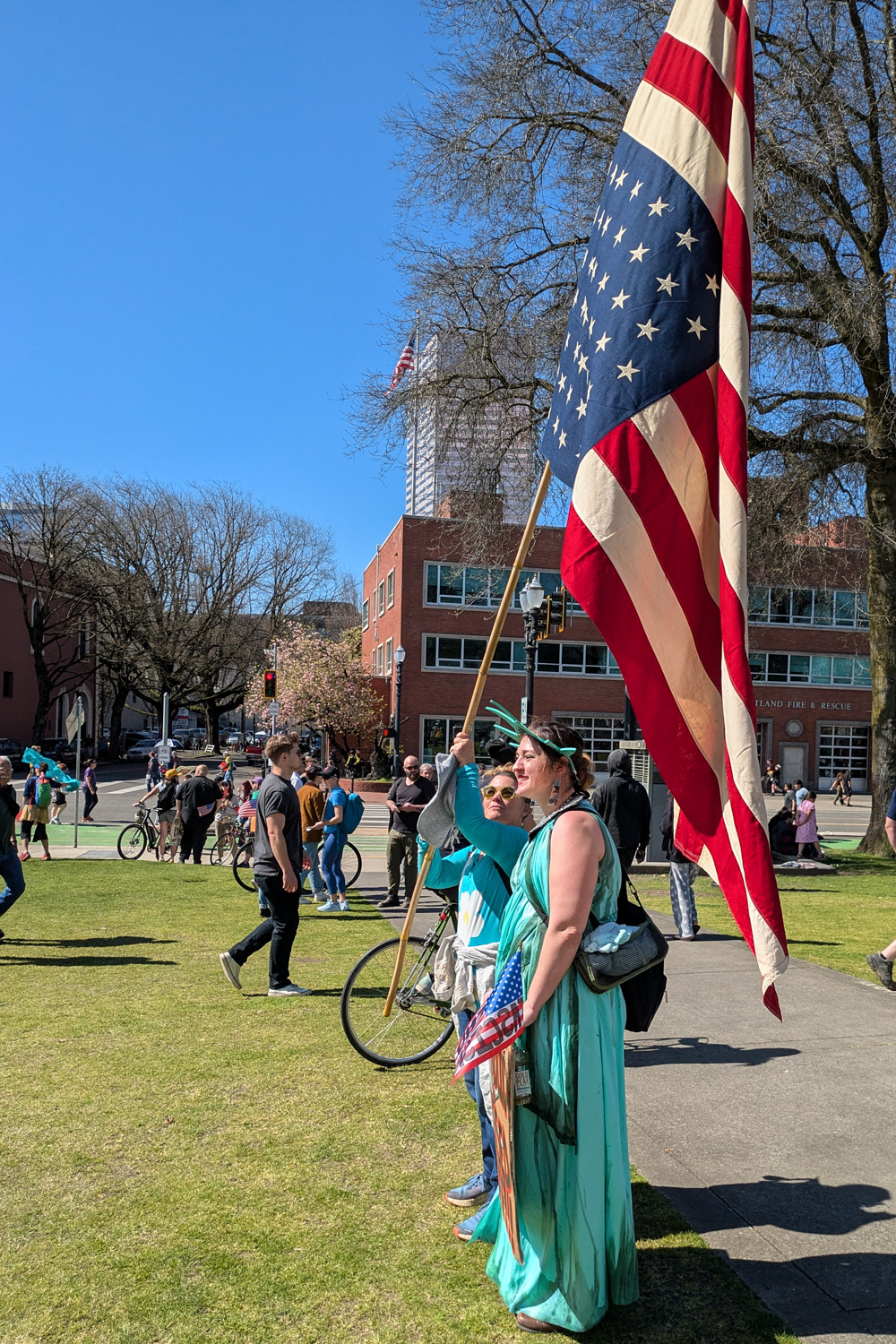
On the weekend marking the 250th anniversary of the first shots fired in the American Revolution against a tyrannical monarch and the British Empire, at least 3,000 people gathered in downtown Portland, Oregon to protest the administration of President Donald Trump.
The April 19, 2025 events kicked off at Pioneer Square, a gathering place for many public events in the city, and then the march took over the streets for over an hour. Protesters represented all ages and carried a wide array of colorful, creative, and biting signs criticizing Trump, Elon Musk, and the administration for its many actions. I saw about a dozen Portland police officers following on bikes, but mostly there was no visible law enforcement presence based on my observations.
There was no need for any police given the entirely peaceful nature of the civil action by thousands of people exercising their protected speech, as allowed by the First Amendment to the U.S. Constitution.
The day was a fitting one too.
Nationally some have dubbed collective national protests on April 19, 2025, as “No Kings Day, Part II.” The reasons for unrest today have a striking similarity to what happened two and a half centuries ago, as British forces gathered in Massachusetts to confront increasingly rebellious colonial residents.
The issues that led to the first conflict of the American Revolution—the right to self-determination, liberty, democracy, the rule of law, a life free from the power of kings—helped to forge a nation 13 years later, in 1788.
That year, the newly christened United States of America was created through the adoption of a founding charter, the Constitution. While revolutionary, it was also terribly marred and flawed by enshrining slavery, our country’s greatest sin. It would still take over two centuries to guarantee the document’s original promise for all persons.
This framework for a nation, set forth in the Constitution, called for a system of checks and balances by three branches of government: the executive, legislative, and judicial branches. On April 19, 2025, in Portland, people gathered with deep and profound concern that this sacred charter had been irrevocably broken by a man who has proclaimed himself to be a king.
At these protests in Portland, the residents who gathered to assemble recalled our original bold vision for a country with their calls for accountability, the rule of law, and the safeguarding of our democratic freedoms. Their demands reminded us all of our daring experiment to forge a more perfect union, stretching from 1775 to 1788, and grounded in our Constitution: “We the People of the United States, in Order to form a more perfect Union, establish Justice, insure domestic Tranquility, provide for the common defense, promote the general Welfare, and secure the Blessings of Liberty to ourselves and our Posterity, do ordain and establish this Constitution for the United States of America.”
Lastly, I observed few persons from a group being targeted for enforcement and deportation action by this administration: Latinos. There was a lot of chatter online by some of the organizers (I can’t confirm who the organizers are based on published posts), who said it would be safe for all people. However, many Latinos are fearful in Oregon, given the cancellations this month of upcoming Latino cultural events statewide. I believe they do not want to be seen, photographed, or filmed at these events. There were very few African Americans too. The lack of diversity at this event is telling and needs to be discussed.
(Click on each photo to see a larger picture on a separate picture page.)
Portland does get its summer concerts in the parks right, even if so many other things are not going well.
We have a lot of issues now in our city, from a wave of gun violence to massive open air drug use of deadly fentanyl, and the failure of our community to meet these and other challenges. These problems have also led to an exodus of nearly 3 percent of Multnomah County’s population since 2020.
In fact, this week, the local weekly newspaper, Willamette Week, published a litany of woes that national and international journalists have shared about the falling star that Portland has become from its quirky, almost rock star status less than a decade ago.
“Portland is on a short list of destination cities for national media,” wrote the Willamette Week. “Rather than a model, however, we have become a cautionary tale. It wasn’t long ago that the nation’s leading newspapers and magazines regularly wrote the same glowing profile of the Rose City—a lovably weird outpost wedged between the Cascades and the Pacific where colorful (but mostly white) residents pedaled tall bikes while playing the bagpipes, eating Voodoo doughnuts, and slurping elderflower-flavored kombucha.”
The Voodoo doughnuts and bagpipes were always absurdities and click-bait style gimmicks disconnected from lived reality of nearly everyone who lives here, but that’s what feeds the media and social media appetites.
Portland, and its countless brand messengers, ran with it, until the city hit the brick wall of harsh reality. This collision of fantasy and reality has made us a model of what can go wrong with civic life and the brute truth of complex issues like gun violence, deadly opioid-fueled drug use, mental health disorders, gentrification, racial disparities, political experiments gone amok, and more.
Despite our many issues, the city can still put on some good public events that bring together diverse residents. That was on display on July 15, 2023, at the great public park near my home, Sellwood Park.
The Portland-based Latin Music group Conjunto Alegre dished up the standards of salsa, merengue, cumbia, bachata, cha-cha, and more. This is a wonderful and eclectic ensemble from the diaspora of musicians from Latin countries who call Portland home.
Even dance-challenged–and yes, mostly white–Portlanders were on their feet dancing. The band had fun. The crowd had fun. Kids had fun. The breeze cooled all of us down at the end of a hot day. And for a couple of hours, the magic of Portland had returned. I loved it!
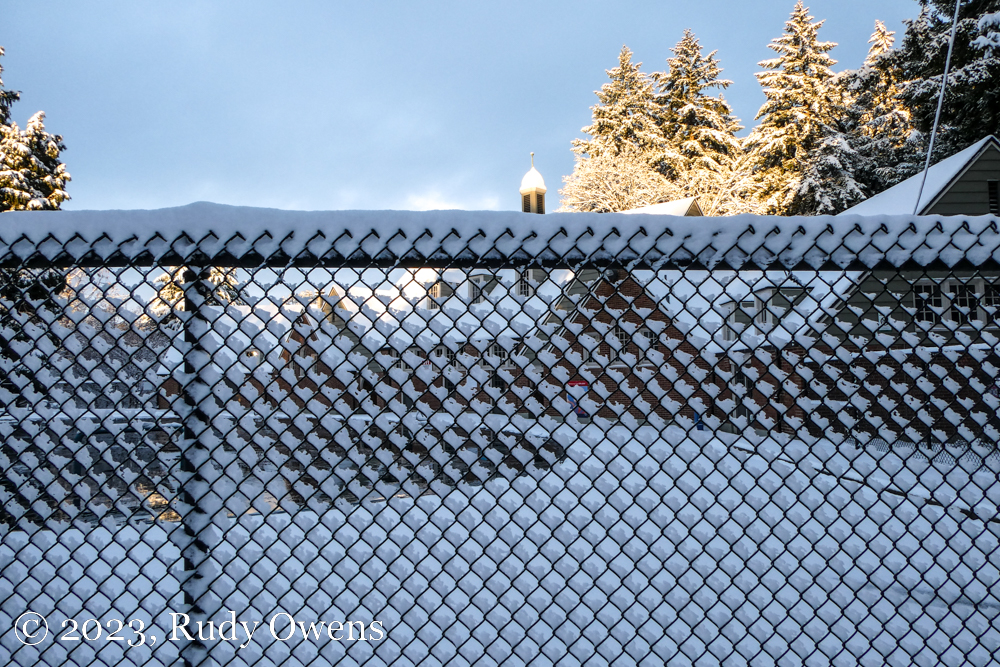
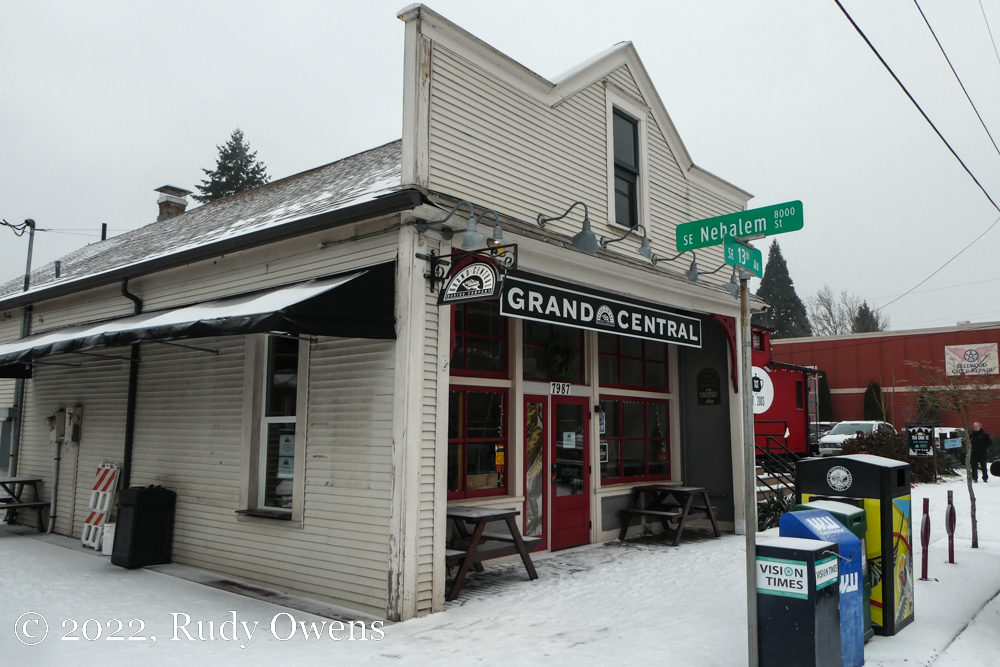
Sellwood after the stormRamen shop, SellwoodSellwood Pool in snow
(Click on each photo to see a larger picture on a separate picture page.)
Around 3 p.m. on Feb. 22, 2023, big flakes began falling in my neighborhood in Portland, Ore. I did not think much of it, because the normally accurate National Weather Service’s winter storm warning only called for one to three inches through the next day. And to my surprise it really started falling. By 6 p.m., when I called it a day working at home, nearly three inches of snow had already fallen, and the blowing flakes were still coming down, heavy and wet.
After a nice and soggy snow walk, I settled in, wondering what the next morning would bring.
Much like Bill Murray’s weatherman Phil Connors in Groundhog Day, who finally sees a new day that ends his torment in Punxsutawney, Penn., when I opened the blinds at 5:30 a.m., I saw a massive dump of snow had accumulated. It was far greater than predicted. Our regional weather data gatherers reported Portland recorded the second-largest snowfall in a single day by the time it all ended, with parts of the city recording up to 11 inches of white stuff.
For hundreds of thousands, this historic snowstorm did what we know happens here, by bringing the commute to a crawl. Most drivers in Portland don’t have good winter driving skills, and the excess of large vehicle owners driving recklessly, causing mishap, not to mention trucks jackknifing and shutting down the arterials, paralyzed the evening commute. Countless big and “manly” pick-ups” and SUVs were abandoned, as were the semis, and it turned into a saga of six-hour commutes for many workers. I really felt sorry for most. I had that happen before to me, in Portland’s February 2017 snowstorm. I counted my blessings, as I am now a telecommuter. I will never forget how lucky I was not to be risking my life to commute–it’s something I hated doing for years of my life.
Before my workday began, I did a nice three-quarter mile walk in my neighborhood, snapping the proverbial winter shots I often do and relishing the snowy quiet.
Local and state transportation officials were urging people to avoid driving if they could, which is impossible for tens of thousands of people who have to work, particularly if they are essential workers. But the icy conditions probably grounded many, and those who showed up showed up like they always do, because when you work, you show up if you aren’t privileged.
As the day ended, I did a fun run through a snow covered wooded trail. It was glorious. I also marveled at narcissistic behemoth vehicle owners gunning it 50 mph on ice covered streets as if they were immune from laws of physics. They always do that here, because that’s who they are. Mostly, I smiled at the teens enjoying the bliss of sledding on a popular sledding hill. Now that was how to make the most of the weather.
As the nation navigates from extreme winter weather that cancelled thousands of flights, lead to fatal crashes by dangerous truck drivers, and imperiled many living on the margins, Christmas Day finally arrives.
Snow and ice hit the Pacific Northwest, blanketing Seattle in perilous ice and closing portions of Interstate 84 outside of Portland. Fortunately, Portland had mostly light snow just before Christmas eve that today, Dec. 25, is turning to wet, soppy mush.
To everyone who is braving the elements or trying to connect with families and friends, please travel safely. Enjoy the season and, if you can, be kind and think of others who may be less fortunate.
(Click on each photo to see a larger picture on a separate page.)
There is an entire genre of photography devoted to the collapse of the United States’ consumerist structures, notably the shopping mall.
Malls in decay represent a specific type of schadenfreude in a country where consumer activity drives about 70 percent of our economy. The collapse of the venerable shopping mall, a landmark from the 1950s through the 1980s, in mostly suburban American, reveals deeper troubles in our economy and the promises we were told and believed.
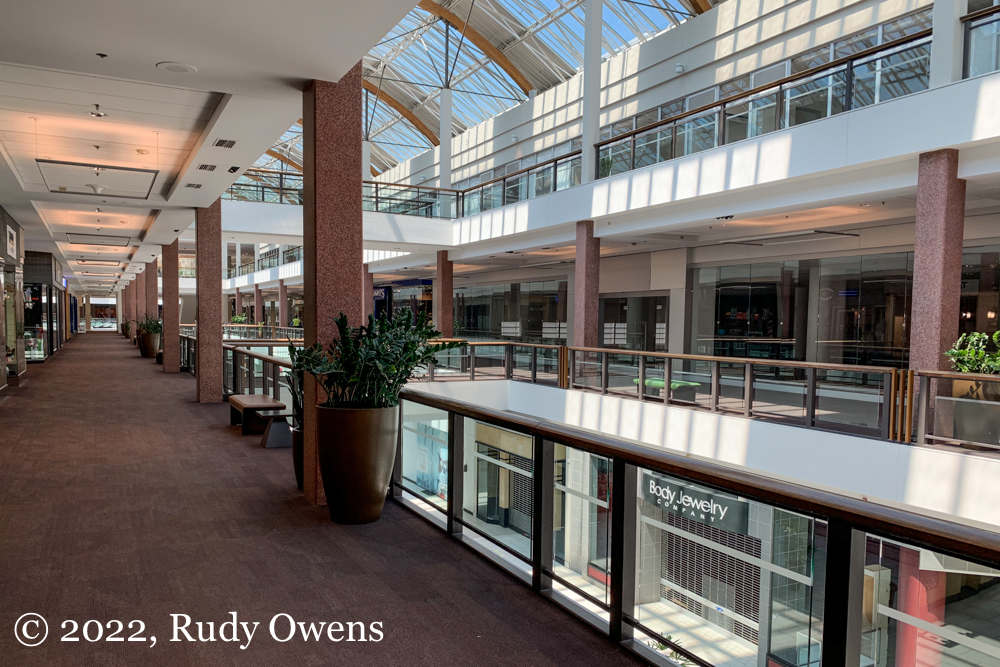
The Lloyd Center, a major landmark in the Lloyd District in Portland, has been slowly dying for years. There were efforts to revive it as late as 2021, and it’s all but certain as of late July 2022 the final nail in the coffin appears to have been pounded in.
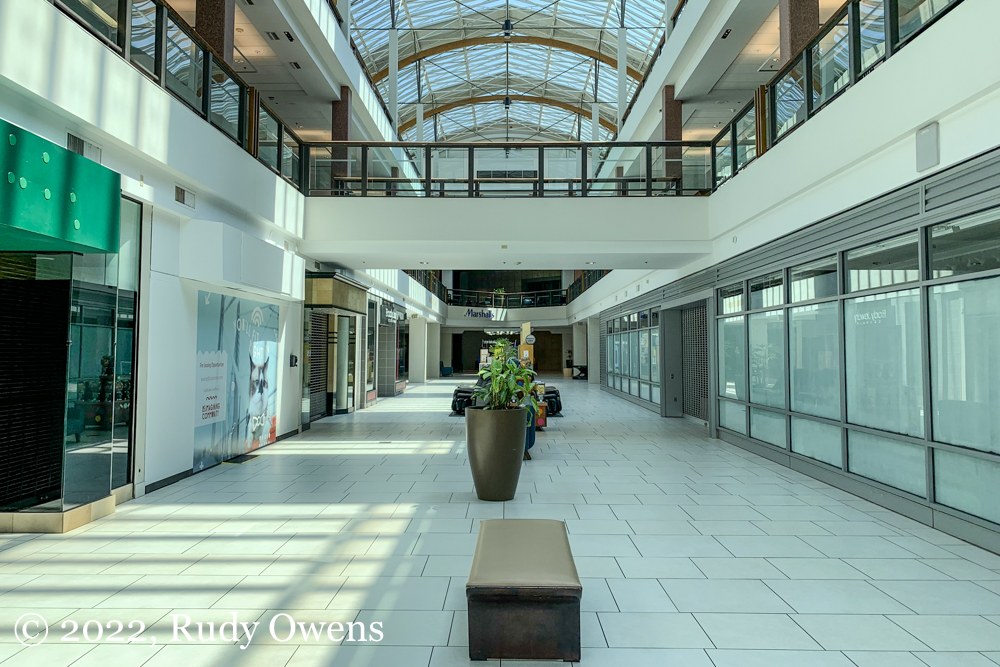
I made what might be my last visit to the Lloyd center in late July 2022, when I was working at the state office building nearby, on the hottest day of the year. The center was meant to be open as a cooling center. The ice rink was still being used, even as the thermometer outside was pushing 95F. Nearly all the stores were shuttered, and major retailers had closed their doors.
I for one will miss it because it provided an urban retail space to serve many residents who didn’t have cars and who didn’t want to drive to the suburbs. I imagine there are other photographers like me getting their final photographs before the death of yet another American shopping mall is formally announced.
Spring in Portland is now winding down its cycle of magnificent blossoms from the many ornamental flowers that adorn lawns and parks. Because of a cooler and wetter than expected spring, like we used to have before the onslaught of climate change conditions, flowers bloomed a little later than we have seen the past five to seven years. Tulips and daffodils have come and gone.
The last great entrant I am seeing now, on their final leg, is the Japanese Iris (Iris ensata). The iris genus, which has many varieties that are planted by gardeners, is among the wildest and sexiest of all flowers planted by gardeners on the west side of the Cascade Mountains, in Oregon and Washington. It prefers wet soil and shade. Most of all, it is delicate and crazy at the same time, with its sultry mix of delicate petals and bold colors. For me, it is a rare gift from nature, which marks the culmination of moisture, sun, pollinators, and of course the flowers themselves. And, dear readers, because I am not a gardener, please correct me if I identified this one incorrectly.
So, with that, here are a few words describing my reaction to seeing these beauties last night. It was the Jimi Hendrix version I heard in my head too:
Wild thing You make my heart sing You make everything groovy Wild thing ….
(Click on each photo to see a larger picture on a separate picture page.)
In late winter 2021, trail users on Portland’s Springwater Corridor were suddenly greeted with Northwest, Coastal Salish, and Alaskan Native imagery on utility towers and graffiti-covered surfaces of the Ross Island Bridge.
The artist, Stephen Cutler, appears to be a Portland-based creator who has been using Native imagery for years in his work. I do not know if he has Native ancestry or if he has worked with Native artists. I also do not know if groups whose iconography he uses have weighed in on these creations.
Appropriation of Coastal Salish, Tlingit, Haida, and other tribal cultural traditions has been going on for decades, sparking controversy about the rights of non-Native persons to use traditions that are not theirs. These important discussions about cultural appropriation have not ended—and the voices of those whose traditions are being used by others needs to be centered in all discussions and displays of such work.
At the same time, I also know that art is never meant to remain static. It never has been as long as humans have created art since they first painted wild animals in caves many millennia ago. Creation involves taking ideas and inspiration from others and reinventing those creations to make something new. In addition, anyone from the public who encounters art, I believe, can both like something that is beautiful and question the larger story around it.
As for these new murals, I like them, aesthetically. They are vital. They adhere to beautiful traditions I have seen first-hand in Southeast Alaska and British Columbia, including in living studios of Native and First Nations artists in those places. These pieces also bring life to an area that is shared by the public. It is a space used all residents for biking, hiking, walking, and other sports, and it is a de facto home to Portland’s large houseless population, who live in the elements a stone’s throw from where you see these pieces. So far, no graffiti artists who tag the concrete and steel spaces in this area have covered these pieces. It appears there is respect by that community too.
If you find yourself in Portland, take a stroll. They pieces can be found just underneath the Ross Island Bridge, on the east bank of the Willamette River.
(Click on each photograph to see a larger picture on a separate picture page.)
I have not had a proper vacation in more than two years now. I have had some weekends off, and I did have five days off in February 2020 to attend to my mom’s passing.
But these pauses from my jobs do not amount to a week’s break from work. That means I am, at times, tired and at times less elastic than I ideally strive to be.
For the last five plus months, I have been working in Oregon’s COVID-19 response. My job requires long days and, I have to admit, not enough compliments to sustain one’s energy as a day drags beyond 12 hours, with no lunch breaks. The situation is fluid, because this is a pandemic. The nature of my job means that many people I engage may not be satisfied that their needs are not met to their liking. So there is frequently unhappiness that is directed at the person who provides them what they cannot get.
Some days my abilities to navigate this are tested. When that happens, I have been fortunate with longer daylight hours and the arrival of spring to stop and literally smell the flowers at the end of my workdays.
Portland’s flowers have brought me much joy the past few months. A flower does not criticize you or bear you ill will. A flower also does not harm human health.
Flowers simply bring joy and provide pollen to our insect pollinator friends. Thank you for making my life more joyful this spring!